
Whose Marriage Is Carved Into the Pillsbury Mansion’s Oak Fireplace?
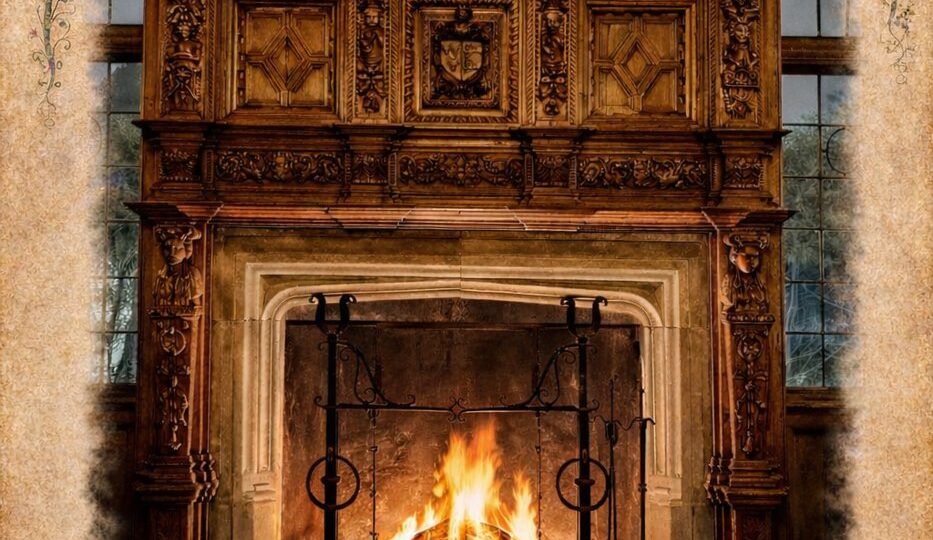
Above the lounge fireplace in the Charles S. Pillsbury Mansion, carved into English oak and four centuries old, is a wedding announcement.
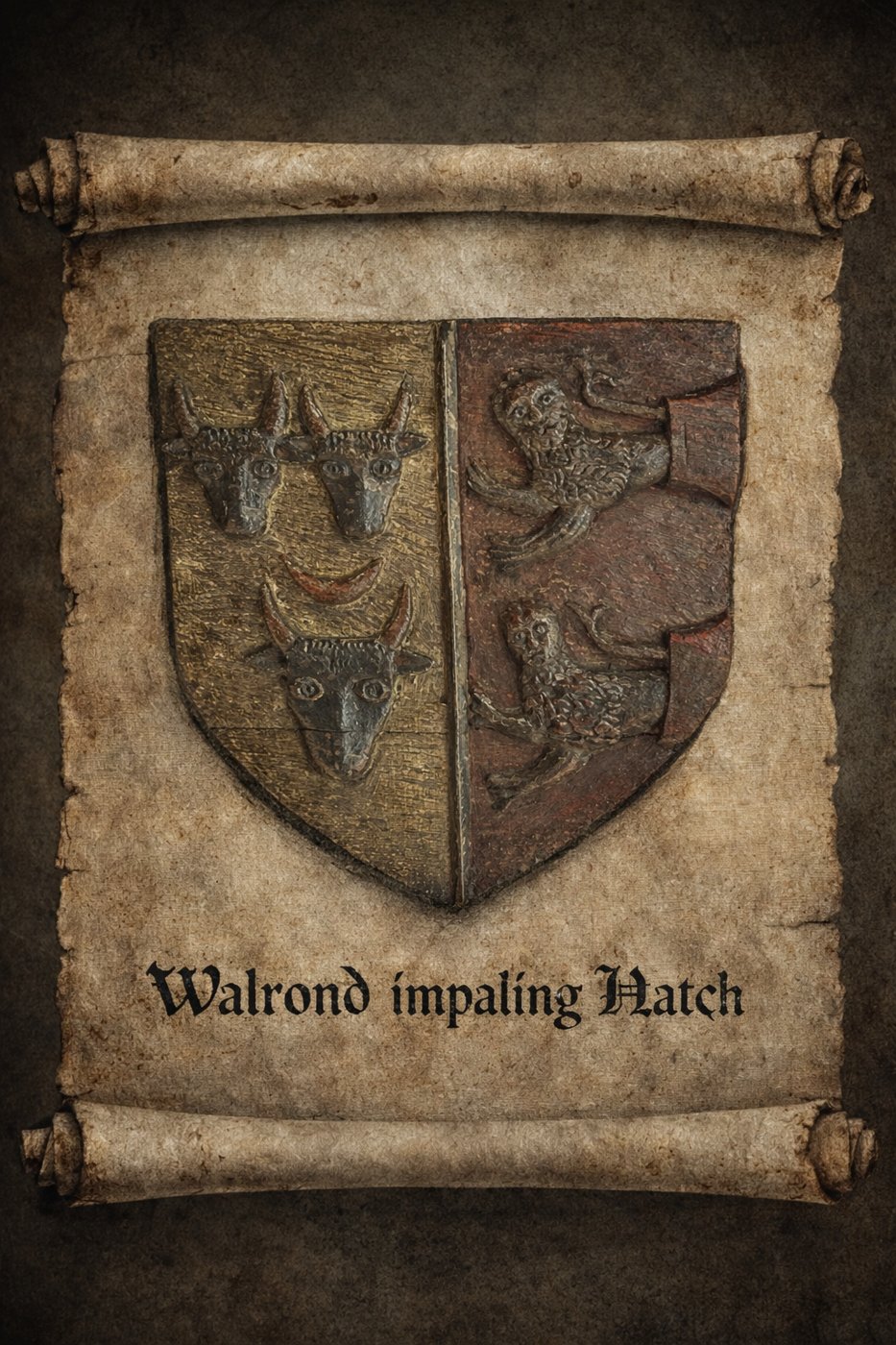
Not a portrait. Not a family motto. A marriage — two coats of arms shoved up against one another in the heraldic device called an impalement, which is what Elizabethan England did instead of a save-the-date. On the left, three charging bulls’ heads. On the right, two lions. And tucked in among them, if you know to look, a small half-crescent moon.
Every part of that carving is telling you something. Here is how to read it.
Whose marriage is it?
The crest joins John Walrond and Jane Hatch. He was a Devon gentleman of about thirty-six from a powerful landholding family; she was sixteen. Their marriage in 1592 united two Devon clans, lasted thirty-one years, and produced fourteen children.
The bulls’ heads are the Walrond signature. The lions are Jane’s — the Hatch arms, the sort of rampant beast an Elizabethan would have read as a straightforward claim to courage. Impaled side by side on one shield, they say what a marriage settlement said: two houses, now one.
The crescent is the detail most visitors walk past. In English heraldry a crescent is a cadency mark, the label attached to the arms of a second son and his descendants. It is a small, permanent, carved-in-oak acknowledgement that this branch of the Walronds was not the senior one. The College of Arms, which has regulated English armorial bearings since 1484, still administers the system that produced it. The family left other marks in Devon too — the Devonshire Association records a Walrond screen in nearby Seaton church.
The house it was carved for
The fireplace was made for Bovey House, at Beer on the Devon coast — an old, fortress-like manor that John and Jane, flush with fortune, remodelled into something lighter and more fashionably Elizabethan. The fireplace was the centrepiece of that remodel.
Bovey House still stands. It is listed Grade II* by Historic England (list entry 1333514, designated in 1951), described there as medieval in origin, rebuilt and extended across the sixteenth century and altered again in the 1660s. A lead rainwater head on the building carries the date 1592 — the same year as the marriage, and the reason that date attaches to the remodel at all.
One honest complication, and we would rather print it than tidy it away. The house tradition passed down with the fireplace has John and Jane Walrond as the owners doing the remodelling in 1592. The English record is less tidy: the Devon Gardens Trust and other local histories date the Walronds’ purchase of Bovey House to about 1670, from Sir William Pole, while allowing that the family is believed to have held it in tenancy considerably earlier. Both accounts can be true — a family can remodel a house it leases — but if you want the fireplace’s provenance stated precisely, the safest version is this: the carving is Walrond, it is dated to the 1592 remodel of Bovey House, and the family’s formal ownership of that house is recorded rather later.

Fourteen children, and one who crossed the Atlantic
Of the fourteen Walrond children, one is worth following. Mary Walrond married a William Pole, sailed for the New World, and helped establish Taunton, Massachusetts — a settlement founded in the 1630s, when the fate of the lost colony at Roanoke was still living memory rather than history.
It is a strange piece of symmetry that the Pole name appears at both ends of this story: at the American end through Mary’s marriage, and at the English end as the family the Walronds are recorded buying Bovey House from decades later. We are not going to claim a tidy connection between the two. We will only say that Devon in the seventeenth century was a small world.
How it got to Minneapolis
The fireplace crossed the ocean the way almost everything ancient in this house crossed it — through Charles Duveen, the dealer who traded as “Charles of London.” He bought English interiors wholesale in the years before the First World War and sold them to American industrialists, sometimes bidding against William Randolph Hearst for the same object.
The best-remembered line in the whole affair belongs to Duveen. When the Walrond family tracked him down and tried to buy their own crest back, he is said to have replied only that it was a thousand miles west of New York — which in those days was as good as saying the moon.
The same trade brought this house the Rotherwas oak, the Tallow Chandlers’ guildhall fireplace that survived the Great Fire of London, and the cathedral stained glass gathered from Salisbury. You can see the full set on The Splendors, or read how the house was assembled around them in Building the Mansion.
What to look for when you stand in front of it
Get close. The oak was split rather than sawn, and hand-rubbed across the grain — there are no saw marks anywhere on it. Then find the crescent. It is small, it is easy to miss, and it is the single most human thing in the room: a family who had everything, carving into permanent oak the fact that they were the junior branch.
The fireplace is in the lounge, where it has been for over a century — an English marriage announcement of 1592, still legible, a very long way from Devon.
Come and read it yourself. The Pillsbury Club runs guided mansion tours year round; details and booking are on Experiences and Tours, and hours and directions on Plan Your Visit.