
Who Owned Rotherwas Before the Bodenhams? The de la Barre Family in the Carving
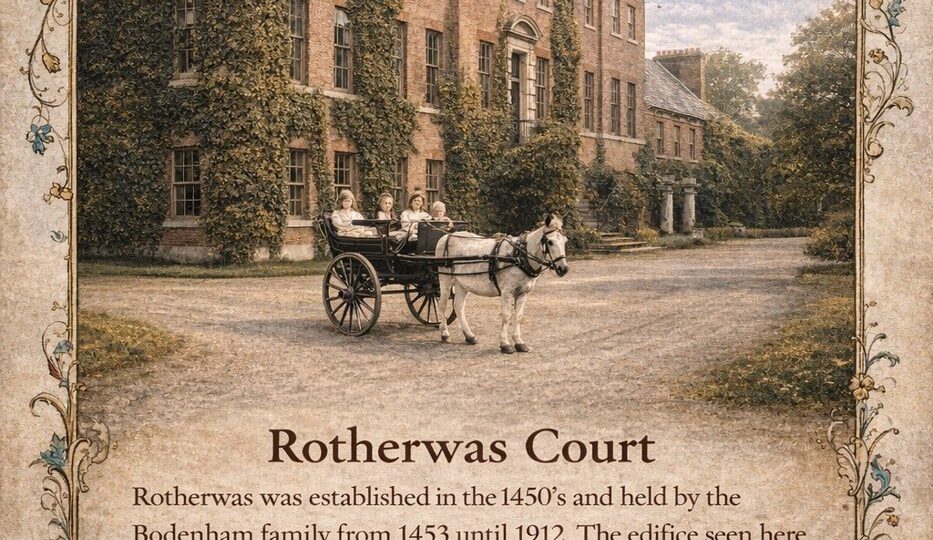
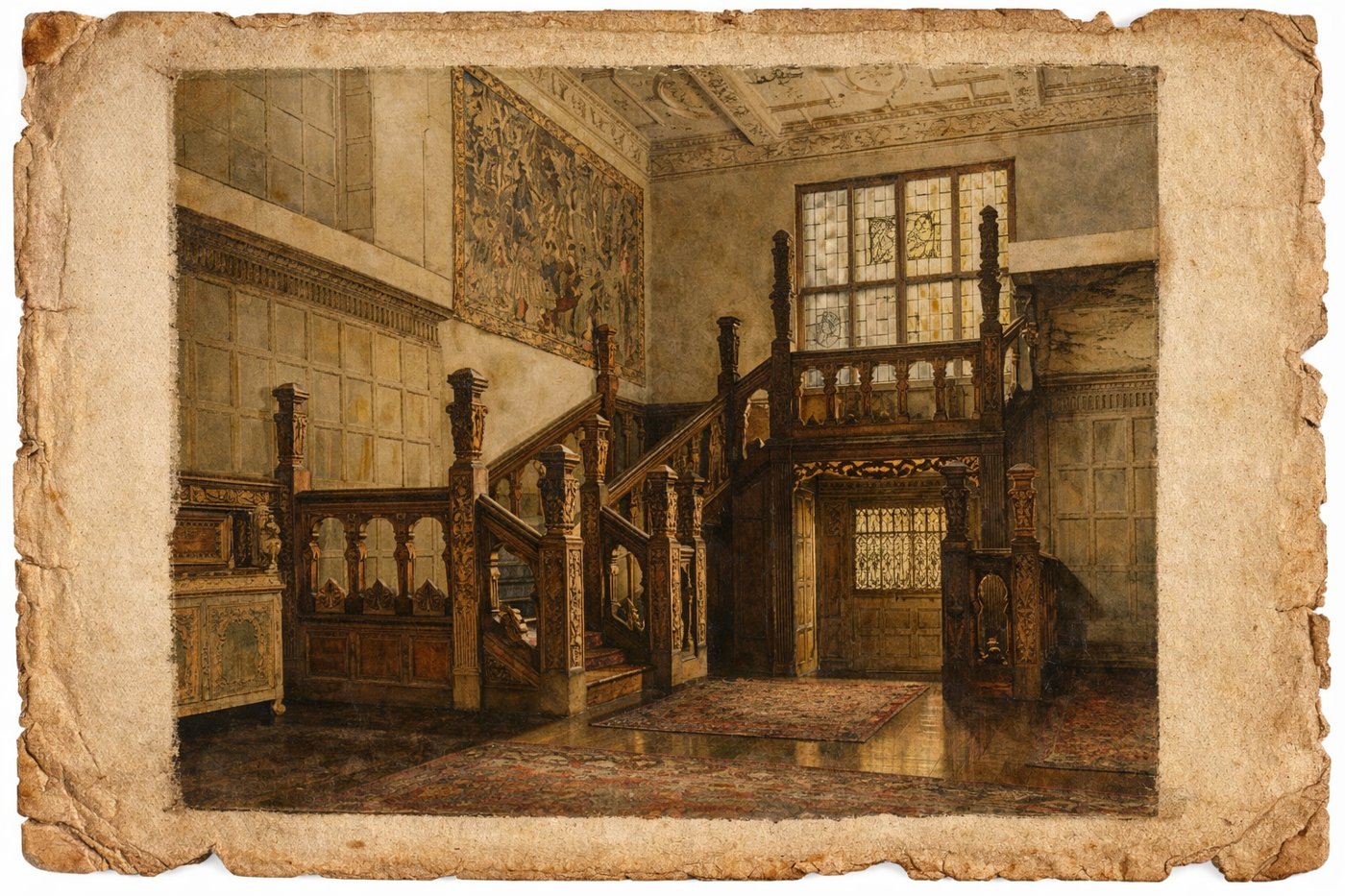
Every guest who climbs the grand staircase at the Pillsbury Club hears the same name: Bodenham. It was the Bodenham family who held Rotherwas Court, the Herefordshire manor whose carved oak — staircase, paneling, ceiling, even the front door — crossed the Atlantic in 1913 and was rebuilt inside the Charles S. Pillsbury Mansion in Minneapolis. Their emblem, three chess rooks, hides throughout the carving to this day. But here is the part of the story we rarely tell: the Bodenhams were not the first family of Rotherwas. Before them — for centuries before them — the estate on the banks of the River Wye belonged to a family whose name most visitors have never heard spoken aloud. The de la Barres.
A manor in the Domesday Book
Rotherwas enters written history in 1086, when the surveyors of William the Conqueror recorded it in the Domesday Book: “Gilbert son of Thurold holds Rotherwas.” In the centuries that followed, the manor came into the hands of the de la Barre family — gentry of Norman stock who also held Barre’s Court at Holmer, just north of Hereford. While the Bodenhams get the glory, it was the de la Barres who kept Rotherwas through the long medieval age of plague, war, and shifting kings.
Sir Thomas de la Barre, knight of the shire
This was no obscure family. Sir Thomas de la Barre (c. 1349–1419) inherited the manor of Rotherwas on his father’s death in 1388 and went on to represent Herefordshire in Parliament as a knight of the shire — a man of standing in the England of Richard II and Henry IV. For generations, the de la Barres were exactly the kind of county family whose arms belonged over a great fireplace.
The wedding that made the Bodenhams
Then came the marriage. Early in the fifteenth century, John Bodenham of Dewchurch wed Isabella de la Barre, daughter and heiress of Walter de la Barre. It was an alliance in the fullest medieval sense — two families, two fortunes, one bloodline going forward. And when the last de la Barre lord of Rotherwas died in 1483, the estate did not pass by sale or by conquest. It passed to Roger Bodenham, John and Isabella’s grandson. The Bodenham age at Rotherwas — the age that would eventually carve the staircase King James I descended — began not with a deed of purchase, but with a wedding ring.
The name that refused to die
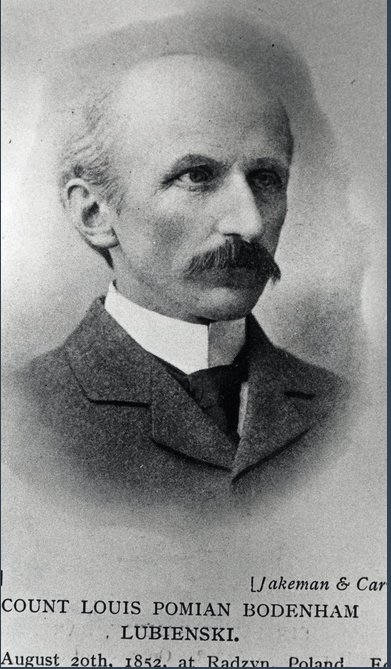
Here is the detail we find most moving: the Bodenhams never let the older name go. Four hundred years after Isabella’s wedding, the squire of Rotherwas was still called Charles de la Barre Bodenham — the last of the direct line, who died in 1883, according to Herefordshire historians. And when Sir Roger Bodenham commissioned his celebrated walnut-paneled parlor in 1611 — the “Rotherwas Room” that now lives at Amherst College’s Mead Art Museum — its great overmantel displayed twenty-five family seals. Carved among them, in painted oak: the arms of de la Barre. The family had been gone from Rotherwas for over a century, yet their seal was still cut into the wood, as permanent as the Bodenhams could make it. Even then the name would not quite die: the estate passed to a Polish kinsman, Count Louis Pomian Lubienski, who anglicised himself as Lubienski-Bodenham and held Rotherwas until the final auction of 1912.
Nine centuries of ownership, two families, one wedding
When the Rotherwas estate was finally dismantled in 1913 and thirteen of its paneled rooms were scattered across America by Charles of London, the oak that came to Minneapolis carried all of this with it. From the Domesday Book to the day the last tenants left, the recorded lords of Rotherwas amount to essentially two families — de la Barre and Bodenham — joined in the middle by a single medieval marriage. Few houses anywhere can claim a chain of ownership so long and so unbroken. The village of Rotherwas still remembers that history today, even though the great house itself was demolished in 1926.
So the next time your hand rests on one of our newel posts — the ones that still carry the scorch marks of the 1907 fire — remember that you are not just touching Bodenham oak. You are touching the inheritance of Isabella de la Barre, an heiress whose wedding, six hundred years ago, decided who would own this wood for the rest of its English life.
Come stand on nine centuries of history yourself. Book a tour of the Pillsbury Mansion — or make an evening of it and arrive aboard Minneapolis Trolley Tours, which calls the mansion home.
Keep reading: Which Pillsbury was mayor of Minneapolis? Meet George A., the family patriarch.