
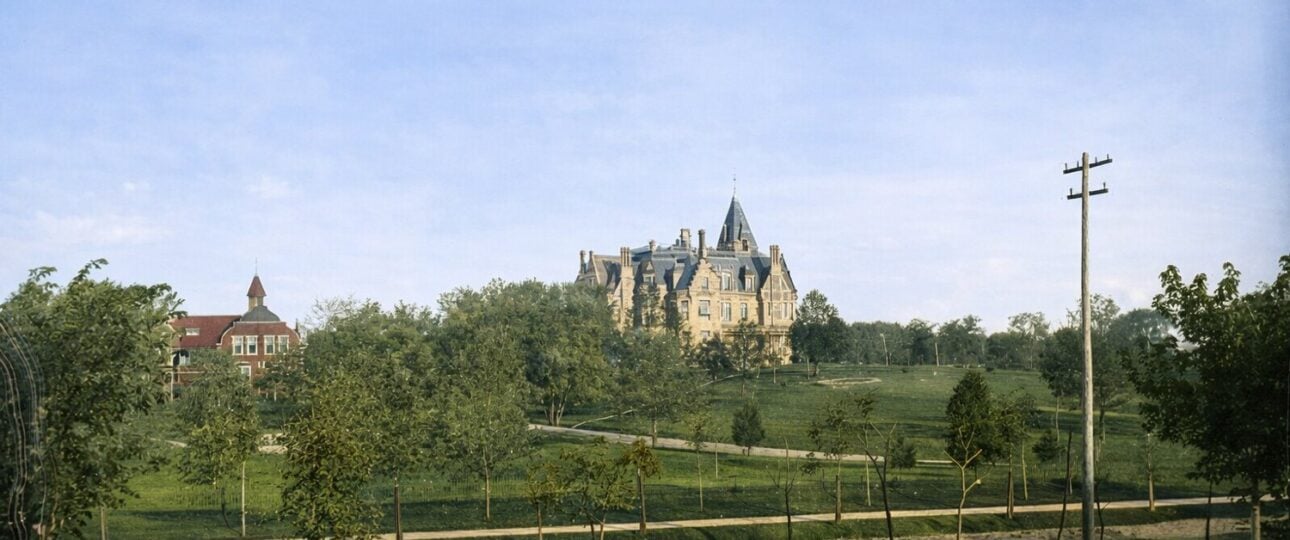
What Was Fair Oaks, the Lost Palace That Named the Park by the Pillsbury Mansion?
Stand at the lion-guarded gates of the Charles S. Pillsbury Mansion and look across East 22nd Street. You’ll see lawn, old shade trees, and four dozen painted benches — a quiet city park with a curious double-barreled name: Washburn Fair Oaks. The “Fair Oaks” was a house. Not just any house — the largest and most extravagant home Minneapolis had ever seen. It has been gone for a century, and the park is its footprint.
The Senator Across the Street
William Drew Washburn arrived in Minneapolis around 1857, a Bowdoin-educated lawyer from Livermore, Maine, and proceeded to touch nearly everything that made the city rich: lumber, flour, railroads, politics. His older brother Cadwallader founded the mill that grew into Washburn-Crosby — the “W” in what became General Mills, and the eternal crosstown rival of the Pillsbury name (a rivalry that would one day give the world the Bake-Off and Betty Crocker). His cousin Dorilus Morrison was the first mayor of Minneapolis. William himself served in Congress and then the U.S. Senate from 1889 to 1895, and was the first president of the Soo Line railroad — which he founded alongside Thomas Lowry and Charles A. Pillsbury himself.
Rivals in name, the families were tangled in business too: it was Washburn who helped assemble the English-financed Pillsbury-Washburn Flour Mills Company, the combine that carried the Pillsbury flour empire into the twentieth century. In Gilded Age Minneapolis, the Washburns and the Pillsburys were rivals, partners, and neighbors all at once.
Forty Rooms and a Private Lake
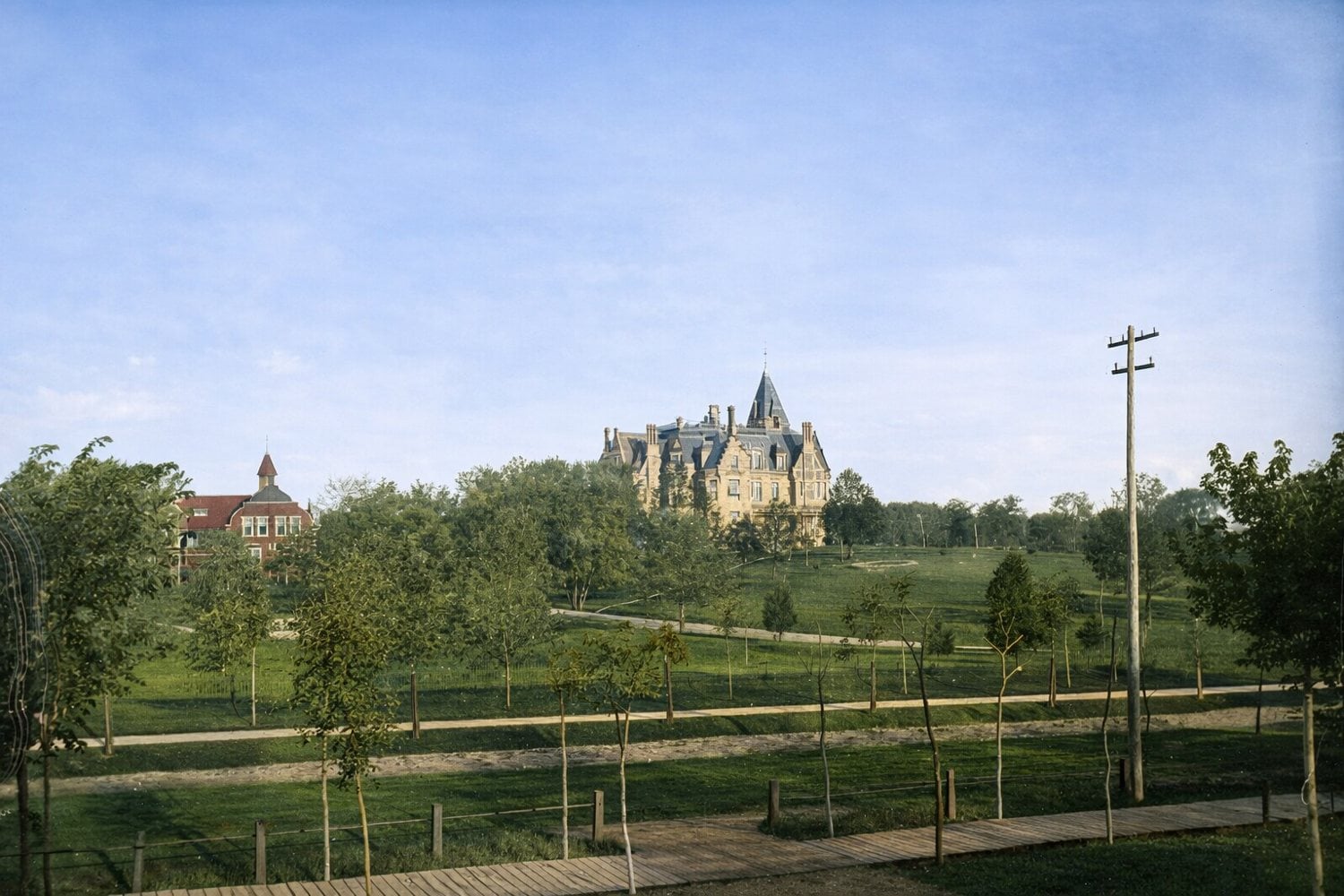
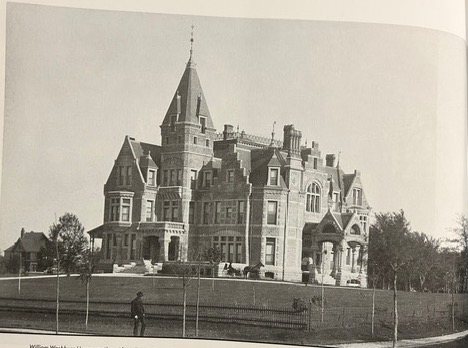
In 1884 Washburn completed Fair Oaks, named for the grove he cleared to build it. The architect was E. Townsend Mix, who also designed the famed Metropolitan Building downtown; the grounds are credited to Frederick Law Olmsted, the landscape genius behind New York’s Central Park. The house held some forty rooms and presided over roughly ten acres — two full city blocks — complete with an artificial stream feeding a small lake, a rustic footbridge, greenhouses, stables, and a carriage house. The buildings alone were later valued at about $400,000, at a time when that sum built entire city blocks.
A Remarkably Generous Sale
In 1911, Clinton Morrison donated his family’s estate immediately to the south as the site for a new art museum — the future Minneapolis Institute of Art. Attention naturally turned to Washburn’s land next door, and the aging senator made the park board an astonishing offer: he would sell the entire estate for the appraised value of the land alone — about $250,000 — effectively throwing in the mansion and its outbuildings for free, on the condition that he and his wife could live out their days there, according to the Minneapolis Park Board’s own history.
He did not get to enjoy the arrangement for long. Washburn died on July 29, 1912 — the very year ground was broken across the street for Charles S. Pillsbury’s steel-framed English manor. When Charles and Nelle’s new house was finished, its leaded-glass windows looked directly out over Fair Oaks. Mrs. Washburn died in 1915, and the great estate passed to the park board.
Nine Awkward Years
What does a park board do with a forty-room palace? Nobody quite knew. The stables and greenhouses came down almost immediately, but the mansion lingered. Civic groups met in its rooms through the First World War; park superintendent Theodore Wirth sketched an 1,100-seat outdoor amphitheater for the grounds in 1917; the board even considered moving its own headquarters in. None of it happened. The house sagged into disrepair while neighborhood children turned the lawns into ballfields.
The $25,000 That Sealed Its Fate
In 1923 a neighbor named Helen Law, joined by others, offered the park board $25,000 toward a new playground elsewhere — if it would tear Fair Oaks down. The Minneapolis Society of Fine Arts, wanting a dignified green approach to its new museum, favored the demolition. In 1924 the wreckers came, and the grandest house in Minneapolis vanished just forty years after it rose.
The grand plaza and mile-long esplanade planned for the site were never built. The land simply stayed green. The Daughters of the American Revolution added a statue of George Washington in 1931, the WPA scattered four dozen benches through the park during the Depression — benches that were repainted in 2012 as deconstructed artworks from the museum’s collection — and that, more or less, is the park you see today.
The House That Watched It All
Every act of this drama played out in front of the Pillsbury Mansion’s windows. And here is the strange reversal: Fair Oaks, the biggest palace of them all, lasted just forty years. The Pillsbury house across the street — the last of the neighborhood’s great mansions still standing — is now past its hundred-and-tenth, rescued by an anonymous donor in 1969 and listed on the National Register in 1974, the anchor of a historic district that still bears both families’ names: Washburn-Fair Oaks.
The palace is gone; its neighbor still opens its doors. Come see the park from the other side of the glass — tour the Pillsbury Mansion with the Pillsbury Club, arrive in style aboard the Minneapolis Trolley, and take a slow walk across the ghost of Fair Oaks on your way out.
Keep reading: Who owned Rotherwas before the Bodenhams? Meet the de la Barre family.