
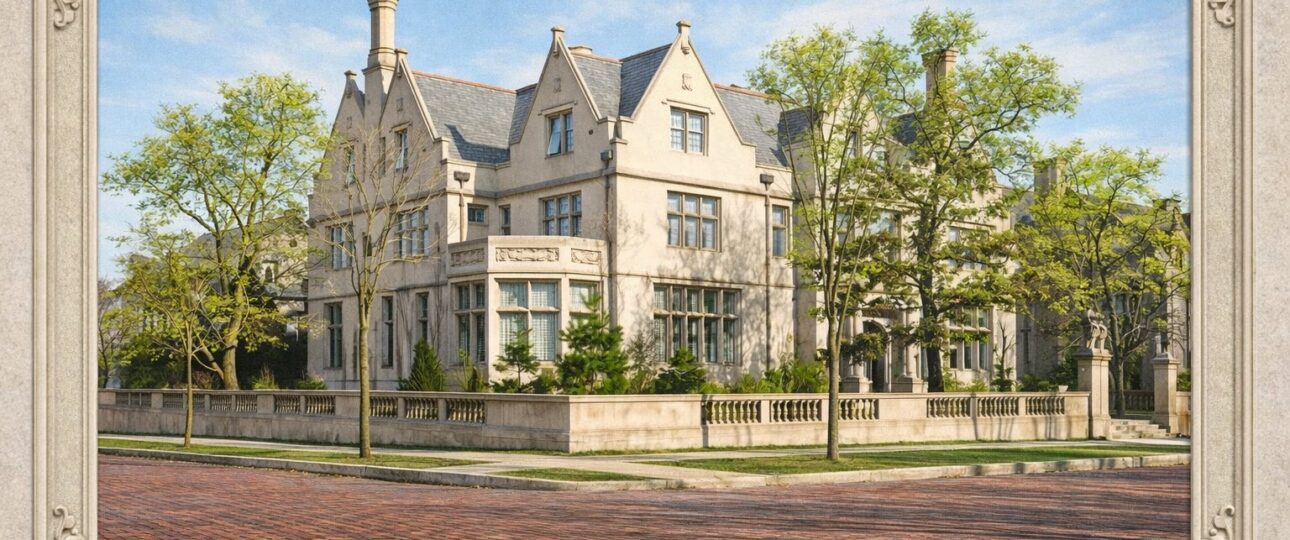
How Did the Pillsbury Mansion Survive When Minneapolis’s Other Great Mansions Fell?
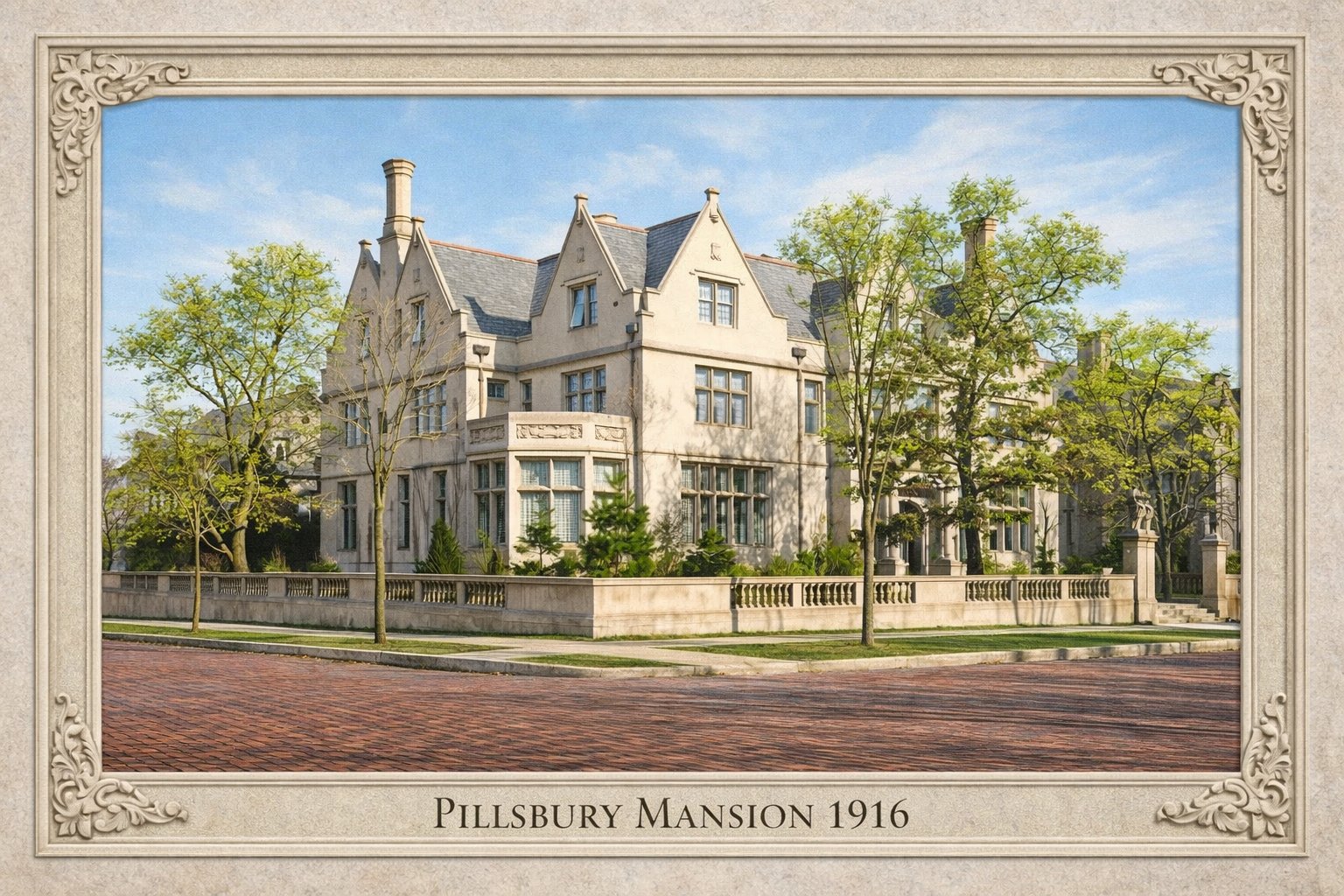
Stand on the edge of Washburn–Fair Oaks Park today and it is hard to imagine what once lined these blocks. A century ago this was an avenue of palaces — the homes of the Washburns, the Eastmans, the Dunwoodys, the Morrisons, the Lowrys, and the Pillsburys — the milling aristocracy that turned Minneapolis into the flour-milling capital of the world. One by one across the twentieth century, those great houses fell. The Charles S. Pillsbury Mansion at 100 East 22nd Street is, very nearly, the last one left standing. This is the story of how it survived.
An Avenue of Palaces — and Then the Wrecking Ball
In its heyday, the neighborhood around Washburn–Fair Oaks Park was where the men who built Minneapolis built their homes. These were not ordinary houses. They were statements in stone, brick, and imported oak, set on broad lawns within sight of one another, a little kingdom of milling money.
And then, one after another, they vanished. The roll call reads like a slow drumbeat: the Washburn mansion gone by 1924, the Eastman house by 1927, the Lowry by 1932, the Gale by 1933, the great Dunwoody home as late as 1967. Fashion turned against the huge old houses; taxes and heating bills made them unlovable; developers wanted the land. Of an entire avenue of palaces, the Pillsbury mansion would end up almost alone.
From a Family Home to a Seminary
Charles Stinson Pillsbury did not build an ordinary mansion either. He summoned England across the Atlantic — whole paneled rooms rescued from centuries-old English estates, a carved oak staircase, a stone fireplace that survived the Great Fire of London — all assembled inside a Tudor-Gothic envelope designed by the architect Edwin Hewitt of the firm Hewitt & Brown. You can read more about how the mansion was built and about the dealer Charles of London who supplied its interiors.
When Charles Pillsbury died, the house passed out of the family. In 1940 it was sold for use as a theological seminary, becoming Passavant Hall of the Northwestern Lutheran Theological Seminary. For nearly three decades, the oak-paneled rooms that had once hosted Minneapolis society instead hosted chapel services and the study of scripture. It was a dignified second life — but the great houses around it were still falling.
Four Saved from the Wrecker

By the late 1960s, the demolitions had become alarming. Then, in 1969, an anonymous donor stepped forward and gave the Minneapolis Society of Fine Arts (the parent of today’s Minneapolis Institute of Art) the means to preserve four threatened mansions across Washburn–Fair Oaks Park. The Pillsbury mansion was the largest of the four. The wrecking ball that had claimed so many of its neighbors would not claim these.
National recognition followed in the 1970s, and the surrounding Washburn–Fair Oaks Mansion District — a cluster of the survivors along and near 22nd Street East — was placed on the National Register of Historic Places in 1978. For a fuller account of these years, see the mansion’s many owners. You can also explore the broader preservation story of the area through the Minnesota Historical Society.
A Creative Life Inside the Old Oak Walls

In 1976 the Society of Fine Arts sold the four houses it had rescued. The buyer who would define the Pillsbury mansion’s next chapter was the advertising agency Carmichael Lynch. Under Lee Lynch, the agency restored the house and made it their offices for some fifteen years — a creative life humming inside the old oak walls, keeping the building cared for and occupied through the 1980s and into the ’90s.
From 1993 to 2025 the mansion served a purpose its builders could never have imagined, as the home of BLIND, Incorporated, a Minneapolis training center helping people who are blind or visually impaired live independently. Faith, art, commerce, service — the house has been carried across more than a century by hands that understood what they held. Today it lives on as the Pillsbury Club, and its imported English splendors are still here to be seen.
See the Last Palace for Yourself
Of an entire avenue of palaces, one remains. The best way to understand what was lost — and what was saved — is to stand inside it. The Pillsbury Club offers year-round tours of the mansion, and it is also the departure point for Minneapolis Trolley Tours, which roll past the ghosts of the vanished mansions and the survivors that still line the park. Making a weekend of it? Our sister property, the historic 300 Clifton bed & breakfast in nearby Loring Park, is a fitting place to rest your head among Minneapolis’s grand old houses. Come see the last palace standing — and hear the story of the avenue that disappeared around it.