
Which Pillsbury Was Mayor of Minneapolis? Meet George A., the Family Patriarch
On this day — July 17 — in 1898, George Alfred Pillsbury died at his home in Minneapolis, and the city paused to mark the passing of its miller-mayor. He never saw the great house at 100 East 22nd Street; it would rise eighteen years after his death. But without George there is no Pillsbury dynasty as Minneapolis knew it — and no Pillsbury Mansion. He was the patriarch: the only Pillsbury ever to run Minneapolis City Hall, and one of the very few Americans elected mayor in two different states.
A New Hampshire storekeeper with a famous little brother
George was born in Sutton, New Hampshire, on August 29, 1816, the son of a village family that measured wealth in thrift and reputation. At eighteen he went to Boston to clerk in a store; within a year he was back home, building businesses of his own. New Hampshire noticed. He served in the state legislature and was elected mayor of Concord in 1876 and again in 1877 — and here the family story turns almost theatrical. While George presided over Concord, his younger brother John S. Pillsbury was serving as governor of Minnesota, the man this journal has already profiled as the “Father of the University of Minnesota.” And George’s own son, Charles A., had gone west in 1869 and lent his name to a flour company grinding its way toward world domination.
Starting over at sixty-two
In 1878, at an age when most Victorian gentlemen were composing their memoirs, George sold his New Hampshire interests, boarded a train, and started over in Minneapolis — joining C.A. Pillsbury & Co., the family firm named for his son. The city put the old mayor to work almost at once: the Board of Education, an alderman’s seat in 1881, and quickly the presidency of the city council. In a town run by transplanted New England Yankees, George Pillsbury was the genuine article — twice over.

The mayor who fenced in the saloons
In 1884 he ran for mayor of Minneapolis and defeated the incumbent, Dr. Albert Alonzo “Doc” Ames. The boomtown was swelling with saloons faster than the police could walk past them, and the temperance movement wanted them gone entirely. George’s answer was neither prohibition nor surrender but something shrewder: the liquor patrol limits, written into the city charter in 1884, which confined drinking establishments to the busy core streets where a beat cop actually patrolled. As the local-history project Historyapolis has shown, it was zoning before zoning existed — and it outlived its creator by decades. Minneapolis voters did not repeal the patrol limits until 1974, ninety years on, and echoes of them shaped the city’s liquor laws into the present century.
Ames took the office back in 1886 — the same Doc Ames whose machine would later become nationally infamous when Lincoln Steffens exposed it in “The Shame of Minneapolis.” George, characteristically, moved on without bitterness. He had other uses for his time, and his money.
The giving habit
If the Pillsburys had a family creed, it was that a fortune was a stewardship. George practiced it on two states at once. In Minneapolis he was a pillar of the First Baptist Church, furnishing its new organ at his own expense; a struggling Baptist school in Owatonna was renamed Pillsbury Academy in 1886 in honor of his gifts. New Hampshire was never forgotten: a hospital in Concord named for his wife Margaret, a library in Warner, a soldiers’ memorial in his native Sutton. As MinnPost has written, the family made generosity a generational habit — and George set the pattern.
The grandfather of the mansion
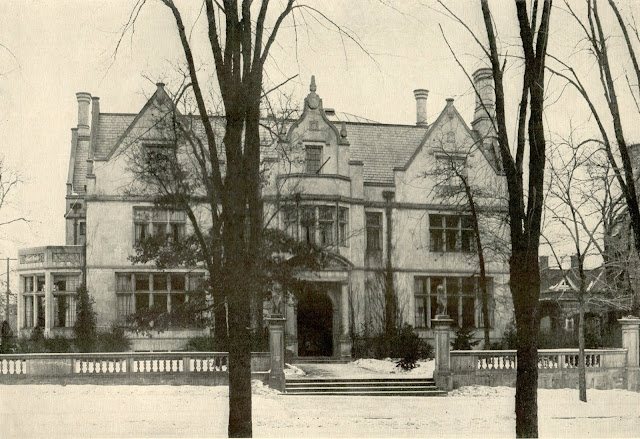
George died on July 17, 1898, and was buried at Lakewood Cemetery, in the city he had adopted at sixty-two and led at sixty-eight. Eighteen years later his grandson Charles S. Pillsbury — one of Charles A.’s twin sons — completed the English manor house at 100 East 22nd Street, filling it with centuries-old English oak and glass. George never walked its halls. But the fortune that built it, the name carved into its history, and the very idea that a Pillsbury owed his city something grand — all of that was his bequest.
You can stand inside that inheritance today. Tour the Pillsbury Club and climb the staircase his grandson brought from England — or begin with Minneapolis Trolley Tours, which departs from the mansion itself, in the city George once governed.
Keep reading: How a Minneapolis flour empire built the Pillsbury Mansion.
Planning an evening at the mansion yourself? Keep reading: a unique date night in a Gilded Age mansion.
Keep reading: George A.’s descendants’ houses had their own brush with the wrecking ball — discover which four Minneapolis mansions were saved by one anonymous gift in 1969.