
Is the Pillsbury Mansion on the National Register of Historic Places?
It comes up on almost every tour. A guest stands in the great hall at 100 East 22nd Street, looks up at four centuries of English oak that were carved in Herefordshire and shipped across an ocean, and asks the practical question hiding inside the wonder: is any of this actually protected?
The answer is yes — twice over, by two different governments, for two different reasons. And the more interesting half of the answer is the part nobody expects.
The short answer: yes, but not under its own name
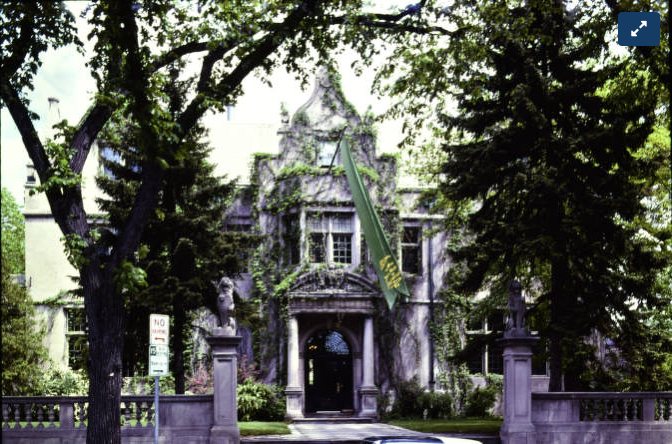
The Charles S. Pillsbury Mansion is on the National Register of Historic Places as a contributing property in the Washburn-Fair Oaks Mansion District, listed on February 17, 1978, under National Register reference number 78001544. The federal district is small and precise — a cluster of seven mansions along and near 22nd Street East, a last surviving fragment of what was once the grandest residential avenue in Minneapolis.
The city’s own landmark file puts it bluntly: date of National Register designation, not individually listed. This house rides in on the district.
Which makes one line in the federal record rather satisfying. Under “Significant Names,” the National Park Service entry for the entire district lists exactly one person: Pillsbury, Charles S. Seven mansions, seven fortunes, one name in the file.

The paperwork began as a rescue
Designation did not arrive because someone admired the carving. It arrived because the neighborhood was vanishing. The Fairoaks mansion itself — forty rooms, two square blocks of landscaped ground — had already been demolished in 1924, and by the late 1960s the wrecking ball was working its way down the avenue.
In 1969 the Minneapolis Society of Fine Arts stepped in and bought four of the surviving houses, this one among them. Then came the paper trail, one document at a time:
- c. 1974 — a Minneapolis Heritage Preservation Commission designation form for the Society of Fine Arts properties
- June 1975 — a report titled Washburn-Fair Oaks: A Study for Preservation
- 1975 — local landmark designation of the Charles S. Pillsbury House
- 1976 — local designation of the wider Washburn-Fair Oaks Historic District
- September 1977 — Charles W. Nelson signs the National Register nomination form
- February 1978 — the Keeper of the National Register makes it official
Nine years from a checkbook to a federal listing. In preservation terms, that is fast.
What the National Register actually does
Here is where most people are surprised. Listing on the National Register is largely honorific. It is, as Minnesota’s State Historic Preservation Office puts it, the official list of the nation’s cultural resources worthy of preservation — a recognition, not a restraining order.
Listing makes a building eligible for federal and state historic rehabilitation tax credits, and it triggers review when a project uses federal money or federal permits. What it does not do is stop a private owner spending private money from gutting a room, or from taking the whole thing down. The Register is a list. Lists do not hold up walls.
The designation with teeth is the local one
The protection that has real consequences came three years earlier, and from City Hall. The Charles S. Pillsbury House was designated a Minneapolis landmark in 1975, and the house also sits inside the locally designated Washburn-Fair Oaks Historic District — a considerably larger boundary than the federal one, running roughly from Franklin Avenue to 26th Street East. Local designation means the Heritage Preservation Commission reviews changes. That is a permit process, not a plaque.
Read the city’s file closely, though, and one word does a great deal of work. Designation: Exterior.
Which leaves the best things in the house unprotected
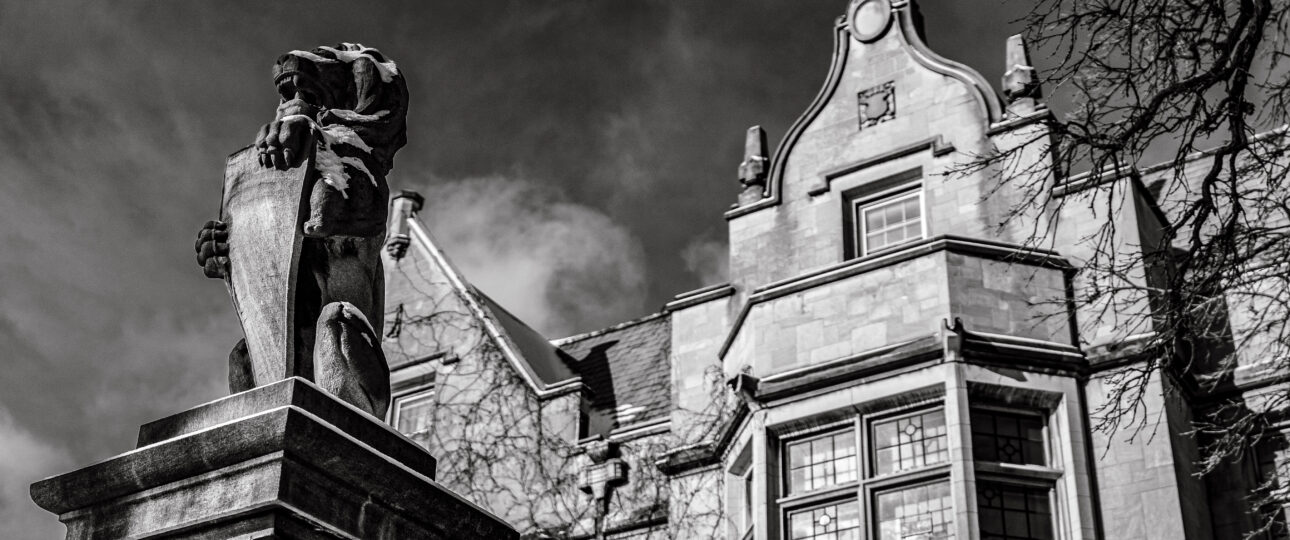
The stone shell that both designations guard is the least extraordinary thing here. The limestone, the hooded windows, the ornate chimneys — they are fine work by Hewitt and Brown, and there are other fine houses by Hewitt and Brown.
What is irreplaceable is inside, and no statute covers it: the Rotherwas oak and staircase, the Tudor plaster ceilings, the 1476 Tallow Chandlers chimneypiece that outlived the Great Fire of London, the ancient cathedral glass — the splendors assembled and shipped west by the dealer Charles of London. Those rooms could have been sold off, piece by piece, at any point in the last hundred years without a single form being filed.
They were not. A theological seminary, an advertising agency, a training center for the blind, and now a private club — every owner in turn left the interiors alone. Not because the law required it, but because each set of hands looked at the carving and decided not to be the one who broke the chain.
Preservation law protects walls. The rooms inside them got lucky, over and over, for a century.
See what the paperwork missed
The mansion is open to guests with a reservation, and the interiors — the ones no designation ever covered — are the whole point of a visit. Book a mansion tour and stand in the great hall yourself, or start here and roll out through the rest of the city on Minneapolis Trolley Tours, which departs from the door.
If you would rather sleep inside a National Register house than tour one, the Eugene J. Carpenter Mansion up in Loring Park was individually listed on September 13, 1977 — five months before this district made the cut — and now runs as the 300 Clifton bed and breakfast. Two mansions, two files in Washington, one very good weekend.
Keep reading: why a world-class art museum sits directly across the park.
Also on the block: the limestone castle on Park Avenue, less than a mile away.