
Who Are the Carved Faces in the Pillsbury Mansion’s Dining Room?
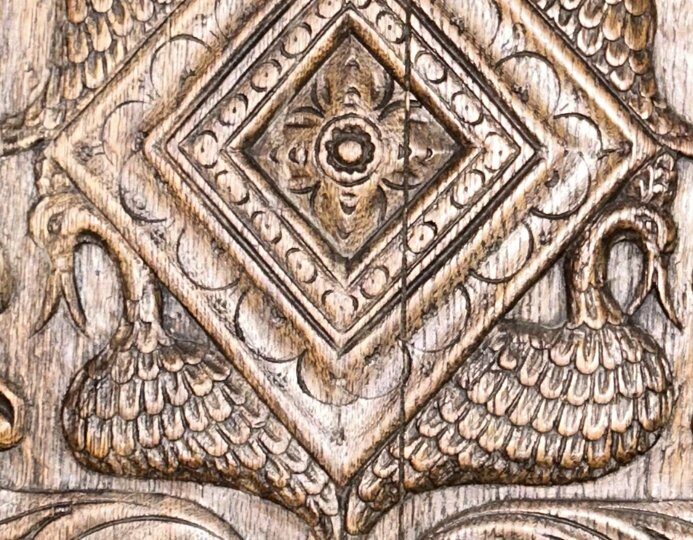
Stand in the dining room of the Charles S. Pillsbury Mansion and you are surrounded by faces. Men in plumed Roman helmets. Women in stiff English bonnets. A rose at the center of the room, ringed by long-tailed birds. Most guests register “old carving, very nice” and move on to the ceiling.
They shouldn’t. An Elizabethan oak room was never decoration for its own sake. It was closer to a library — a wall of names a guest of the period was expected to recognize on sight. The panels here have been keeping their references for roughly five hundred years, and they are still legible if you know the vocabulary.
A paneled room was meant to be read
Before framed portraits hung in rows, before wallpaper, a great English house made its argument in wood. Wainscot — the thin, tight-grained oak used for carved panels — clad a room in warmth, color and status all at once, and the imagery pressed into it announced what the household wanted to be associated with: antiquity, virtue, lineage, loyalty to the crown.
The dining-room panels at what is now the Pillsbury Club date from the reign of Henry VIII (1509–1547) and came from the country estate of a royal courtier. They reached Minneapolis the same way the rest of the mansion’s ancient interiors did — through the London dealer Charles Duveen, who worked under the name “Charles of London” and made a business of dismantling English rooms for American fortunes. We’ve told that story before: why so many English rooms crossed the Atlantic in the first place.
The men in helmets have a proper name: romayne work
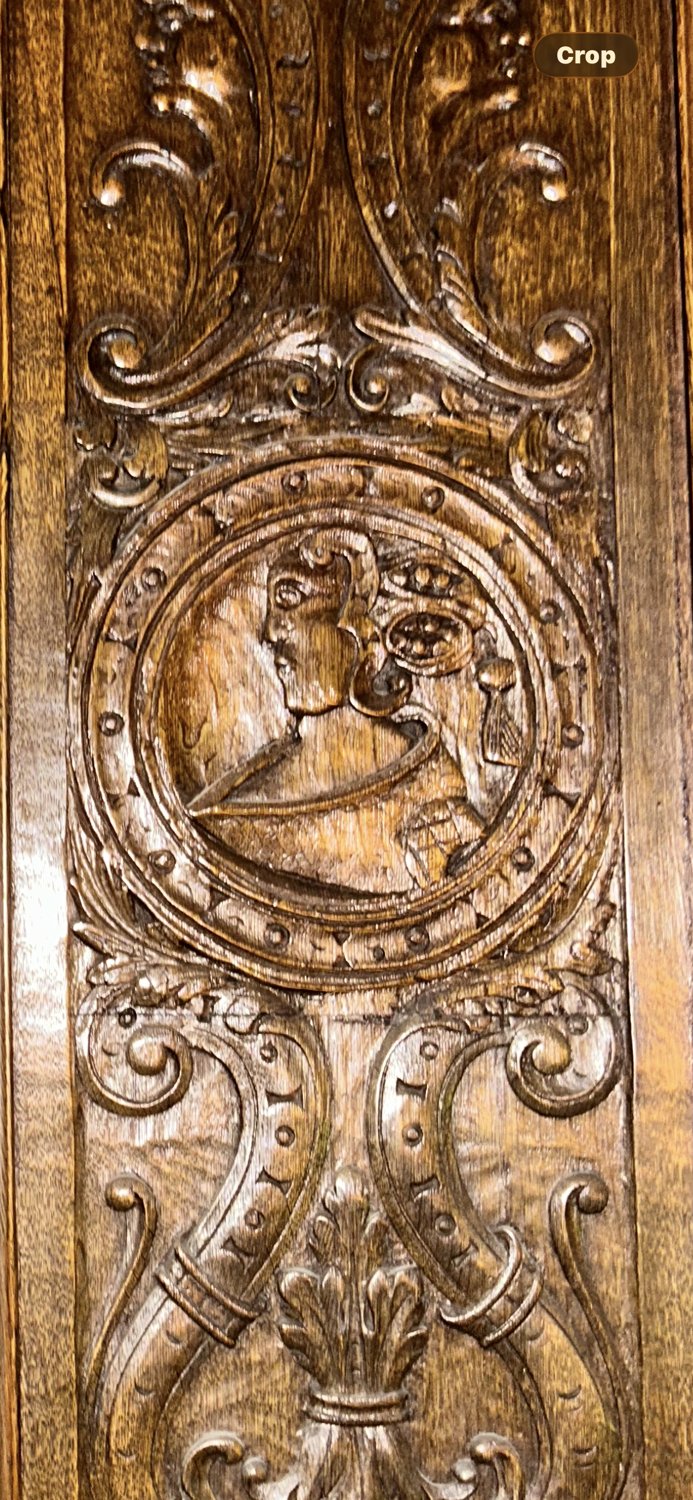
Those profile heads set inside medallions and wreaths aren’t a local quirk. They’re a documented English style with a name — romayne heads, from “Roman” — and they start turning up in English woodwork around 1520. The Victoria and Albert Museum holds a fine example from 1520–1550, a single oak panel carved with a head in profile within a wreath, and describes exactly the effect: one of many panels that would have clad the walls of a particularly well-appointed room.
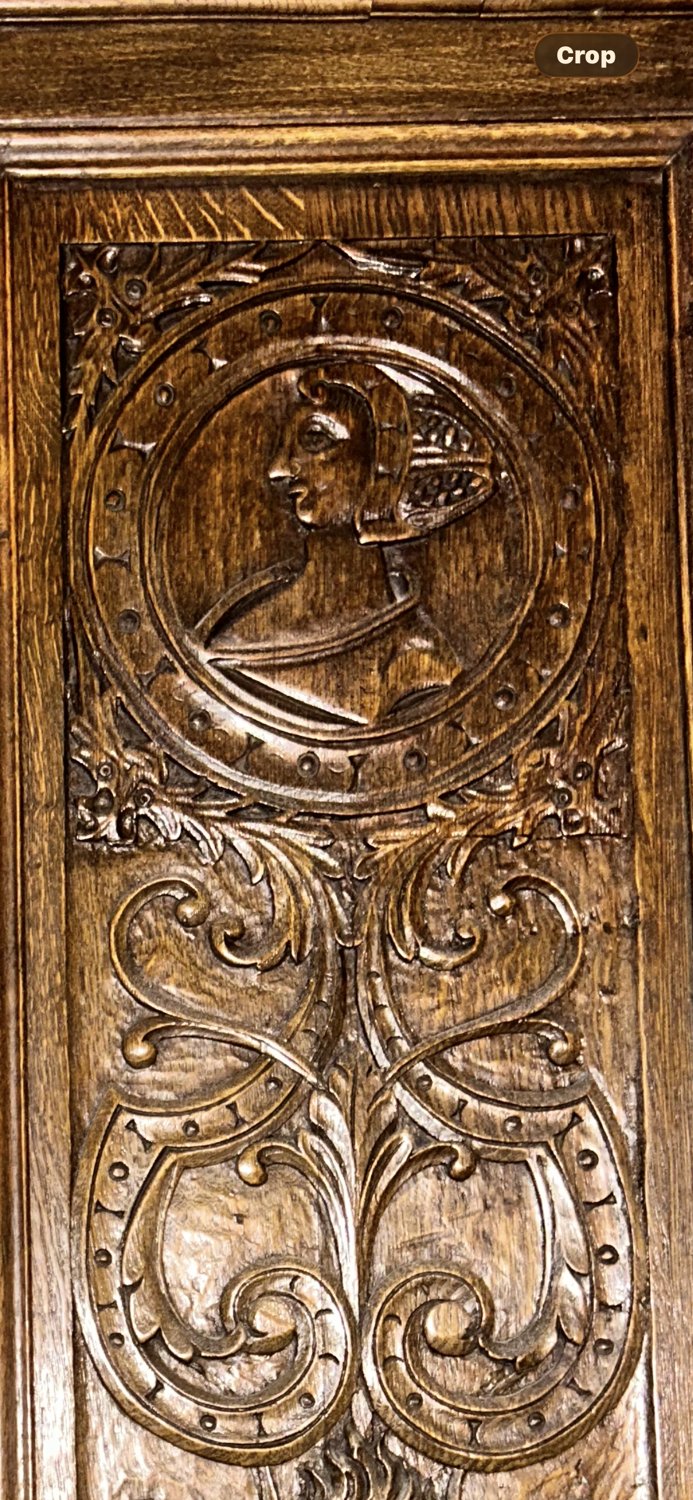
The profiles derive from classical coins and medallions, and they traveled north into England through printed pattern books from Germany and the Netherlands, carried by continental craftsmen working in Britain. So a helmeted head in Minneapolis oak is a Renaissance import twice over — Italy to England in the 1500s, England to Minnesota in 1913.
The Nine Worthies: chivalry’s hall of fame
Helmeted men arranged around a great room almost always gesture at one tradition. The Nine Worthies were first named in the early-14th-century French poem Les Voeux du Paon (“The Vows of the Peacock”), and for the next several hundred years they were the standard shorthand for ideal rulership — in tapestry, stained glass, sculpture and carved oak alike.
They come in three neat triads. Three pagans: Hector, Alexander the Great, Julius Caesar. Three Hebrews: Joshua, David, Judas Maccabeus. Three Christians: King Arthur, Charlemagne, Godfrey of Bouillon. The scheme was so entrenched that heralds invented coats of arms for men who lived centuries before heraldry existed — a catalog of those invented arms survives, David with his golden harp, Arthur with three crowns, Caesar with the double-headed imperial eagle.
And the women in bonnets
Out of a medieval love of symmetry, a female counterpart appeared in the 14th century — the Nine Worthy Women, the neuf preuses. Their roster was never fixed. One 15th-century list runs Deborah, Judith, Esther, Susanna, Lucretia, Boudicca, Mariamne, Clotilde and Antigone. A German woodcut series by Hans Burgkmair swaps in Veturia, Virginia, Jael, St. Helena, St. Bridget of Sweden and St. Elizabeth of Hungary. Regional taste decided the rest.
Which is the honest answer to the question guests ask most often in this room. The house reads its bonneted figures as Worthies, and the imagery fits the convention exactly — but no inscription survives to name them, and the female lists never agreed with each other anyway. What is certain is the intent. Whoever they are, they were carved to be recognized, in a room built for people who would have recognized them.
The rose in the middle of the argument
At the center sits a Tudor rose — five white inner petals for the House of York, five red outer petals for the House of Lancaster. Henry VII took the crown from Richard III at Bosworth Field in 1485 and married Elizabeth of York in January 1486; the doubled rose was the badge he built out of that marriage, a civil war folded into a single flower.
Put a Tudor rose in the middle of a wall of exemplary rulers and the room stops being decorative and starts making a claim: this household stands on the right side of history, with the peacemakers, in the company of Caesar and Arthur. It is not a subtle argument. It was never meant to be.
Why a Minneapolis flour man wanted this particular room
Charles S. Pillsbury finished his house at 100 East 22nd Street in 1916, in a city barely sixty years old, on a fortune milled from spring wheat. He wrapped a thoroughly modern steel-framed building — engineered like a small skyscraper — in five-hundred-year-old English skin, and he chose for his dining room the panels that say dynasty loudest of all.
That was the point. New money in a young city bought the vocabulary of old power and hung it on the wall where guests would sit under it for three hours at a stretch. A century later the argument still works, which is more than most marketing can claim. You can meet the family who ate beneath these faces — and see the other treasures in the house on The Splendors, from the Rotherwas staircase a king is said to have descended to a fireplace that lived through the Great Fire of London. Much of the oak upstairs and down came from the same English estate: the Bodenhams of Rotherwas held it for nearly a thousand years.
Come read the walls yourself
Photographs flatten carving; you need raking afternoon light and about ten inches of distance to see how deep these reliefs actually go. Year-round mansion tours put you in the room, and planning your visit takes about a minute. The mansion is also the departure point for Minneapolis Trolley Tours, so you can pair the Tudor panels with a ride through the rest of the city’s history — and if you’re making a weekend of it, 300 Clifton is a National Register mansion of its own, a few minutes away in Loring Park.
Bring your questions about the faces. We’ll tell you what we know, and we’ll tell you what we don’t.
Keep reading: What Happened to the Pillsbury Company? From a Minneapolis Mill to General Mills