
Why Did Whole English Rooms Cross the Atlantic in the Early 1900s?
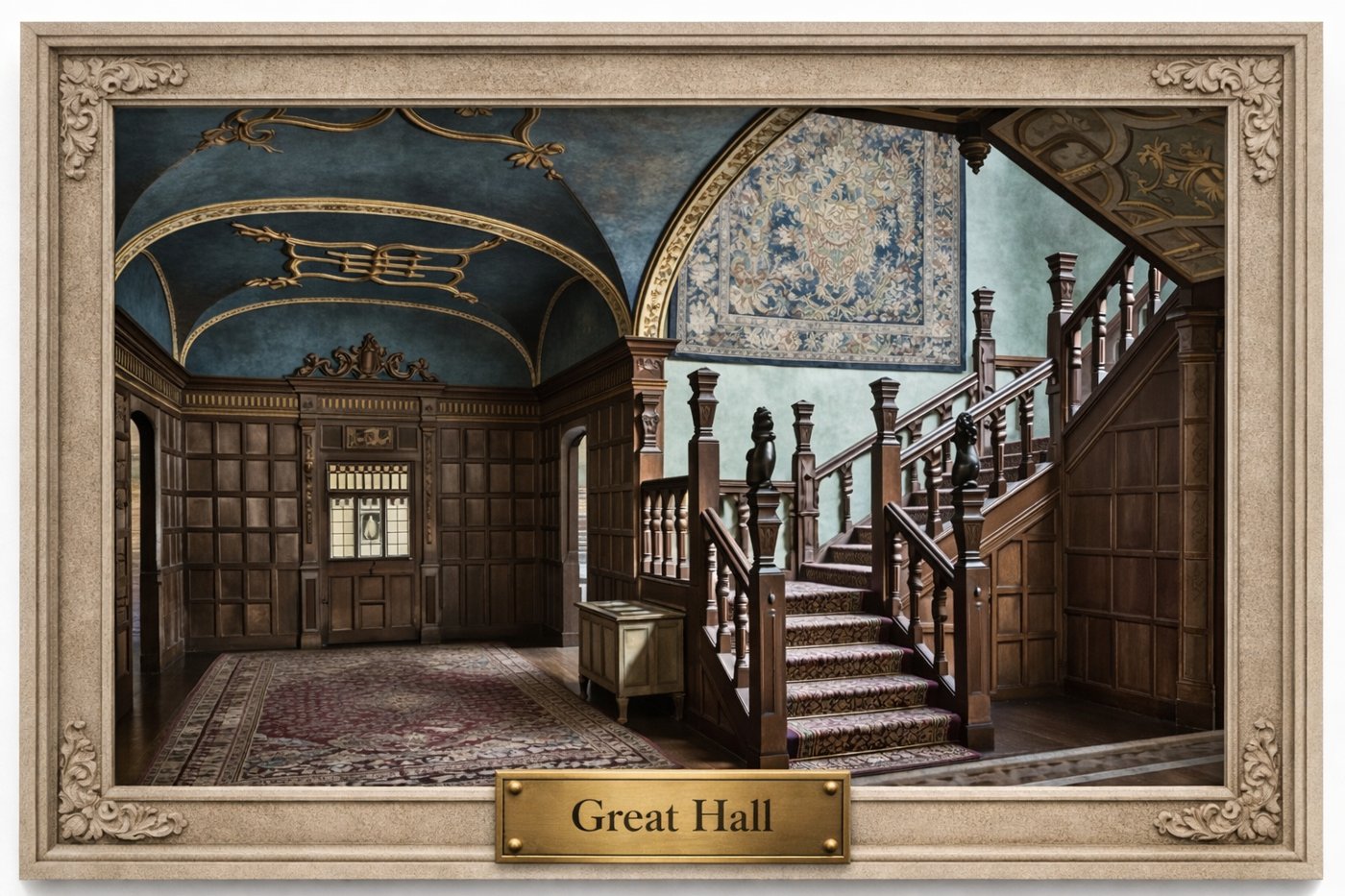
Stand in the great hall at 100 East 22nd Street and you are standing inside a room that was built in Herefordshire, England — and then put on a ship. It sounds like a tall tale. It was not even unusual. For roughly two decades on either side of the First World War, a steady transatlantic traffic carried English interiors to America: carved paneling, staircases, chimneypieces, plaster ceilings, ancient glass, and eventually entire houses. The Charles S. Pillsbury Mansion, completed in 1916, was one of the earliest and most complete examples anywhere in the Midwest.
Why England was suddenly selling its rooms
The great English country house had been in slow trouble since the agricultural depression of the 1870s. Rents collapsed, estate duties arrived, and families who had held their land for centuries found themselves cash-poor and roof-rich. Then the First World War took the heirs, and after it the gardeners and footmen did not come back.
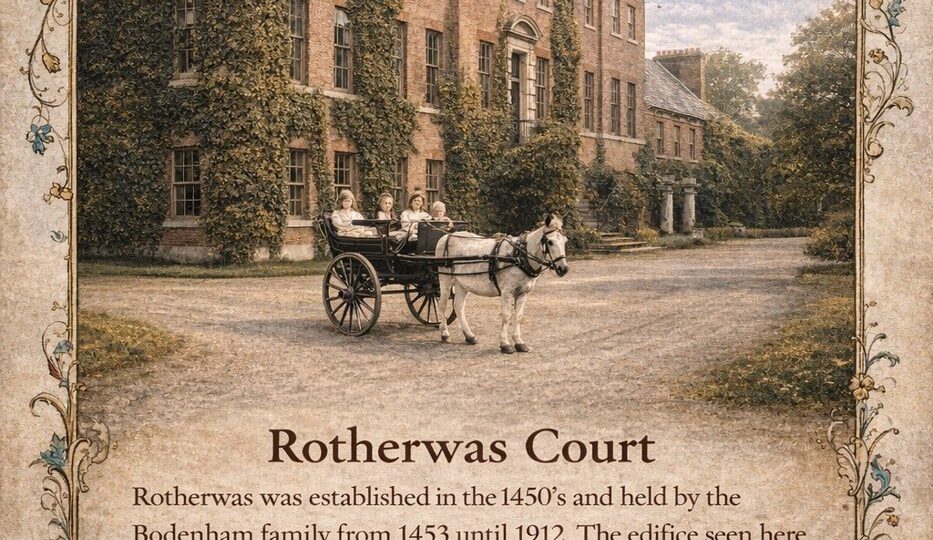
Rotherwas Court near Hereford is the case study. The Bodenham family had held those lands since before the Domesday Book, but by the end of the nineteenth century they could no longer sustain the estate. It went up for sale in 1912, passed through several hands, and was demolished outright in 1926. Only the family chapel survived — rescued by local effort and taken into state guardianship in 1928. You can still visit Rotherwas Chapel today, standing alone in a field beside the parch marks where the house used to be.
The dealers who made the market
Someone had to connect a bankrupt English squire with a Minneapolis flour fortune, and that someone was usually a Duveen. While Lord Duveen sold Old Masters to Frick and Mellon, his brother Charles Joel Duveen went into business for himself as Charles of London and specialized in the fabric of old houses — the oak, the plaster, the glass. He had been buying paneled rooms years before Americans wanted them, and he is credited with making Tudor and Elizabethan interiors fashionable in the United States. The whole extraordinary family is worth reading about on the Duveen brothers page.
When Charles stripped Rotherwas in 1913, the Pall Mall Gazette issued a placard about it and English newspapers ran angry protests. The cables reached New York within days. It was, in every sense, a scandal — and a very good advertisement.
What Minneapolis bought
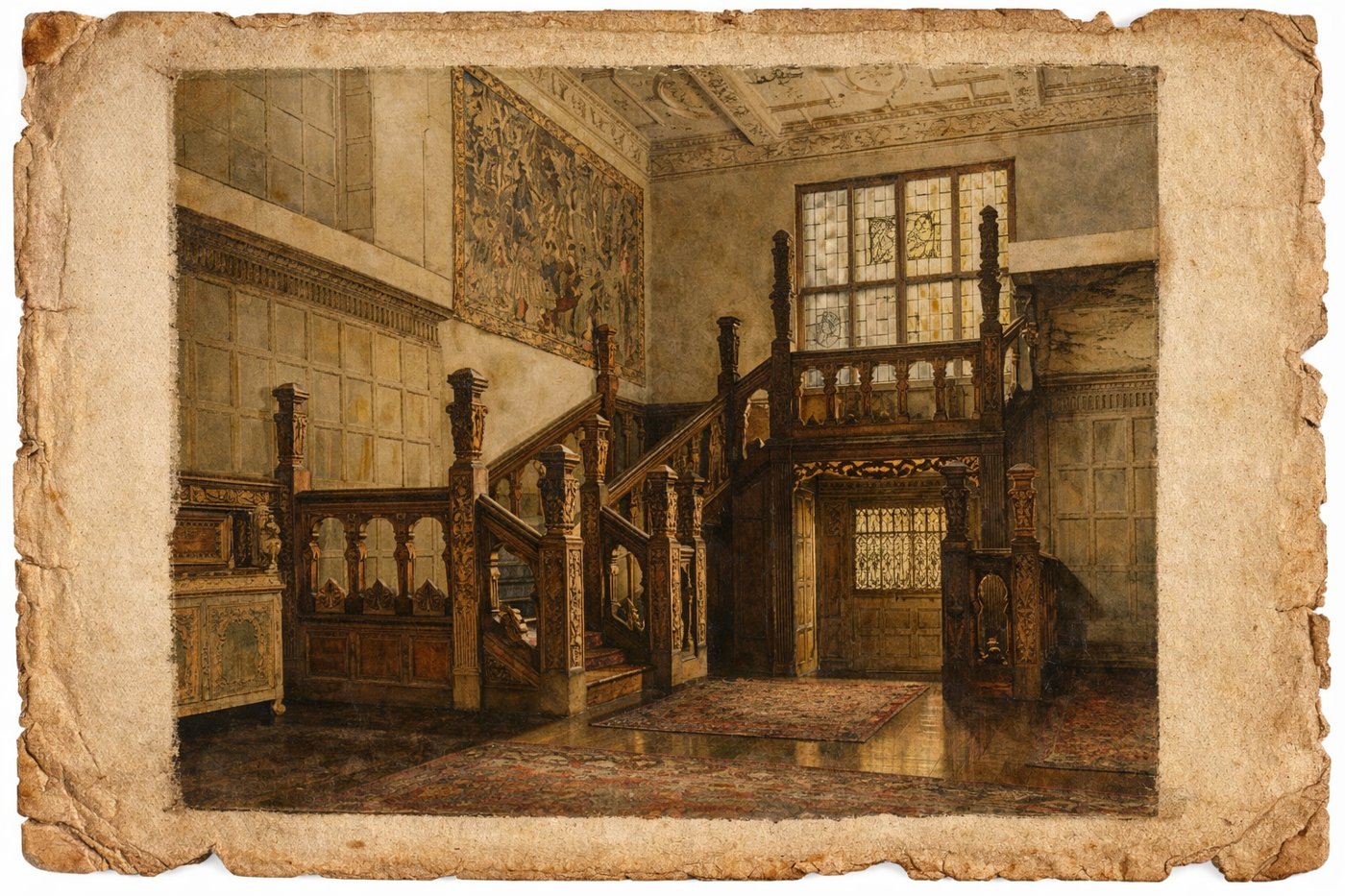
Charles S. Pillsbury bought some of the best of it. The hand-split oak paneling, the fire-scarred Jacobean staircase, the Tudor plaster ceilings and even the front door came from Rotherwas. The stone chimneypiece in the library was carved for the Tallow Chandlers of London in 1476 and survived the Great Fire of 1666. The lounge fireplace celebrates a 1592 Devon marriage. The glass is cathedral glass. Seven of these treasures are catalogued on The Splendors, and the story of fitting them into a brand-new steel-framed house is told in Building the Mansion.
Rotherwas had thirteen paneled rooms. Where did the rest go?
The house was reported to have thirteen paneled rooms, and the crown jewel — a walnut-paneled dining room completed in 1611 for Sir Roger Bodenham — did not come to Minnesota. Charles shipped it to his New York gallery, reassembled it there, and sold it to Herbert L. Pratt, an Amherst graduate and future president of Standard Oil of New York. It moved to Pratt’s Long Island house in 1914 and, by his bequest, to Amherst College, where it is installed to this day as the Rotherwas Room at the Mead Art Museum. Amherst notes the room is said to have cost Pratt $350,000 in 1913 — the equivalent of more than $11 million now. We have traced the others in where the other Rotherwas rooms ended up, and told the sad end of the house itself in what happened to Rotherwas Court after the rooms left.
Then Americans started buying entire houses
Rooms were only the beginning. In 1925 a Richmond couple, T. C. Williams Jr. and his wife Elizabeth, bought the Tudor manor of Agecroft Hall near Manchester, had it dismantled, crated and shipped to Virginia, and rebuilt it above the James River; it was finished in 1928. That same year the diplomat Alexander Weddell and his wife Virginia bought the ruined Warwick Priory, shipped its numbered stones across, and rebuilt them as Virginia House — using the same architect, Henry Grant Morse. Museums joined in: the Metropolitan Museum of Art acquired the Cassiobury Park staircase after that house came down in 1927, and installed Robert Adam’s Lansdowne House dining room among its period rooms.
Seen against all that, the Pillsbury Mansion is remarkable mostly for being early. Minneapolis had its Elizabethan interiors installed and lived in nearly a decade before Richmond broke ground.
Was it plunder, or was it rescue?
At the time the English press had no doubt: it was plunder. But the demolitions did not stop when the dealers went quiet. In the decades after the Second World War, English country houses were coming down at a rate of roughly two a week, and in 1974 the Victoria and Albert Museum mounted a famous exhibition, The Destruction of the Country House, 1875–1975, that finally shocked the public into caring.
Which leaves an uncomfortable, rather wonderful fact. Rotherwas Court is a footprint in the grass. Its oak is warm and intact and standing four square in Minneapolis. Whatever the dealers thought they were doing, the rooms survived because they left.
Come stand in a room that crossed an ocean
The oak, the staircase, the fireplaces and the glass are all still here, and you are welcome to come see them. Book a tour of the Pillsbury Club to walk the great hall in person — and if you would like the rest of the city’s story too, the mansion is the departure point for Minneapolis Trolley Tours. Not everyone, as King James is supposed to have said of Rotherwas, is permitted to go. These days, happily, you are.
Keep reading: once those rooms landed in Minneapolis, the carving still had things to say — who are the carved faces in the Pillsbury Mansion’s dining room?