
Why Was Nelle Pillsbury the Frontispiece of Town & Country in January 1916? Reading the Arnold Genthe Page That Introduced the Mansion to New York
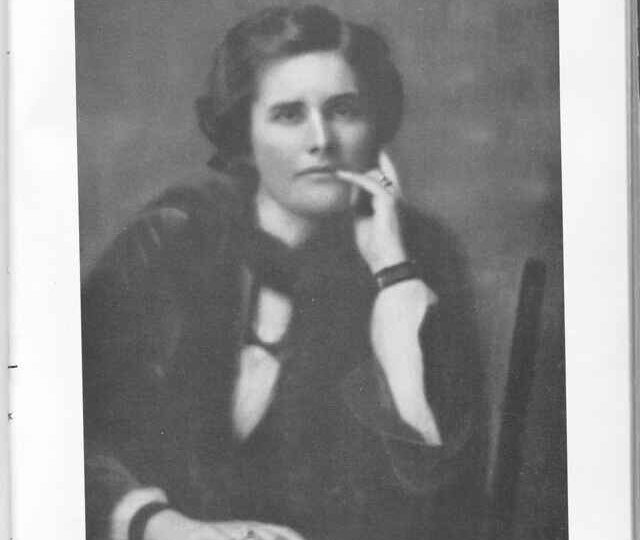
In the Pillsbury Club’s archive there is a single magazine page, stamped in the corner by some long-ago library clerk: JAN 19 1916. It is page 15 of Town & Country, and it is given over entirely to a photograph of a woman seated in a dark velvet gown, chin resting on her hand, looking past the camera with an expression somewhere between patience and amusement. The caption reads MRS. CHARLES S. PILLSBURY. The photographer’s credit, set small in the lower left corner, reads Arnold Genthe. And the four lines of type beneath it are, as far as we can tell, one of the first times anyone outside Minneapolis was told what was rising at 100 East 22nd Street.
What the page actually says
Here is the caption in full, because every clause in it earns its place: “Mrs. Pillsbury, as her picture would suggest, is a most artistic and charming person. Wife of one of Minneapolis’ magnates, their house is hardly to be equalled in the West. It is done in the Elizabethan period and much of it is genuinely authentic. Mrs. Pillsbury was Miss Nelle Pendleton Winston.”
Read it as a New York society editor would have written it. The subject is Nelle, not the house; the house gets two sentences. But those two sentences are doing a great deal of work. “Hardly to be equalled in the West” places the mansion, sight unseen, above everything between the Hudson and the Pacific. “Done in the Elizabethan period” tells a reader who knew the difference that this was not one more Beaux-Arts pile. And “much of it is genuinely authentic” is the line the family has always read with a raised eyebrow, because it is true in a way the caption writer may not have understood: whole rooms of the house were, quite literally, four hundred years old. We have told the story of where that oak came from in Charles of London and the Splendors pages, and the tale of the fireplace Hearst thought he owned in its own post.
Who Arnold Genthe was
The photographer of presidents and Garbo
The credit line matters. Arnold Genthe was not a society-page staffer with a box camera. According to the Library of Congress, which holds his negatives, he was a German-born classicist who came to San Francisco in 1895 as a tutor to a baron’s son, taught himself photography, and made his name with photographs of the city’s Chinatown and, in April 1906, with a borrowed camera, of the earthquake and fire that had just destroyed his own studio. By 1911 he had moved to New York, where he spent the 1910s through the 1930s as one of the country’s leading portrait photographers. His sitters included Woodrow Wilson, Theodore Roosevelt, John D. Rockefeller, Arturo Toscanini and Greta Garbo.
That is the man who photographed Nelle. The soft focus, the dark ground, the single lit hand and face: it is his manner exactly, the “idealistic impressionism” a colleague credited him with. Whether Nelle sat for him in New York or he came west, the page does not say. What it does say is that in January 1916 a Minneapolis miller’s wife was being presented to the East Coast in the same visual language as its presidents.
The issue around the page
The archive holds the contents page too, and it fixes the page in time and place. This is Volume 71, Number 3618, dated January 20, 1916, of a magazine that described itself as “An Illustrated Journal, Founded in 1846 by N. P. Willis and George P. Morris.” H. J. Whigham was editor, Franklin Coe publisher; the offices were at 8 West 40th Street in New York, “near Fifth Avenue, and opposite the Public Library.” It came out on the 1st, 10th and 20th of each month, at five dollars a year or twenty-five cents a copy, and could be bought in London at the Pall Mall American and Colonial Exchange and in Paris at Brentano’s.
Nelle is listed second in the table of contents, right after the calendar: “Mrs. Charles S. Pillsbury (Frontispiece) . . . 15.” The rest of the number is a snapshot of what its readers cared about that winter: Notes of the Week, About People We Know, Winter Sports for Royalty and Commoners, Philadelphia Women, Polo and Hunting, Our London Letter, an exhibition of forty important tapestries, a farmhouse of colonial type in Pennsylvania, Fashions, Dogs and Their Owners, and The Week in Society. The column of Broadway theatre advertisements down the left margin names Ethel Barrymore, Maude Adams and a new Franz Lehár operetta. Into that company, between the polo and the tapestries, went a Minneapolis house.
One small puzzle stays open. The printed date on the contents page is January 20; the stamp on the frontispiece reads January 19. The likeliest answer is that copies reached subscribers and libraries a day ahead of the cover date, but we note it rather than resolve it.
Who owned the magazine, and why it has been asked
Our own page on the Pillsbury family repeats a story handed down in the family: that Town & Country belonged to William Randolph Hearst, Charles’s rival in the hunt for English antiquities, and that the phrase “much of it is genuinely authentic” was Hearst’s small dig at a man he believed had settled for a copy of his fireplace. It is a good story and we have told it before. The masthead on the contents page, however, names The Stuyvesant Company as publisher and Franklin Coe as its president, with no Hearst anywhere on the page. Town & Country is a Hearst title today, but whether it was in January 1916 is a question the archive does not answer, and we leave the two accounts side by side rather than pick one.
Why a frontispiece mattered in 1916
Our building-the-mansion page dates the completion of the house to 1916. If that is right, the Genthe page ran in the very month the last of the English oak was going up, and before most of Minneapolis had seen inside. A frontispiece in a national society journal was, in effect, the house’s debut: a declaration that what Charles and Nelle had built on Washburn Hill belonged in the same pages as Newport and Philadelphia. Nelle, whose grandfather John H. Stevens built what the city counts as its first house, had put the city’s name in Town & Country; the caption, whoever wrote it, had put the house there too. You can read more about her in Who Was Nelle Pillsbury?
See the rooms the caption meant
The “genuinely authentic” rooms are still here, and you can stand in them. The Pillsbury Club offers guided tours of the mansion year-round; details and booking are on our experiences and tours page, and everything you need to plan a visit is on plan your visit. Come see what a New York magazine called hardly to be equalled in the West, and decide for yourself whether the caption writer was being generous.