
Why Are There Painted Figures Labeled America, Europa and Africa in the Pillsbury Mansion’s Windows?
Look closely at the leaded windows of the Pillsbury Mansion and you will find small painted figures set into the clear glass, each in its own octagonal frame. Three of them carry a label written right on the glass: America, Europa and Africa. They are personifications of the continents, a subject European artists painted for centuries, and they are some of the most overlooked pieces in the house.
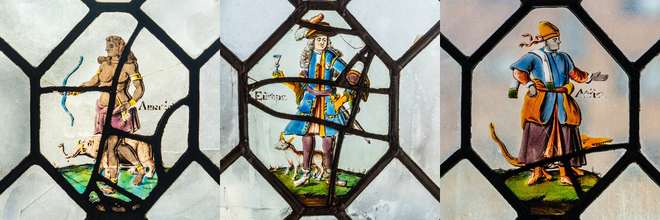
What do the three painted figures show?
Each panel holds a single standing figure on a patch of green ground, with an animal at the feet and the continent’s name lettered beside the head. The America figure carries a bow and has a long-nosed animal beside him that reads as an elephant. The Europa figure wears a long curled wig and a knee-length blue coat, holds a goblet, and has a small horned animal at his feet. The Africa figure wears a turban and a blue coat with an orange lining, and a crocodile-like creature curls behind him. The animals are the painter’s choice of shorthand for each place, not a zoology lesson.
We have not found a record naming where these panels were made or who painted them, so we are describing what the glass itself shows. The wig and coat on Europa look like the fashions of the decades around 1700, but that is a visual impression, not an appraisal.
Where does the Four Continents idea come from?
Personified continents became a standard decorative subject in Europe after Cesare Ripa’s 1593 Iconologia, which gave artists a shared vocabulary of attributes for each one. The Metropolitan Museum’s essay on Allegories of the Four Continents traces how the figures spread through prints, tapestries, porcelain, maps and decorative arts from the sixteenth to the nineteenth century. The Met also holds a German plaquette of Africa personified, made around 1580 to 1590.
The Met’s note on that plaquette says it shows Africa through “precious goods that Europeans coveted” rather than accurate representation, which is why a painter could set an elephant beside America without anyone at the time blinking. That is the same reason these little glass figures are worth reading carefully: they show how a European craftsman imagined the world, painted in enamel and set in lead.
How did painted glass like this end up in the mansion?
The mansion’s windows combine glass of many dates and subjects, assembled by the London dealer Charles of London for the Pillsburys. Our stories of the glass cover the 1913 Atlantic crossing, the 1636 roundel with two different dates, the three Swedish kings and the Luther rose. For the dealer behind it all, see Charles of London, and for the house as a whole, The Splendors.
Where can you see the glass?
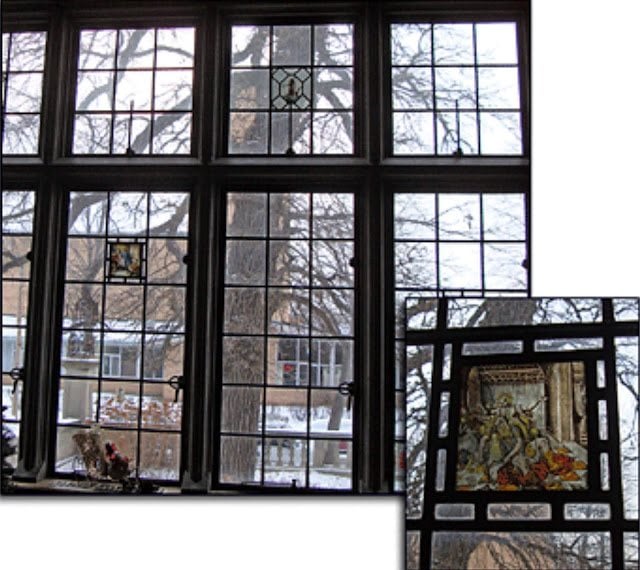
Painted glass this small is easy to walk past. On a guided mansion tour you can ask your guide to point out the figures set into the windows. Plan your visit on our Plan Your Visit page, see the experiences and tours, and remember that Minneapolis Trolley Tours departs from the mansion.