
Why Does the Pillsbury Mansion’s 1636 Stained Glass Roundel Carry Two Different Dates? Reading a Window Made of Fragments
Among the old painted glass in the windows of the Charles S. Pillsbury Mansion there is a small round panel that rewards anyone willing to stand close to it. Across its lower edge, on a golden scroll, four numerals are painted large enough to read from across the room: 1636. We have mentioned it once before, in passing, as one of the glass medallions Pillsbury set into the steel-and-concrete mansion he finished in 1916. It deserves a closer look, because the longer you look, the stranger it gets.
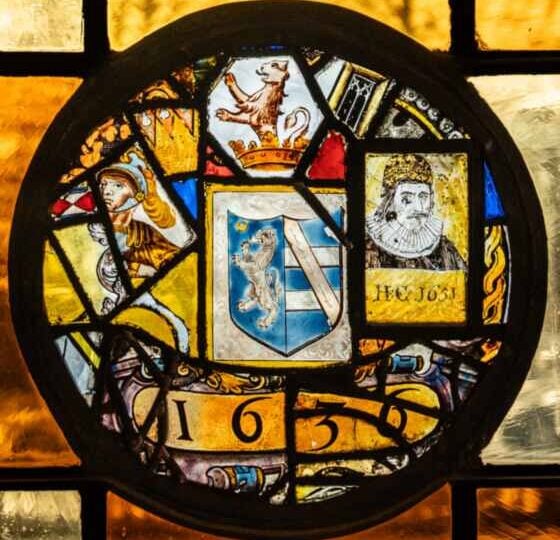
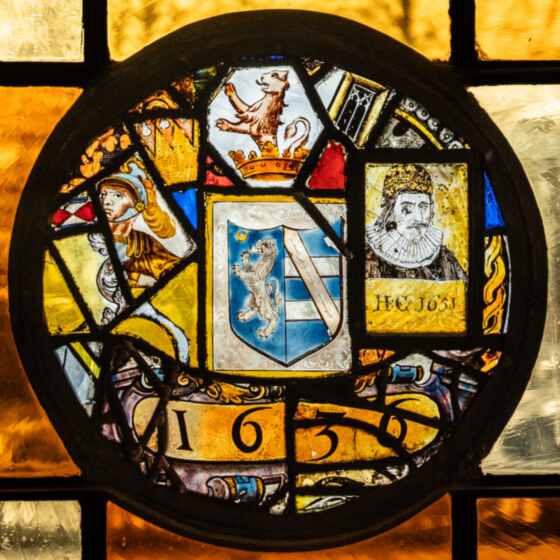
What do you actually see in the 1636 roundel?
Read it the way you would read a page, piece by piece, lead line by lead line:
- At the top, a lion rising out of a golden coronet, painted in brown and gold on clear glass.
- At the centre, a heraldic shield. It appears to be divided down the middle: on the left, a silver lion standing on its hind legs on a blue field, with a small crescent beside its head; on the right, blue and white bars crossed by a diagonal band.
- To the left, a young figure in a plumed, classical-looking helmet, turned in profile, with a fragment of a second figure below.
- To the right, a bearded man in a gold cap and a crisp white ruff, with painted letters and a date beneath him.
- Around the edges, scraps of red and white chequer, gold foliage, a sliver of architectural canopy and pieces of coloured border.
Why are there two different dates in one window?
This is the clue that gives the game away. The scroll at the bottom says 1636. But the little label under the bearded man carries a date of its own, and it is not 1636. The third numeral is worn and crossed by a crack, so we read it as 1651, though 1631 cannot be ruled out. Either way, the two dates do not agree — and a single, freshly made panel would not argue with itself.
The simplest explanation is that this is a composite: a roundel pieced together from fragments of several older windows. That was a common fate for old glass. As the Victoria and Albert Museum explains, stained-glass windows broke easily, had to be repaired again and again, and often survive only in fragmented and altered form. Coloured glass was far more expensive than plain glass, so it was regularly reused. A glazier with a box of salvaged pieces — a lion here, a portrait there, a dated scroll — could lead them into one handsome medallion.
There is even a technical wrinkle. In the strict language of glass scholars, a “silver-stained roundel” is a single piece of clear glass painted and fired with silver stain; a panel built from many coloured pieces held in lead is something else. The Corpus Vitrearum’s introduction to its American checklist of roundels makes exactly that distinction. By that definition our “roundel” is really a small leaded panel wearing a roundel’s shape — which suits a patchwork perfectly.
What does the shield tell us?
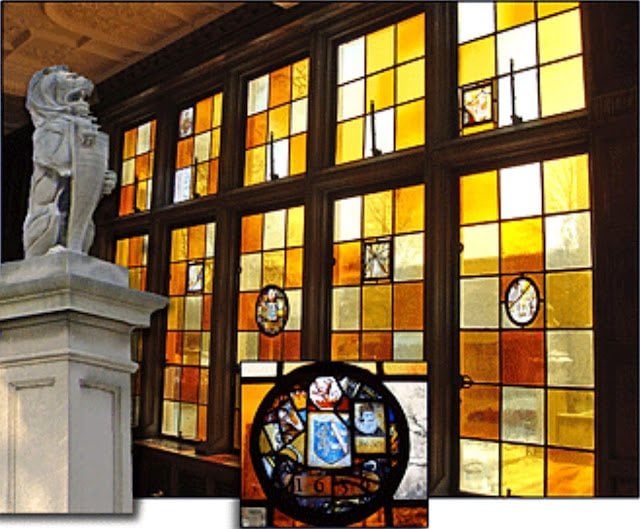
A shield split down the middle, with one set of arms on each side, is the arrangement heralds use to join two families — usually a husband’s arms beside his wife’s. You can see the same idea carved in oak elsewhere in the house, in the Walrond marriage fireplace.
Then there is that tiny crescent by the lion’s head. In English heraldry, a crescent is the traditional mark of a second son, one of the “marks of cadency” used to tell brothers’ arms apart, as Britannica’s entry on cadency describes. Whoever these arms belonged to, the glass seems to be telling us he was not the eldest. Crescents turn up in the mansion’s carved heraldry too; our post on the coats of arms carved into the Pillsbury Mansion walks through them.
Which family is it? We do not know, and we would rather say so than guess. Lions and bends were popular with a great many families, and in a patchwork like this one a piece may not even sit where it started. If a heraldry enthusiast recognises the combination, we would love to hear from you.
How did glass like this reach Minneapolis?
By the time the Pillsburys were building, old European glass had become a collector’s commodity. The Corpus Vitrearum notes that several thousand roundels were collected wholesale in the nineteenth century and installed in parish churches across Britain, and that large private collections in the United States — William Randolph Hearst’s among them — were the exception. The mansion’s own story runs through the London dealer Grosvenor Thomas and Charles Duveen’s New York showroom, told on The Splendors and in our earlier posts on where the centuries-old glass came from and how it crossed the Atlantic.
Not every piece is a puzzle. Some of the glass is neatly labelled: see the three Swedish kings in the windows, named and dated around their rims. The 1636 roundel is the opposite — a medallion that keeps its secrets, stitched together from at least two centuries-old stories.
Can you see the 1636 roundel in person?
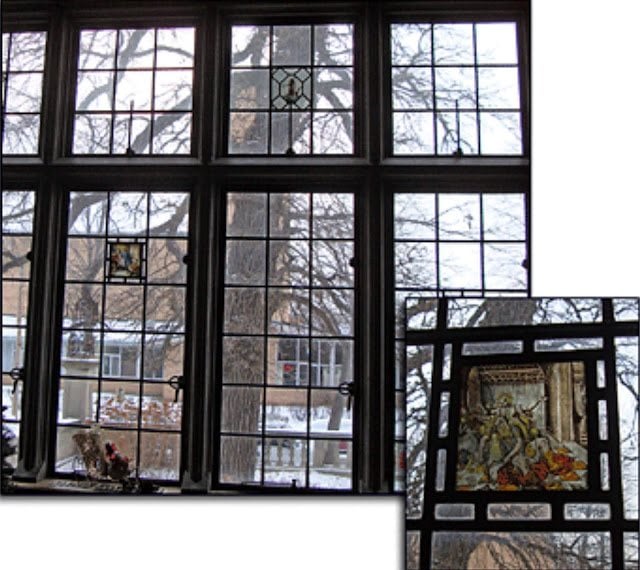
The glass is part of the house, so the best way to meet it is on a guided mansion tour. Bring your curiosity, look for the scroll, and see whether you read the bearded man’s date as 1631 or 1651. Explore tours and experiences or plan your visit to the Pillsbury Club — and for more stories from the house, browse the History Journal.
Keep reading: What Did a Newspaper Columnist See Inside the Newly Rescued Pillsbury Mansion in January 1969?.