
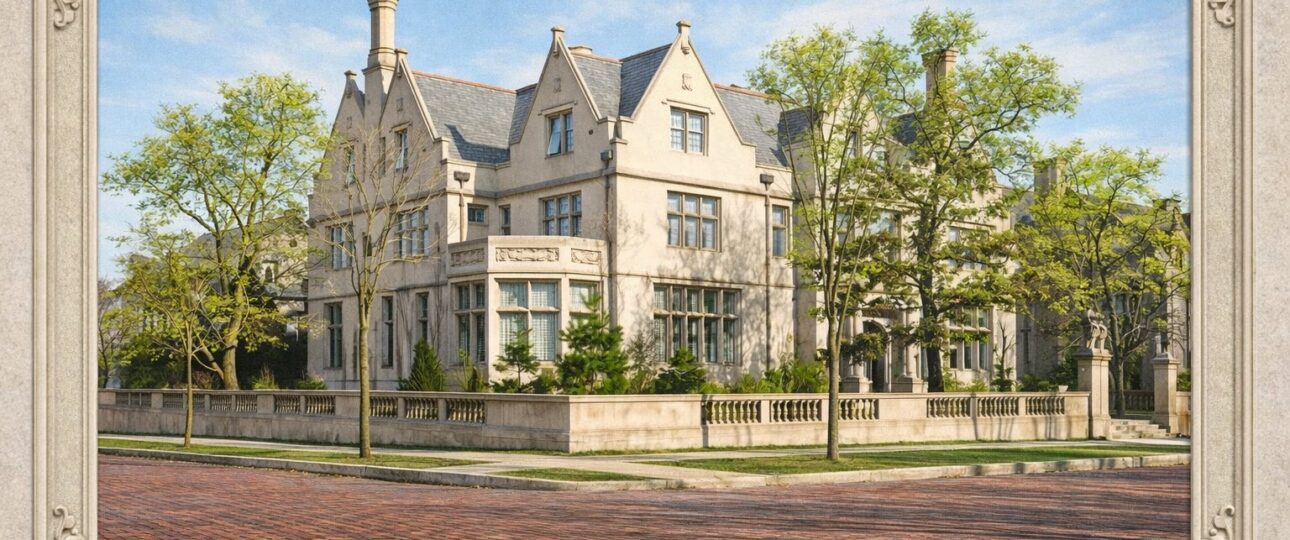
Why Is There a Luther Rose in the Pillsbury Mansion’s Stained Glass?
Almost every leaded window inside the Charles S. Pillsbury Mansion has the same origin story: centuries-old European glass, gathered by the London dealer Charles Joel Duveen and installed when the house was built in 1916. Heraldic shields, continental roundels, a fireplace that survived the Great Fire of London — the glass is old, foreign, and aristocratic. So one small roundel photographed among the mansion’s windows doesn’t fit that pattern at all. It shows a white rose with a red heart at its center and a black cross inside the heart, ringed in blue and gold. It isn’t a Bodenham crest or a Continental import. It’s the Luther Rose — Martin Luther’s own personal seal.
What the Luther Rose Actually Means
Luther designed the seal himself in the early 1520s and used it on the title pages of his own works. In 1530, Lazarus Spengler — a Nuremberg reformer and friend — asked Luther to explain what it meant, and Luther answered in a letter dated July 8, 1530, element by element. The black cross set inside a heart, he wrote, is there “to remind me that it is faith in the Crucified One that saves us” — the cross causes pain but does not kill, so the heart keeps its natural color. The white rose (not red, Luther was careful to specify) stands for the joy and peace that faith brings, the kind belonging to spirits and angels rather than the world. The sky-blue field behind the rose represents the joy of the spirit and the hope of heaven to come, and the gold ring around the whole design stands for a blessedness in heaven that “lasts forever and has no end.”
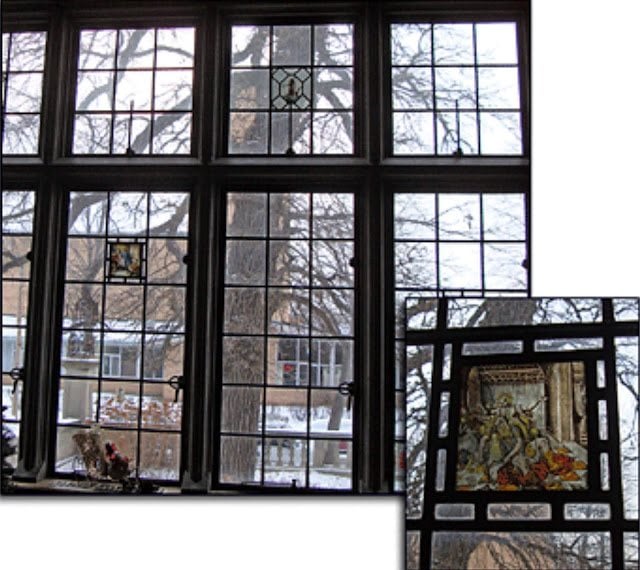
It’s a specific, personal, unmistakably Lutheran emblem — not a family crest, not a decorative flourish borrowed for its colors. Whoever put that roundel into a mansion window meant a Lutheran seal, precisely.
How a Lutheran Seal Ended Up in an Episcopalian Family’s House
We’ve written before about the twenty-seven years the mansion spent as Passavant Hall, the administration, classroom and chapel building of the Northwestern Lutheran Theological Seminary, from 1940 until the seminary announced its move to a new St. Paul campus in 1966. A mansion built as a private Episcopalian family’s home doesn’t come with a Lutheran seal already worked into its glass — and a seminary running chapel services in a former drawing room is exactly the kind of tenant who might add one. No dated invoice or building record has turned up yet to prove precisely when this roundel went in, so we won’t claim more than the photograph shows. But of every era in this house’s hundred-plus years, the seminary decades are the only one that makes a Luther Rose in a window make sense.
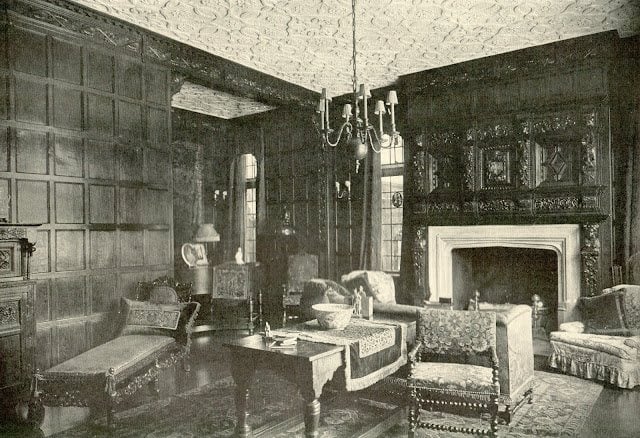
It’s a small detail, easy to miss on a tour focused on Duveen and Rotherwas and the Pillsbury family’s own story — which is exactly why it’s worth pointing out. The mansion’s hundred-plus years didn’t stop with the family that built it, and the glass keeps a record of the tenants who came after, whether or not anyone wrote it down at the time.
Curious what else the house has kept from its different lives? Book a guided tour or read more of the History Journal for the rest of the mansion’s hundred-year story.
Keep reading: Did the Pillsbury Children Spend Their Summers at Lake Minnetonka?