

Who Designed the Pillsbury Mansion? Meet Architect Edwin Hewitt
Before a single centuries-old English room could be shipped across the Atlantic and rebuilt inside the Charles S. Pillsbury Mansion, someone had to design a house worthy of holding them. That someone was Edwin Hawley Hewitt — a Red Wing boy turned Paris-trained architect who, in 1916, gave Minneapolis one of its grandest manor houses. His name is easy to miss behind the dazzle of imported Tudor oak and Great-Fire fireplaces, but the building you tour today on East 22nd Street is, first and foremost, his composition.
From Red Wing to the École des Beaux-Arts
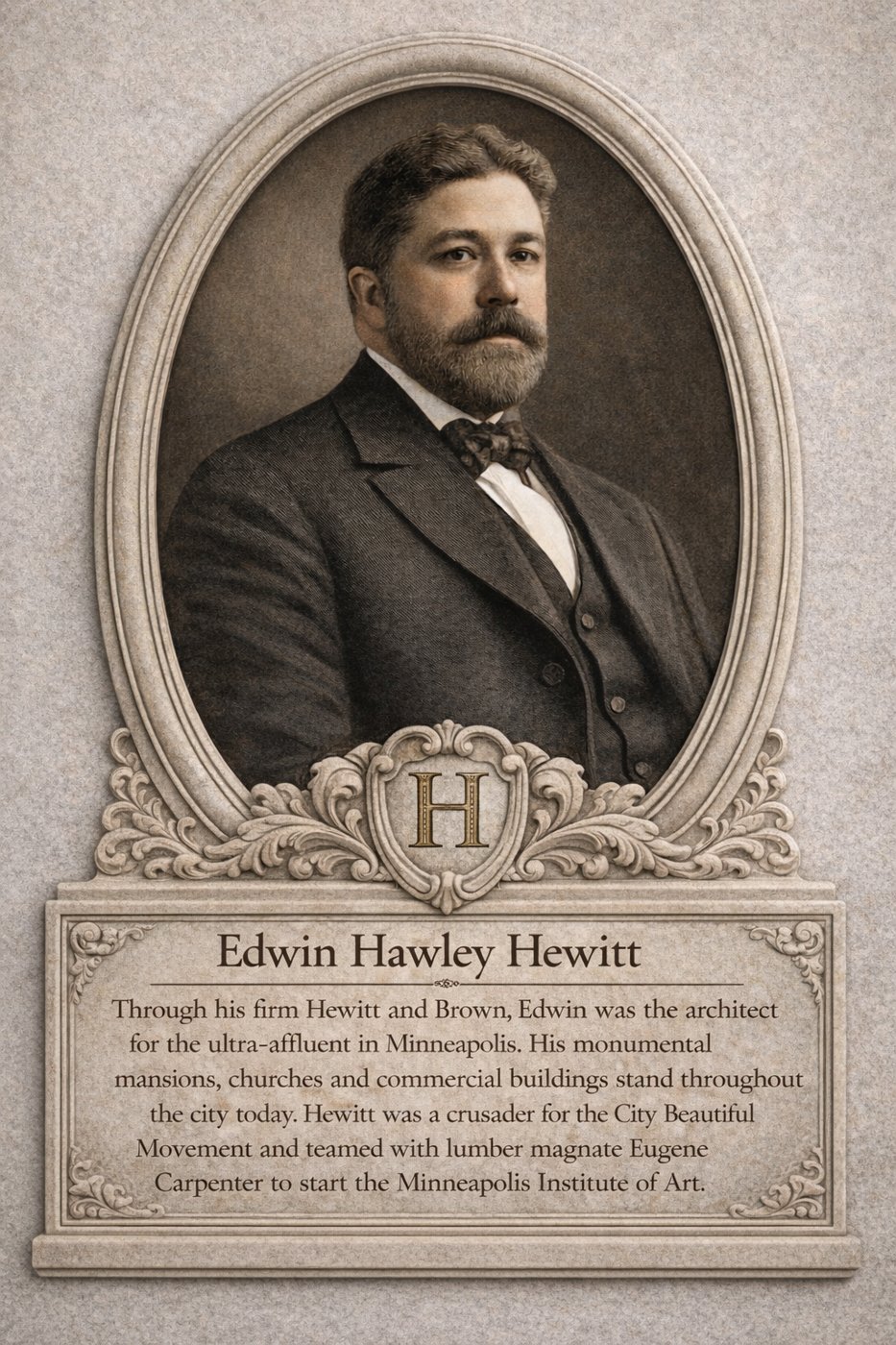
Hewitt was born in Red Wing, Minnesota, in 1874. He studied at the University of Minnesota, then at MIT, and apprenticed in the prestigious Boston offices of Shepley, Rutan and Coolidge. But the formative chapter came in 1901, when he sailed for Paris and entered the École nationale supérieure des Beaux-Arts, joining the famed Atelier Pascal. The Beaux-Arts method drilled into him a love of proportion, symmetry, and ceremony — the idea that a great building should move you the moment you approach it. You can feel that training every time you stand beneath the Pillsbury portico.
Hewitt & Brown: architects to the golden age of Minneapolis
In 1910 Hewitt partnered with Edwin H. Brown to form Hewitt & Brown, “architects and engineers” — a deliberate pairing, because Hewitt understood that the ambitions of his era demanded modern engineering as much as classical taste. For roughly two decades the firm was the architect of choice for an ultra-affluent, fast-growing Minneapolis flush with flour-and-lumber money. When the city’s milling barons wanted a home, a church, or a tower that announced their arrival, they often called on Hewitt & Brown.
Steel bones, a Tudor-Gothic skin
The Pillsbury Mansion is a clever piece of sleight of hand. It looks like an ancient English manor, but it is built on a thoroughly modern structural steel frame set on massive concrete caissons, with walls and floors of reinforced concrete, masonry, and structural tile. That hidden skeleton is exactly what makes the romance possible: the soaring ceilings, the enormous windows, and the broad, column-free spans that let a 500-year-old paneled room sit comfortably inside a 1916 house. Hewitt wrapped those steel bones in a Tudor-Gothic envelope of carved stone — a dignified, slightly severe face designed expressly to receive the imported interiors that dealer Charles of London and the Duveen brothers would install within.

The lions, the portico, and the crest
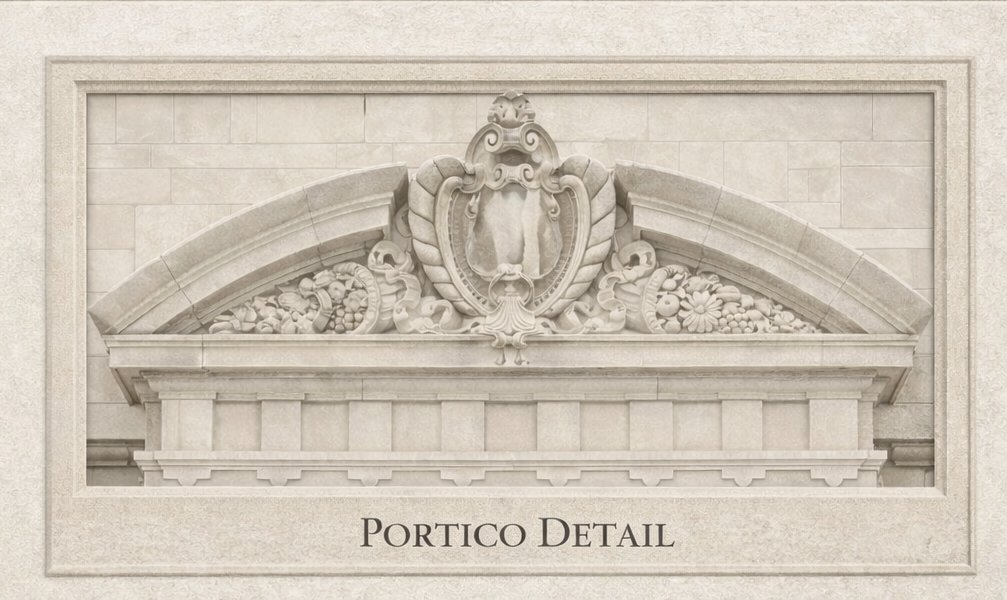
The details at the front door are pure Hewitt theater. The carved stone portico, the parapet friezes, and the armorial crest above the entrance were all part of his design. According to a 1913 newspaper account, the sculptor Charles Wells carved the Bedford-stone lions that guard the entry pillars, along with the portico and frieze work. Pause at those lions on your way in — they are the first thing Hewitt wanted every visitor to notice, and they still do their job a century later.
A city builder beyond the mansion
Hewitt’s fingerprints are all over Minneapolis. The same year the Pillsbury Mansion was completed, his firm finished the Hennepin Avenue United Methodist Church in nearby Loring Park — an English Gothic landmark modeled on Ely Cathedral, faced in the same soft gray Bedford limestone, its spire once the second-tallest structure in the city. Earlier work included the Episcopal Cathedral of St. Mark and the soaring Soo Line Building downtown. Hewitt was also a tireless civic figure: president of the Minnesota State Art Society and a driving force behind the creation of the Minneapolis Institute of Art. For more on how his work shaped the city’s “City Beautiful” era, the Minnesota Historical Society is a wonderful rabbit hole.
Knowing the architect changes how you read the house. The mansion isn’t only a collection of salvaged English treasures — it’s a single, coherent vision by a Minnesotan who trained in Paris and came home to build beautifully. To see how those imported rooms landed inside his steel frame, wander through Building the Mansion and The Splendors.
See Hewitt’s masterpiece for yourself
The best way to appreciate Edwin Hewitt’s craftsmanship is to stand inside it. The Pillsbury Club offers year-round tours of the mansion, and it’s also the departure point for the vintage Minneapolis Trolley Tours — a fun way to roll past more of the architect’s landmarks and the lost-and-saved mansions of the old avenue. Plan your visit to the Pillsbury Club and come meet the lions in person.
Keep reading: How a Minneapolis flour empire built the Pillsbury Mansion — the milling fortune that paid for every imported English room.