
Which Rotherwas Room Stayed in England? A Manchester Newspaper Visits the Bond Street Showroom, May 1913
Thirteen panelled rooms left Rotherwas Court in the spring of 1913. Several of them are around you at the Pillsbury Club; one became a gallery at Amherst College; the rest, we have always said, vanished into private hands. A single column in a Manchester newspaper, printed on Wednesday, May 28, 1913, turns out to answer part of that mystery — and it does so from an unexpected vantage point. The reporter was not in Herefordshire watching the panelling come down. He was in London, standing inside the rooms after they had been put back up, for sale.
A showroom in the heart of Mayfair
The piece runs under the plain headline “Oak Rooms of Rotherwas” in the Manchester Courier and Lancashire General Advertiser, page six. Its writer describes stepping out of “the heat of closely packed Bond Street” into “the quiet peace of an old English room” — and explains that Messrs. Charles, the dealers who had bought the Rotherwas interiors, had re-erected two of the apartments, complete, “here, in the heart of London.” The dealer was Charles Duveen, trading as Charles of London, and the Illustrated London News had placed his firm at Brook Street when it broke the story that March. Brook Street meets New Bond Street in Mayfair, so the two papers agree: the rooms were rebuilt, wall by wall, in the middle of the London art trade, where the right people would walk past them.
That detail matters. We knew from the customs records that the oak sailed to New York and was admitted duty-free as art. We did not know that at least some of the rooms made a stop first — assembled, dusted and lit in a Mayfair showroom in the spring of 1913, as sample rooms for buyers on both sides of the Atlantic.
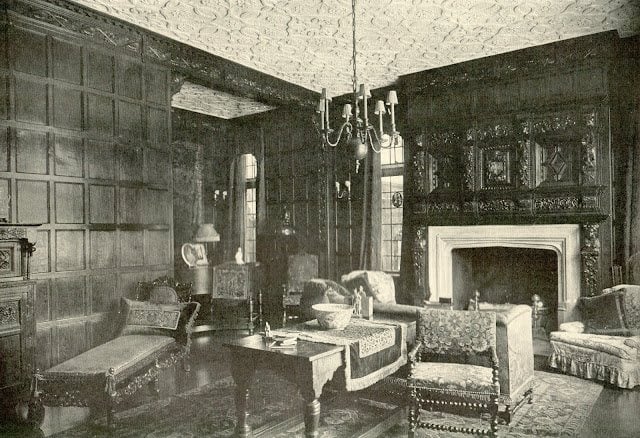
The “fair parlour” and the King James I room
The reporter names the two rooms he walked through. One is “the ‘fair parlour'” — the quotation marks are his, and the name suggests it was what the Bodenhams themselves called it, in the old sense of a fine or handsome parlour. The other is “the King James I. room, later so-called because that worthy monarch was a frequent visitor at Rotherwas.” That is the same royal visit behind the legend of the King’s Staircase at the Pillsbury Club, and the Manchester paper treats the king’s visits as plural and routine, not a single famous night.
Then comes the sentence that changes the map. The King James I room, the writer reports with evident relief, “is to remain in this country, having been purchased by an English collector.” He goes further: it “would have been a poor compliment to our national appreciation of beautiful things if this exceptionally fine specimen of Jacobean art had been allowed to cross the water.” In the same breath he admits that “American competition is always keen in such matters, and already one of the Rotherwas rooms is on view in Messrs. Charles’ New York galleries.”
So by the end of May 1913, the thirteen rooms were already in three places at once: two standing in London, one on view on Fifth Avenue, and the rest presumably in crates. And one of them — the room named for the king — had been sold to stay in England.
Two newspapers, one contradiction
Here the record disagrees with itself, and we will leave the disagreement standing rather than paper over it. Eleven weeks earlier, on March 8, 1913, the Illustrated London News had run a full page headed “Lost to England: Superb Rotherwas Panelling for America.” Its four photographs show panelling from the banqueting hall “to be transported to the United States,” an Elizabethan chimneypiece from the same hall, and — in the bottom right corner — “In the James I. Room: a finely carved chimneypiece of Rotherwas.” In March, the London paper counted the James I room among the things America was taking. In May, the Manchester paper said an English collector had kept it.
Both can be true. The Illustrated London News was reporting an announcement — the whole house had been bought and its rooms “are to be dismantled and taken to the United States” — before any individual room had found a buyer. Two months later, one room had been sold at home. Which room that was, and where its panelling and chimneypiece stand today, we cannot say from Minneapolis; we have found no later record of it. What we can say is that the Pillsbury Mansion’s Rotherwas oak was never described, in either paper, as the King James I room.
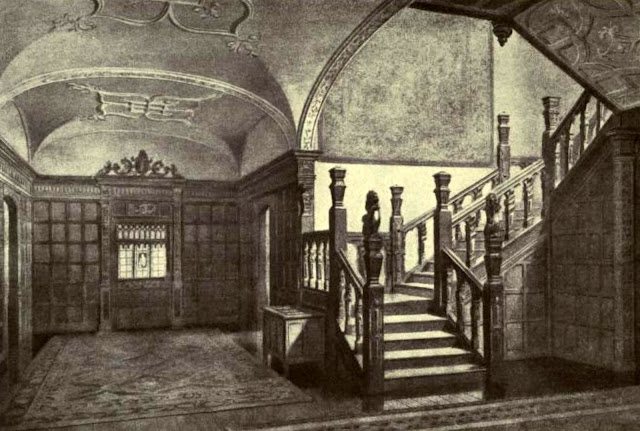
What the reporter thought it was worth
The column is also a rare contemporary judgement of the oak’s quality by someone who knew the English houses it was being compared to. “Richly adorned though English mansions often are with the skill of the craftsmen of the Renaissance,” he writes, “the Rotherwas oak rooms are something quite unique.” The nearest rivals he can think of, “for purity of oak and delicacy of carving,” are the panelled rooms at Levens Hall in what was then Westmorland — the Elizabethan house near Kendal that still opens to visitors today — and, “notably,” the woodwork at Hoghton Tower near Preston, another house with a famous James I visit in its history. He also lets slip an older description of the place: the Illustrated London News had reminded readers that Rotherwas is in the Domesday Book, “where it is spelt ‘Retrowas,'” that it passed to the Bodenhams by marriage to a de la Barre heiress, and that the main house was rebuilt in 1731, “when the panelling was removed to the new house.” The oak had already survived one move before it ever saw a crate.
Why a Minneapolis mansion should care
Because it tells us how these rooms were sold. Not as salvage, but as finished, furnished apartments you could walk into on a hot London afternoon and feel “swept swiftly back down the stream of time to the Middle Ages.” That is exactly the experience Charles Pillsbury bought for his house on Washburn Hill — and it is what the Pillsbury Club still offers, minus the crossing. The panelled rooms are open to guests with a reservation, and the Gilded Age Mansion Tour departs from the front door.
Sources: Manchester Courier and Lancashire General Advertiser, May 28, 1913, p. 6, “Oak Rooms of Rotherwas”; The Illustrated London News, March 8, 1913, p. 9, “Lost to England: Superb Rotherwas Panelling for America”; both read from the originals in the Pillsbury Club’s clipping files. The Minnesota Historical Society’s newspaper collections hold the Minneapolis side of the 1913 story.
Plan your visit to the Pillsbury Club → — and stand in a room that a London newspaper once wished had never left.
Keep reading: Why did the Minneapolis Society of Fine Arts sell the Pillsbury mansion in 1976?