
What Was the Costessey Collection, and How Did Its Stained Glass Reach Minneapolis?
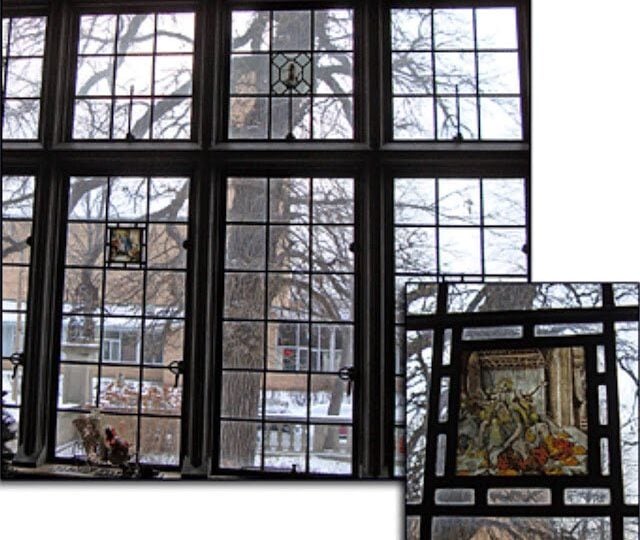
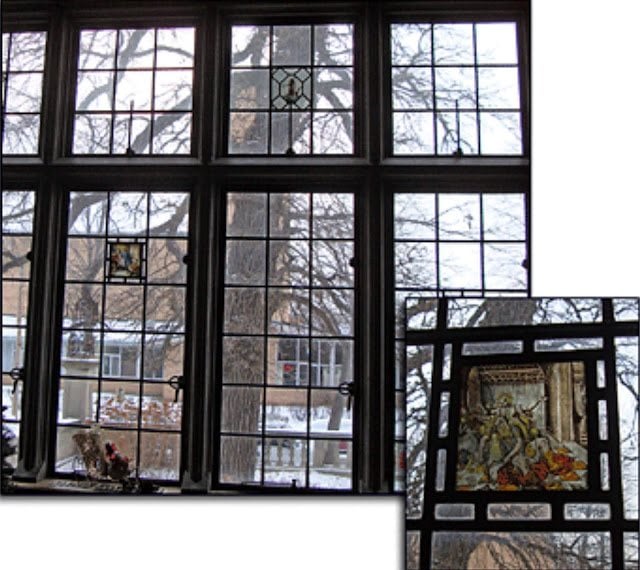
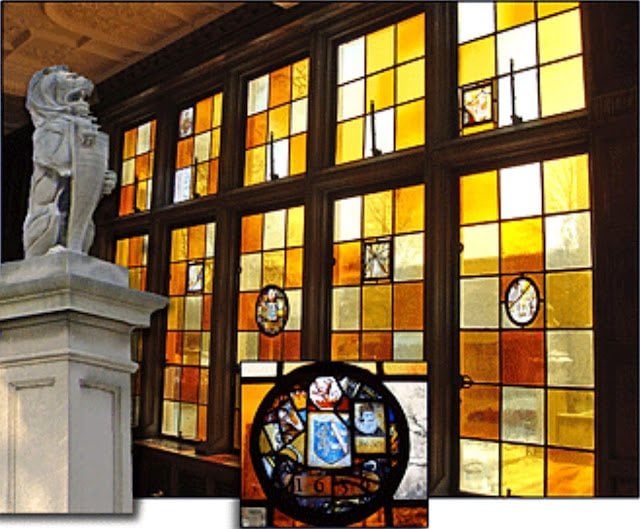
Among the panels of ancient glass set into the windows of the Charles S. Pillsbury Mansion, a few carry a provenance with a name attached to it: Costessey. We have written before about where the mansion’s centuries-old glass came from. This is the story of the collection itself — how it was built, how it broke up, and why fragments of a Norfolk castle ended up on East 22nd Street.
A castle four miles west of Norwich
Costessey Hall stood in Costessey, Norfolk, four miles west of Norwich. Its lineage ran extraordinarily deep: the manor is first mentioned around 1086, when William the Conqueror gave it to Alan Rufus, Earl of Richmond. In 1555 Mary I awarded it to Sir Henry Jerningham as thanks for his support during the contested accession of Lady Jane Grey, and the Jerninghams built a new house on the south side of the River Tud.
The building most people picture, though, is much later. Between 1826 and 1836 the architect John Chessell Buckler raised an enormous Gothic castle for Lord Stafford Jerningham — several times the size of the Tudor hall it engulfed. It is that romantic, battlemented pile that housed one of the great private collections of stained glass in England.
Two generations of collecting
The Costessey collection was not the work of one man. It was assembled by Sir William Jerningham (1736–1809) and continued by his son, George William Stafford-Jerningham, 8th Baron Stafford (1771–1851). Between them they gathered heraldic and continental panels across decades — exactly the period when monasteries, churches and cathedrals across Britain and Europe were shedding medieval glazing through reform, revolution and simple neglect, and when English country-house owners were buying it up by the crate.
That is the same current that eventually carried glass to Minneapolis. Charles Pillsbury was buying at the far end of a market that men like the Jerninghams had helped create a century earlier.
How the collection came apart
The dispersal happened in two stages, which is worth being precise about because the dates are easy to blur together.
First, in 1913, the contents of Costessey Hall were sold and the house was left empty. At the outbreak of the First World War it was commandeered by the War Office. In 1919 the decision was taken to pull it down, and the hall was demolished in 1925. Today, the belfry block beside the 18th fairway of Costessey Park Golf Course is essentially all that remains of Buckler’s castle.
Second, the glass collection itself passed to the Glasgow-born dealer Grosvenor Thomas (1856–1923), one of the most important figures in the early twentieth-century trade in antique glass. It was Thomas who turned the Costessey glass into a documented, saleable collection rather than a heap of salvage.
The catalogue that made it sellable
In 1920, the firm published a handsome volume in Exeter: The Costessey Collection of Stained Glass, formerly in the possession of George William Jerningham, 8th Baron Stafford of Costessey in the County of Norfolk. It was written by Maurice Drake, with an introductory article by the antiquary Aymer Vallance, F.S.A., and printed with twenty-five plates, some in colour. The Stanford University Libraries catalogue record notes plainly that the collection “made by Sir William Jerningham and his son George William, 8th baron Stafford, was subsequently acquired by Mr. Grosvenor Thomas.” The full text is available through HathiTrust.
It is a revealing object. The book is scholarly in tone and deliberately avoids looking like an auction catalogue — yet it exists to sell. Scholarship raised the value of the glass, and it worked: the Costessey panels went out into the world, and a great many of them crossed the Atlantic to American buyers.
Which is how a Norfolk castle reaches Minneapolis
The mansion at 100 East 22nd Street was built between 1912 and 1916, precisely the window in which Costessey was being emptied and its glass catalogued and sold. The English rooms and fittings came to Minneapolis through the London dealer Charles Joel Duveen — “Charles of London” — and his circle, the same trade that moved the Rotherwas Court interiors out of Herefordshire. You can read more about the imported fittings on The Splendors and about the construction itself in Building the Mansion.

There is a quiet irony in it. Costessey Hall is gone — a belfry beside a golf course. Rotherwas Court is gone. The houses that these things were made for did not survive the twentieth century. The glass did, and a portion of it has now stood in a Minneapolis window for well over a hundred years, which in some cases is longer than it spent in the building it was made for.
See it in person
The glass is best understood standing under it, with the light coming through. Guided tours of the mansion run year round — see Experiences & Tours for what is on, and Plan Your Visit for hours and directions.
Keep reading: Who Carved the Stone Lions at the Pillsbury Mansion’s Door?