
Did a King Really Walk the Staircase Inside the Pillsbury Mansion?
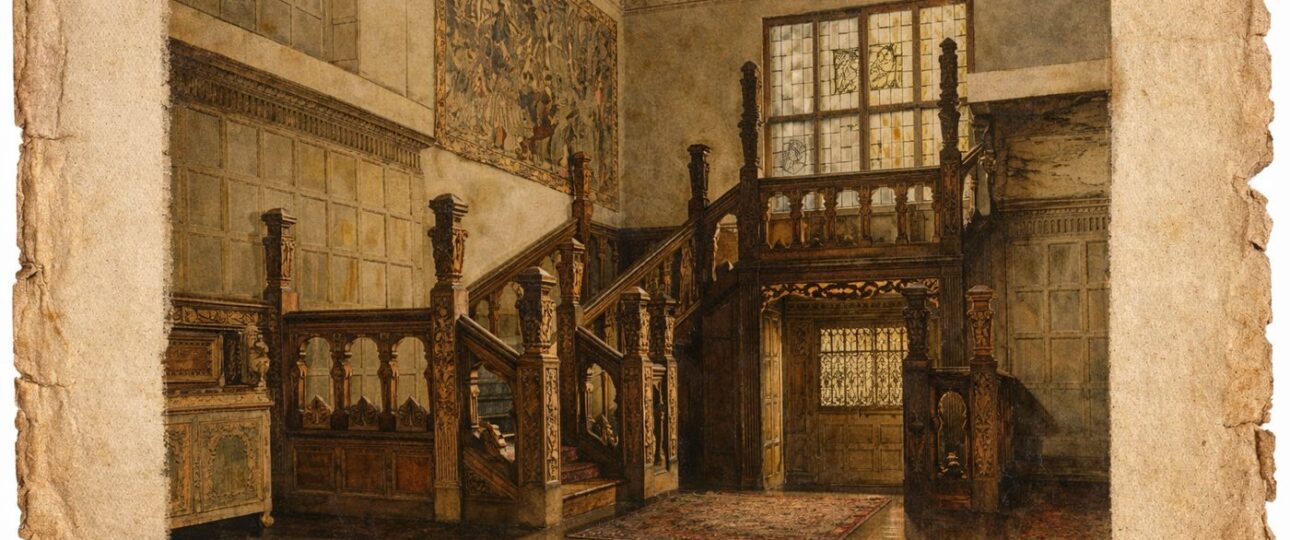
Of all the stories whispered inside the Charles S. Pillsbury Mansion, one is repeated on nearly every tour, usually with a hand resting on five-hundred-year-old oak: a king walked down this staircase. It sounds like the kind of legend every grand old house awards itself. But this one has a paper trail — a 17th-century historian, a Latin quip, and a Herefordshire estate so storied that England mourned in print when its treasures sailed for Minneapolis. Here is what we actually know.
A Staircase Born at Rotherwas Court
The grand staircase at 100 East 22nd Street did not begin its life in Minneapolis. It was carved for Rotherwas Court, the Herefordshire seat of the Bodenham family — a Catholic gentry dynasty whose lands appear in records reaching back to the Domesday Book of 1086. Sir Roger Bodenham (1545–1623) transformed the old timber manor around the turn of the 17th century, adding stone rooms, a domestic chapel, and interiors so lavish they were still being called “the wonder of centuries” three hundred years later.
“Not Everyone Can Come to Rotherwas”
The royal visit is not merely family lore. According to the 17th-century historian Thomas Blount, King James I was so taken with Rotherwas that he turned to his followers and declared, “Non datur cuivis adire Rotherwas” — “Not everyone is permitted to go to Rotherwas.” The king was playing on an ancient Roman proverb about Corinth, the most luxurious and exclusive city of the classical world. It was the Jacobean equivalent of calling the house a members-only club — which, four centuries later, feels rather fitting. Blount’s account is still cited today by Amherst College’s Mead Art Museum, which houses Rotherwas’s famous panelled dining room.
Tradition in this house adds a delicious wrinkle: that the king’s remark was also a sly nod to the King’s Men — Shakespeare’s own company, which performed under James’s royal patent from 1603 — said to be playing at Rotherwas that very night. The performance itself we cannot prove; the troupe’s provincial tours were real, but surviving records are thin. What is certain is that James reigned over England from 1603 to 1625, that Rotherwas was exactly the sort of house a royal progress favored, and that the staircase he would have descended now stands in Minneapolis.
The Scorch Marks on the Newel Posts
Look closely at the staircase today and you’ll find it wears its history openly. In 1907 a great fire swept the Rotherwas estate — the stables burned, and the house itself had a close brush with destruction. The newel posts still carry charred scars attributed to that blaze. When the dealer Charles Duveen — “Charles of London” — reassembled the staircase in Minneapolis, he moved the carved dogs from the upper landing down to the bottom posts. The scorch marks traveled with them. Run a hand along the oak and you are touching both the year 1600 and the night Rotherwas nearly burned.
An Ocean Crossing, and a Second Life in Minneapolis
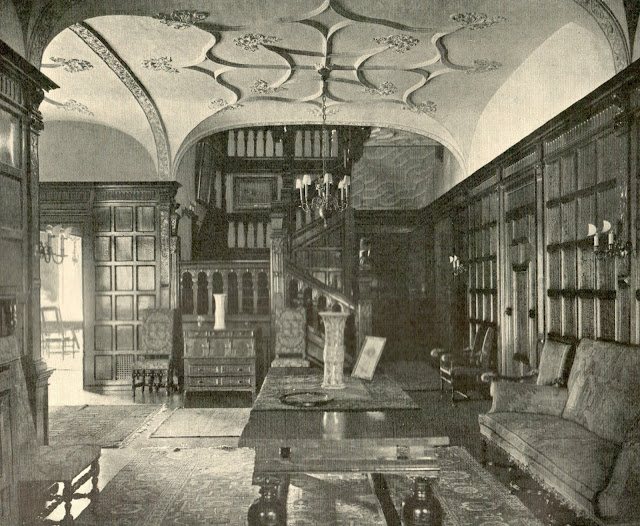
By 1912 the Bodenham fortunes had faded, and the estate went to auction. In 1913 Duveen dismantled Rotherwas’s celebrated interiors — thirteen panelled rooms, ceilings, and the staircase — and shipped them to America, to England’s loudly printed anguish. The dining room went east, to Standard Oil president Herbert Pratt and eventually to Amherst’s Mead Art Museum. The staircase and several of the finest oak rooms came west, into the steel-framed Elizabethan manor Charles S. Pillsbury raised between 1914 and 1916 — the story we tell in full in The Splendors and in our earlier post on where the other Rotherwas rooms went.
Rotherwas House itself was demolished in 1926. Of the great manor a king once praised, only two things remain standing anywhere in the world: Rotherwas Chapel, preserved by English Heritage in Herefordshire — and the rooms and staircase inside this mansion, on a quiet corner of Minneapolis.
Come Stand Where a King Stood
You don’t need a royal patent to visit anymore. The Pillsbury Club opens the mansion for year-round tours — and it’s the home station of Minneapolis Trolley Tours, whose vintage trolley rolls past the city’s other Gilded Age survivors, including the Eugene J. Carpenter Mansion at 300 Clifton, where you can spend the night in one. Book a tour, climb the stair, and find the scorch marks for yourself. Not everyone could come to Rotherwas. Everyone can come here.
Keep reading: Why Is the Minneapolis Institute of Art Across the Street from the Pillsbury Mansion?