

What Happened to Rotherwas Court After Its Rooms Came to Minneapolis?
In the summer of 1913, workmen at Rotherwas Court in Herefordshire pried centuries-old carved oak from the walls, crated up a staircase a king once descended, and sent the heart of one of England’s oldest houses across the Atlantic. Much of it landed here in Minneapolis, inside the rising Charles S. Pillsbury Mansion. We have already told the story of the Bodenhams, the family who held Rotherwas for five centuries — but that tale usually ends with the crates leaving the dock. It shouldn’t. What happened to the great house after its rooms departed is one of the strangest second acts in English history.
An empty shell above the River Wye
By the time the dealer Charles Duveen — trading as “Charles of London” — came calling, Rotherwas was already wounded. A serious fire had damaged the house in 1907, the last heir of the line died soon after, and in December 1912 the whole estate went up for auction, according to Herefordshire’s Past. In 1913 Duveen stripped out roughly thirteen of its paneled Elizabethan and Jacobean rooms. England protested loudly. The rooms sailed anyway — and the house they left behind stood hollow, its windows dark above the River Wye.

Then came the war — and 70,000 shells a week
Two years after the oak left, the guns of the First World War were starving for ammunition, and the flat land along the Wye below the house was chosen for one of Britain’s emergency national filling factories. Construction of the Rotherwas munitions works began in July 1915, and by 1917 the factory was filling some 70,000 shells every week, with a workforce of roughly six thousand — about four thousand of them women, who worked with TNT that stained skin and hair yellow. And the emptied mansion? It was pressed into service as a barracks for the soldiers who guarded the factory. Bedchambers that had hosted a king now slept sentries.
Demolition — and the bombs that came back
The house never recovered a purpose. In 1926, Rotherwas Court — recorded in the Domesday Book, rebuilt in grandeur in the 1730s — was simply demolished. Its site became part of the works. In the Second World War the factory filled bombs again, and this time the war came to it: on 27 July 1942 a lone Luftwaffe raider dropped two bombs on the site, killing workers in a transit shed, and on 30 May 1944 a smoking naval bomb set off a chain of explosions felt more than six miles away — reckoned the biggest munitions-factory blast in wartime Britain. Unexploded ordnance was still being found on the estate decades later. Had the paneling stayed home, it might well have burned after all.
The chapel the wars couldn’t touch
One building survived everything. Rotherwas Chapel, first recorded in 1304 and rebuilt by Sir Roger Bodenham in the 1580s, had been the family’s private Catholic chapel from the time of Sir Roger’s conversion in 1606, and was later embellished inside by the Pugin brothers. Taken into state guardianship in 1928, it stands today in the care of English Heritage — a small, defiant survivor amid a modern industrial estate, still holding its Elizabethan timber roof.
The rooms that got away
So where does Rotherwas truly live on? In America. Its great Jacobean dining room, completed around 1611, was bought in 1913 by Standard Oil’s Herbert Lee Pratt — reportedly for $350,000, more than $11 million today — and now glows inside the Mead Art Museum at Amherst College. And the grandest share of all came here: the carved oak staircase that King James I descended, the paneling, the ceiling, even the front door, all reinstalled at 100 East 22nd Street among the splendors of the Pillsbury Mansion.
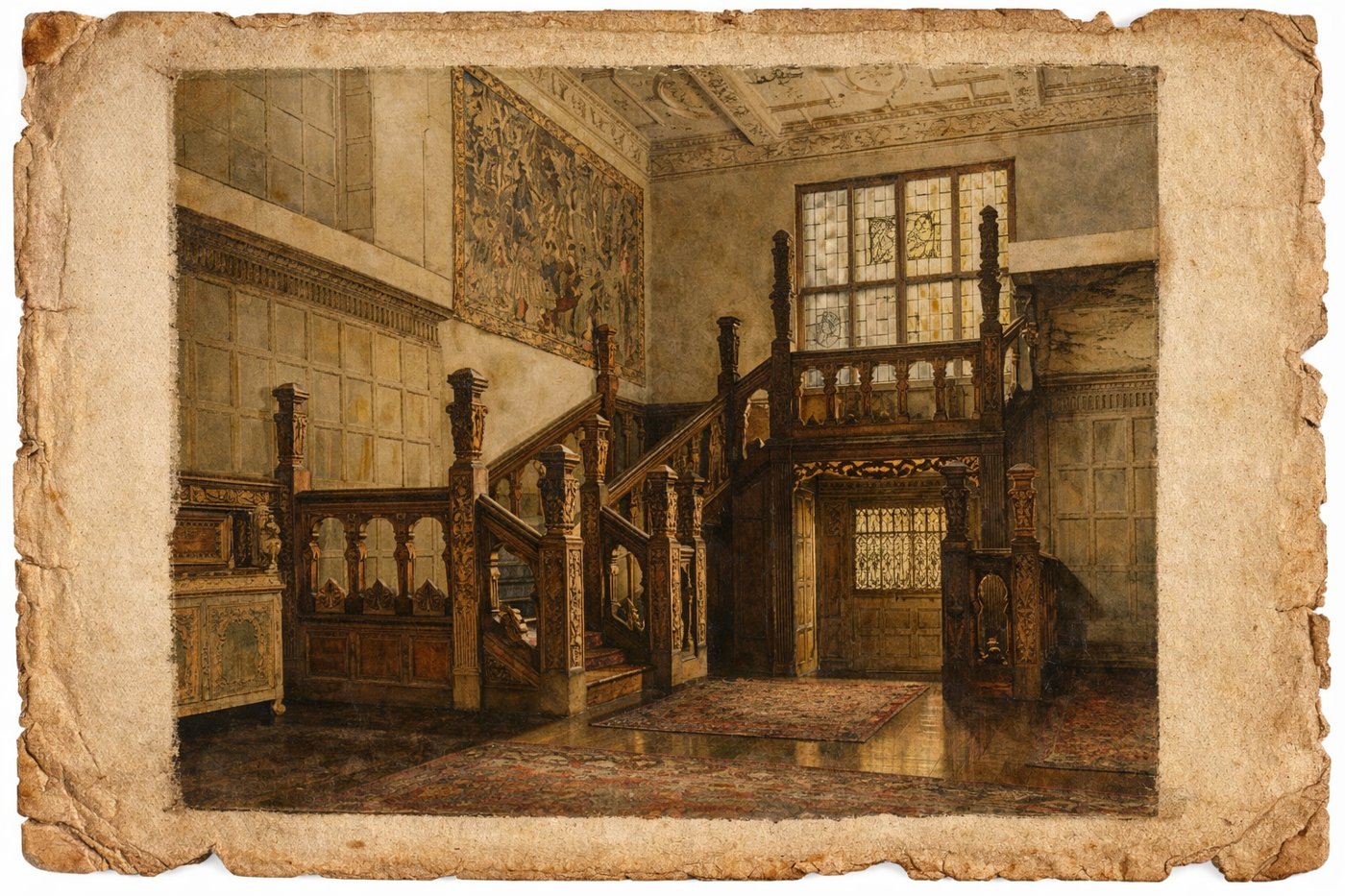
Rotherwas Court is gone; its bones are here. The surest way to stand inside what remains of it is to walk through our front door — which was, of course, its front door. Visit the Pillsbury Club for a tour, or begin with a ride on Minneapolis Trolley Tours, which departs from the mansion itself. Not everyone could come to Rotherwas — but everyone can come here.
Keep reading: Charles Pillsbury had a twin brother — so why does only one of their mansions survive?