
Who Was John S. Pillsbury, the ‘Father of the University of Minnesota’?
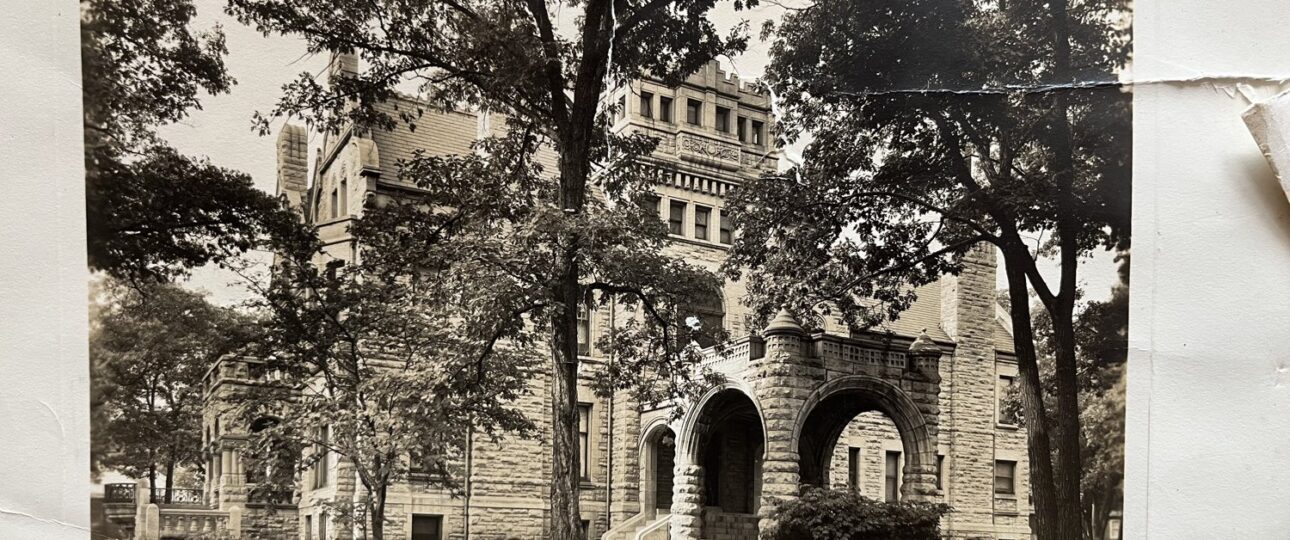
The name on the flour sack. The bronze statue on the University of Minnesota campus. The governor who asked an entire state to pray away a plague of locusts. All the same man — and without him, the mansion at 100 East 22nd Street would never have been built. Before Charles S. Pillsbury filled this house with centuries-old English oak, before there was a Doughboy, there was an uncle with a hardware store and an uncommon willingness to bet on family.
A hardware man at the Falls of St. Anthony
John Sargent Pillsbury was born in Sutton, New Hampshire, in 1827, and arrived at the village of St. Anthony — the east-bank settlement that would fold into Minneapolis — in 1855. He opened a hardware store within earshot of the falls, weathered fire and financial panic, and earned a reputation for paying his debts when other men walked away from theirs. That reputation carried him into the state senate, and eventually much further. His story is told alongside the rest of the Pillsbury family, but he deserves this chapter of his own.
The $10,000 bet on a nephew
In June 1869, John’s nephew Charles Alfred Pillsbury bought a one-third share of a struggling flour mill at the falls for $10,000 — staked by his father George and his uncle John. The young man knew, by his own admission, almost nothing about milling. It scarcely mattered. Within a year the little mill turned a $6,000 profit, and by 1872 the firm reorganized as C.A. Pillsbury & Co., with Governor-to-be John S. Pillsbury as a founding partner, according to the Minnesota Historical Society’s MNopedia. A decade later the family’s Pillsbury “A” Mill was the largest flour mill on earth. The full sweep of that story is on The Company page — and in our post on how the flour empire built this mansion.

The governor who prayed away the locusts
In 1876, John S. Pillsbury became the eighth governor of Minnesota — the first to serve three terms, holding office until 1882, per the Minnesota Legislative Reference Library. He inherited a state under siege. For four summers, clouds of Rocky Mountain locusts had descended on Minnesota’s farms and eaten them bare — a disaster chronicled in the grasshopper plagues of 1873–1877. Pillsbury toured the ravaged counties himself, and is said to have quietly given relief money from his own pocket.
Then he did something stranger. On April 26, 1877, the governor proclaimed a statewide day of prayer and fasting for deliverance from the locusts. Days later, an unseasonable cold snap — snow, in late April — froze millions of newly hatched larvae in the fields. The plague collapsed that summer and never returned. Coincidence, meteorology, or answered prayer: Minnesotans have argued about it ever since. The governor simply collected the credit.
The Father of the University
His grandest title had nothing to do with flour or locusts. As a regent from 1863 until his death, Pillsbury rescued the debt-ridden, shuttered University of Minnesota in its darkest hour and shepherded it for nearly four decades — earning the name “Father of the University,” as his biography records. In 1887 he personally donated a science building costing roughly $150,000; Pillsbury Hall still stands on campus today. In 1900, a year before his death, alumni unveiled a bronze statue of him by Daniel Chester French — the sculptor who would later carve the seated Lincoln of the Lincoln Memorial. It remains the oldest piece of public art on campus, and his papers are preserved in the university archives.
What the uncle has to do with this mansion
John S. Pillsbury died in October 1901, fifteen years before his grand-nephew Charles Stinson Pillsbury raised this Elizabethan manor on East 22nd Street. He never walked beneath its Rotherwas oak or its ancient stained glass. And yet every carved panel in the house traces, dollar by dollar, back to the hardware man who staked his nephew in 1869 and asked a state to pray in 1877. Dynasties need builders — but first they need believers.
Come stand in the house the believer made possible. Tours of the Pillsbury Mansion run year-round with Minneapolis Trolley Tours — and if you’d like to sleep inside a Gilded Age mansion of your own, our sister property 300 Clifton is waiting a few blocks away.
Keep reading: the flour empire John’s family built was forged in catastrophe — the Great Mill Disaster of 1878, the explosion that reshaped Minneapolis and the Pillsbury fortune.