
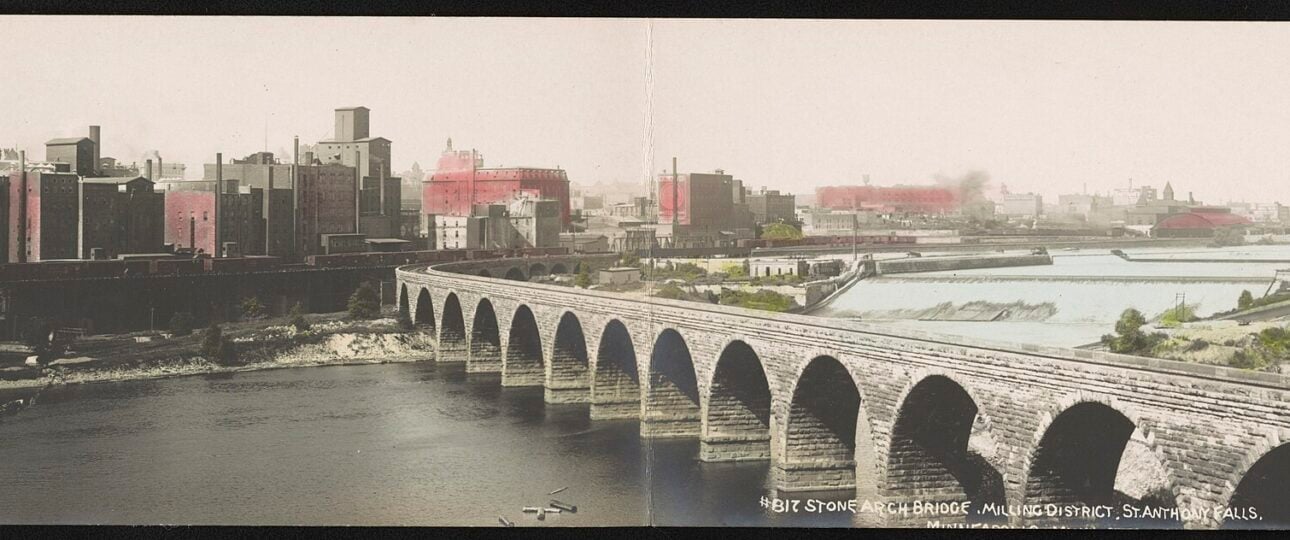
What Is the Stone Arch Bridge? The 1883 Railroad Bridge in the Flour District That Built the Pillsbury Fortune
Stand on the Stone Arch Bridge on a winter afternoon and the whole story of Minneapolis flour is laid out around you: the roar of St. Anthony Falls, the old mill buildings on both banks, and the Pillsbury A-Mill on the east side of the river. The bridge was finished in 1883, in the decades when this stretch of the Mississippi was the heart of Minneapolis flour milling — the industry that made the fortune that later built the Pillsbury Mansion on East 22nd Street.
It is the only arched bridge made of stone on the entire Mississippi River, according to its Wikipedia history. Here is how it came to be, and why it belongs in any tour of the Pillsbury story.
A Railroad Bridge Built by James J. Hill
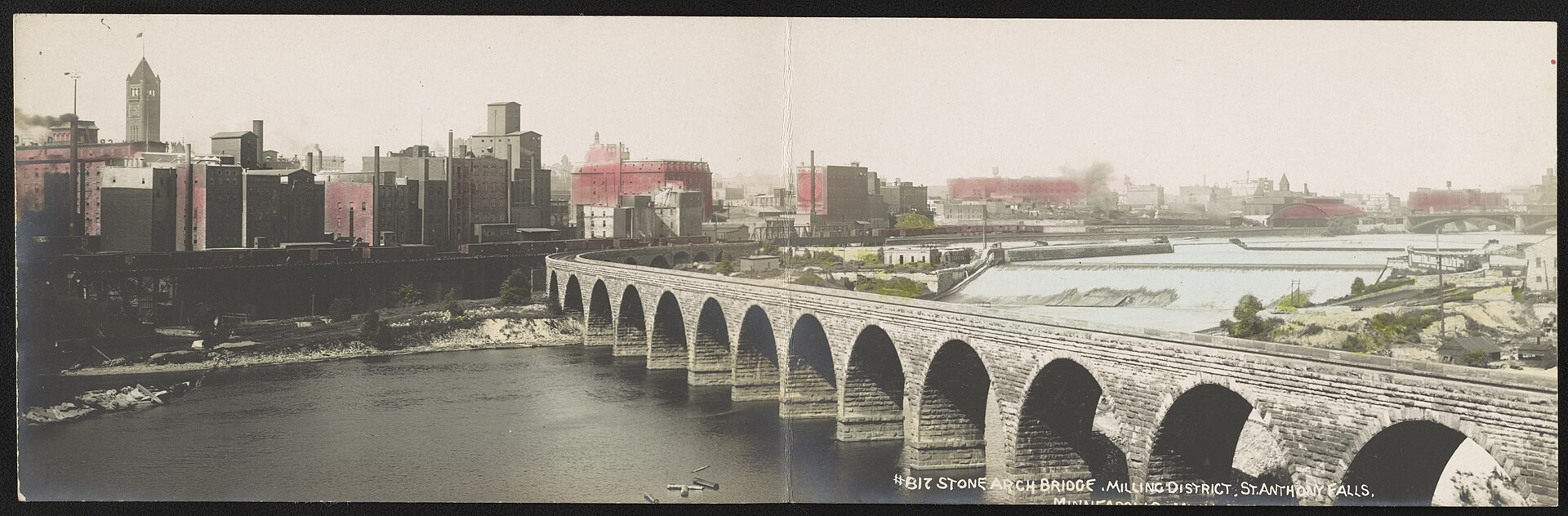
The bridge was the work of the railroad magnate James J. Hill. According to the Minnesota Department of Transportation’s historic bridge record, it was built between 1881 and 1883 to carry the Minneapolis Union Railroad across the Mississippi just below St. Anthony Falls. The aim was to bring Hill’s trains into a new Union Depot in downtown Minneapolis, on the west bank, where most of the city’s commerce sat.
Skeptics nicknamed it “Hill’s Folly.” The project cost $650,000 and took about 22 months of work, with Col. Charles C. Smith as head engineer. The doubters were wrong: for nearly a century the bridge carried passenger trains to and from the city’s depots, including the Great Northern’s famous Empire Builder.
Why Is the Stone Arch Bridge Curved?
The bridge does not run straight across the river. MnDOT’s record describes an 817-foot, six-degree curve on the west end, and a total length of 2,100 feet. As built it had 23 limestone arches, with spans from about 40 to nearly 98 feet. Look closely and you can still see original details the state lists among its key features: the stone parapet walls, black granite marker stones, a stone plaque, and metal tie rods threaded through the walls to keep the masonry from spreading.
It was built the way the Pillsbury Mansion would later be built — to last. Masonry on this scale was a statement of permanence in a young city that had grown up almost overnight around its waterfall.
What Does the Bridge Have to Do With the Pillsbury Mansion?
Everything around the bridge was flour. The falls powered the mills, and the mills powered Minneapolis. Charles Alfred Pillsbury founded the Pillsbury company in 1869, and the family firm completed the Pillsbury A-Mill on the east bank in 1881 — the same year Hill commissioned his bridge. From the deck today you look straight across at it.
The wheat that fed those mills was bought and sold at the Minneapolis Grain Exchange, and the flour went out on the railroads that made this riverbank a crossroads. A generation later, Charles Stinson Pillsbury took that milling wealth south of downtown and spent it on a house filled with genuine English oak, Tudor plaster ceilings and centuries-old fireplaces. You can read the family’s whole arc in our history of the Pillsbury family and company.
From Trains to Footsteps
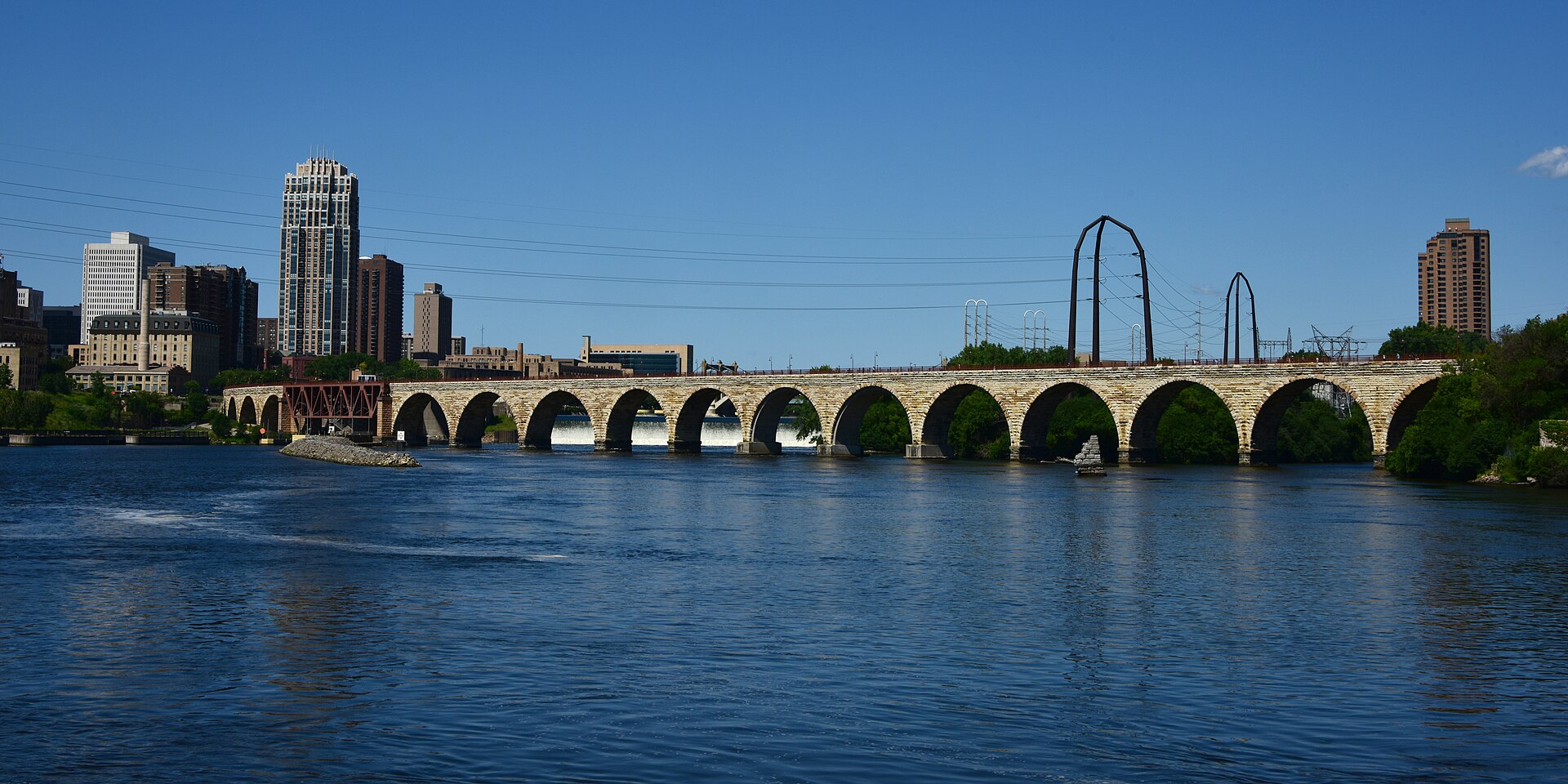
The bridge has changed with the river. When the Upper Lock and Dam was built at St. Anthony Falls, two arches were replaced with a steel truss so barges could pass — MnDOT dates that change to 1962, while Wikipedia’s timeline gives the lock-and-dam work as 1961–1963. In 1965, flood waters undermined the piers and the bridge sagged about fourteen inches before it was repaired.
The sources also differ on when the trains stopped. Wikipedia’s timeline says the last passenger train crossed in 1978; MnDOT says railroad use ended in 1982. Either way, after a period of disuse the bridge was repaired and reopened in the early 1990s for walkers and cyclists. It joined the National Register of Historic Places in 1971 as part of the St. Anthony Falls Historic District, and it is a designated National Historic Civil Engineering Landmark.
See the Bridge, Then Come See the House
The best way to understand the Pillsbury fortune is to see both ends of it. Walk the Stone Arch Bridge, step into the ruins of the Washburn A Mill at the Mill City Museum, and then come see what that flour money built: carved English oak, the Rotherwas staircase and the treasures gathered by Charles of London.
Ready to step inside? Explore our mansion tours and experiences, and check hours on Plan Your Visit before you come. For more on the business behind the house, start with the Pillsbury Company.
Photos: F. L. Wright (public domain) and August Schwerdfeger (CC BY 4.0), via Wikimedia Commons.
Keep reading: What Is the Hennepin History Museum? The Flour Family Mansion a Few Blocks From the Pillsbury House