
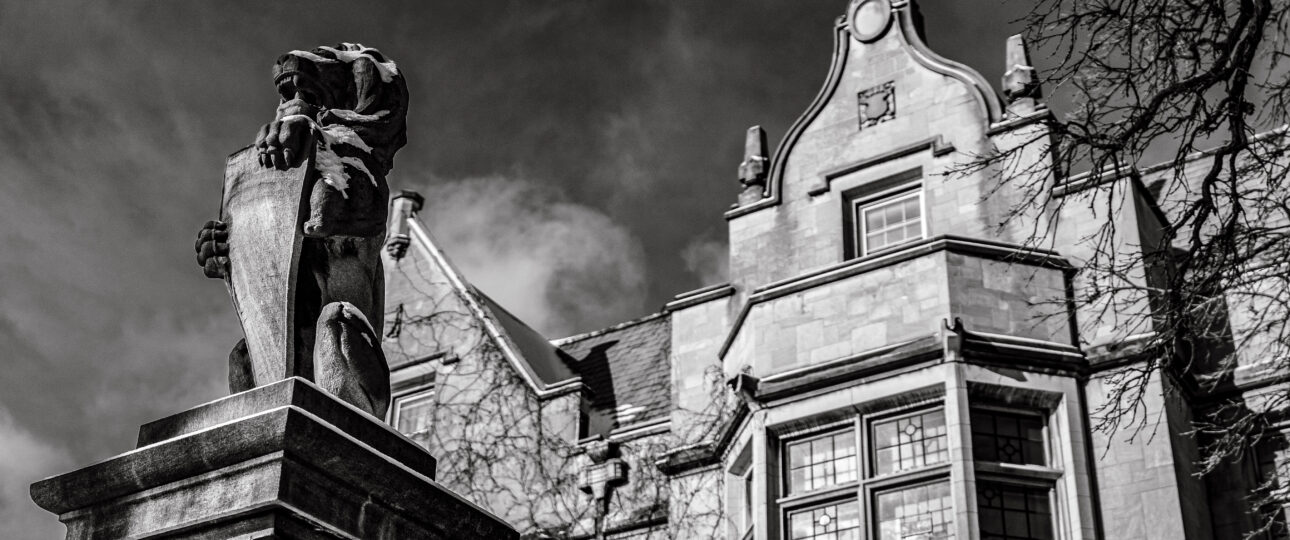
Where Else in Minneapolis Will You Find the Pillsbury Name?
Say the word Pillsbury in Minneapolis and most people picture a doughboy. Say it while standing on the corner of East 22nd Street and Stevens Avenue, and you are standing in front of something else entirely — a house full of genuine Elizabethan rooms that crossed the Atlantic in crates and were reassembled here in 1916.
But the mansion is only one place the name landed. Drive a few miles in almost any direction and you will find Pillsbury carved into rough Minnesota stone, cast in bronze by the man who sculpted Abraham Lincoln, lit over a theatre door in south Minneapolis, and stamped on what was once the largest flour mill on earth. Here is where to read it.
The house at 100 East 22nd Street
Start where we are. Charles Stinson Pillsbury completed his manor house in 1916, and it is not a copy of an English house — it contains English houses. Oak panelling and a staircase traceable to Rotherwas Court in Herefordshire, a fireplace from the Tallow Chandlers’ hall that survived the Great Fire of London in 1666, ancient cathedral glass — all bought through the London dealer Charles Joel Duveen and shipped west. The whole improbable procurement story is told on Charles of London and Building the Mansion.
It joined the National Register of Historic Places in 1974, and the City of Minneapolis lists it among its designated local landmarks. That mattered more than anyone expected: of the entire avenue of palaces that once lined Washburn–Fair Oaks Park, this one is the last one standing.
A hall of rough stone on the old campus
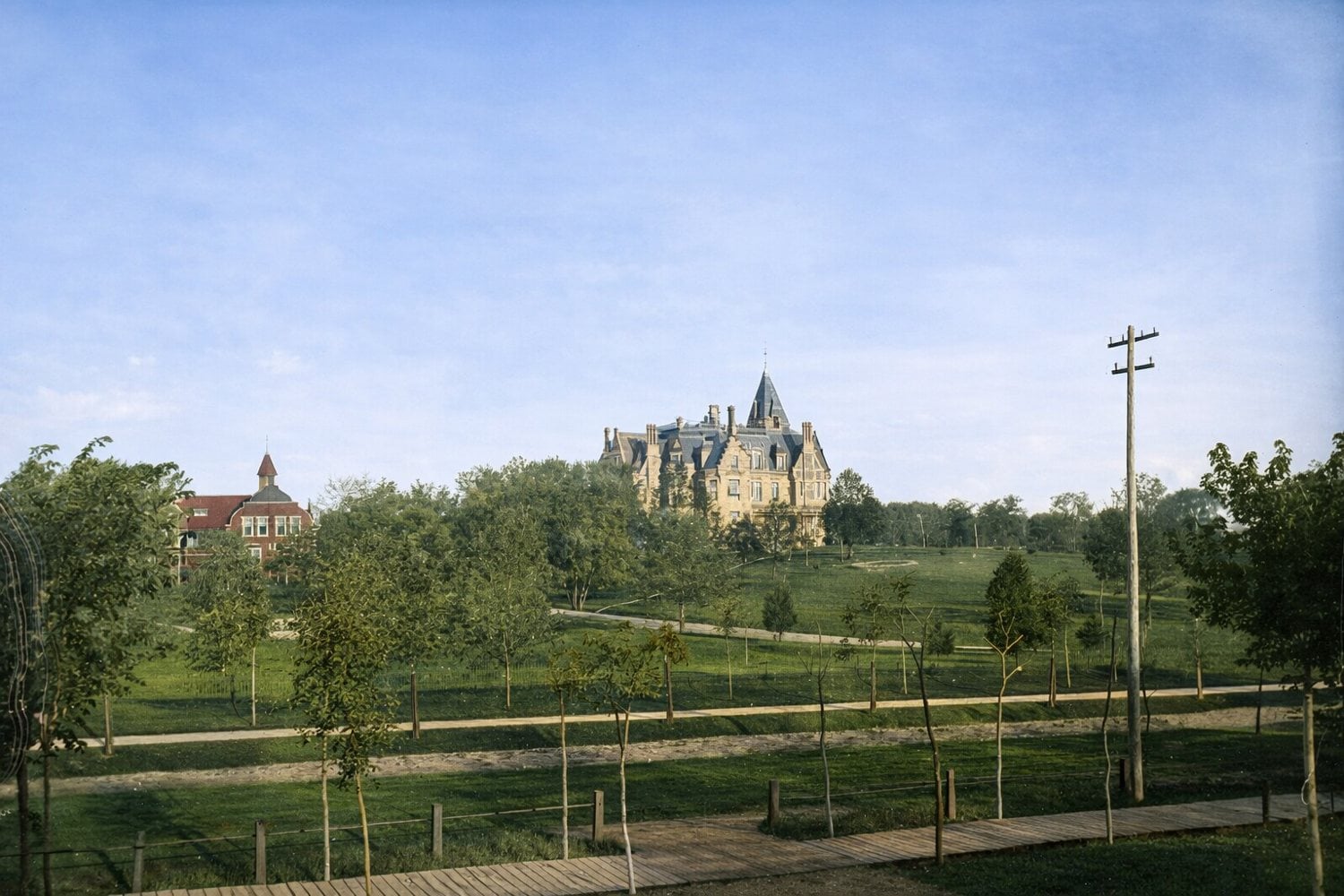
Cross the river to the University of Minnesota and look for a building that seems to have been quarried rather than built. Pillsbury Hall opened in 1889, designed by Leroy Buffington and Harvey Ellis in the Richardsonian Romanesque style. The Minnesota Historical Society describes it beautifully: it resembles a large, multifaceted specimen of rock hauled out of the earth. Locally quarried Minnesota stone, much of it left deliberately rough-hewn — and then, up close, the same hard material breaks into delicate carvings, gargoyles and coloured patterning.
The hall is named for John Sargent Pillsbury: governor, regent for life, and the man Minnesota still calls the Father of the University. It opened as a science building, spent decades housing geology and mineralogy, and was listed on the National Register in 1984 as part of the Old Campus Historic District. After a long closure it reopened in 2021 as the home of the Department of English and the Creative Writing Program, a renovation documented in detail by the College of Liberal Arts. A building put up for rocks now belongs to poets.
And a statue by the man who carved Lincoln
Nearby, across Pillsbury Drive from Burton Hall, sits a seated bronze of John S. Pillsbury — the oldest piece of public art on the campus. It was unveiled on 12 September 1900, paid for by alumni and friends of the university, and the sculptor was Daniel Chester French. Twenty-two years later, French would finish a rather larger seated figure: the Abraham Lincoln inside the Lincoln Memorial in Washington. Minneapolis got there first.
A mill that fed a continent
Downstream on the east bank of the Mississippi stands the Pillsbury A-Mill, the industrial engine underneath every carved panel in the mansion. For forty years it was the largest flour mill in the world, and the fortune it ground out is what allowed Charles to go shopping in England. The building survives today as artists’ housing — a mill turned into studios, a few miles from a science hall turned over to novelists.

A Pillsbury house of an entirely different kind
There is a second Pillsbury house in Minneapolis, and it was never a private one. It began in 1879 as a mission started by women of Plymouth Congregational Church, working with the children of immigrant and working families. Swept up in the settlement house movement, it grew — and in 1905 the Pillsbury family funded a permanent building for it on Sixteenth Avenue South. By the 1930s, more than a hundred and sixty groups a week were meeting inside.
The original building came down in 1968, lost to the same wave of freeway and urban-renewal clearance that erased so much of the old city. The institution did not. Pillsbury House + Theatre operates today at 35th and Chicago, part of Pillsbury United Communities — the family’s name on a wholly different kind of legacy, and in its way the busiest one.
Reading the name across the map
Once you start looking, the name will not leave you alone. Pillsbury Avenue runs for miles through south Minneapolis; Pillsbury Drive threads the old university campus. A flour dynasty, written into streets, stone and bronze.
The difference is that most of those places you can only look at. This one you can walk into. Trace the family through The Pillsbury Family and The Pillsbury Company, then read about a neighbouring survivor in our piece on the castle on Park Avenue.
Come see the one that survived
The Pillsbury Club offers year-round mansion tours of the house at 100 East 22nd Street — the oak, the imported fireplaces, the ancient glass, and the gaps where the seminary quietly removed the rest. It is also the departure point for Minneapolis Trolley Tours, the easiest way to see the rest of this map in an afternoon. Staying the night? Our sister mansion, 300 Clifton, is a short walk away in Loring Park.
Plan your visit — and come read the name where it was carved first.
Keep reading: Who was Charles A. Pillsbury, the miller who made the fortune behind the mansion?