
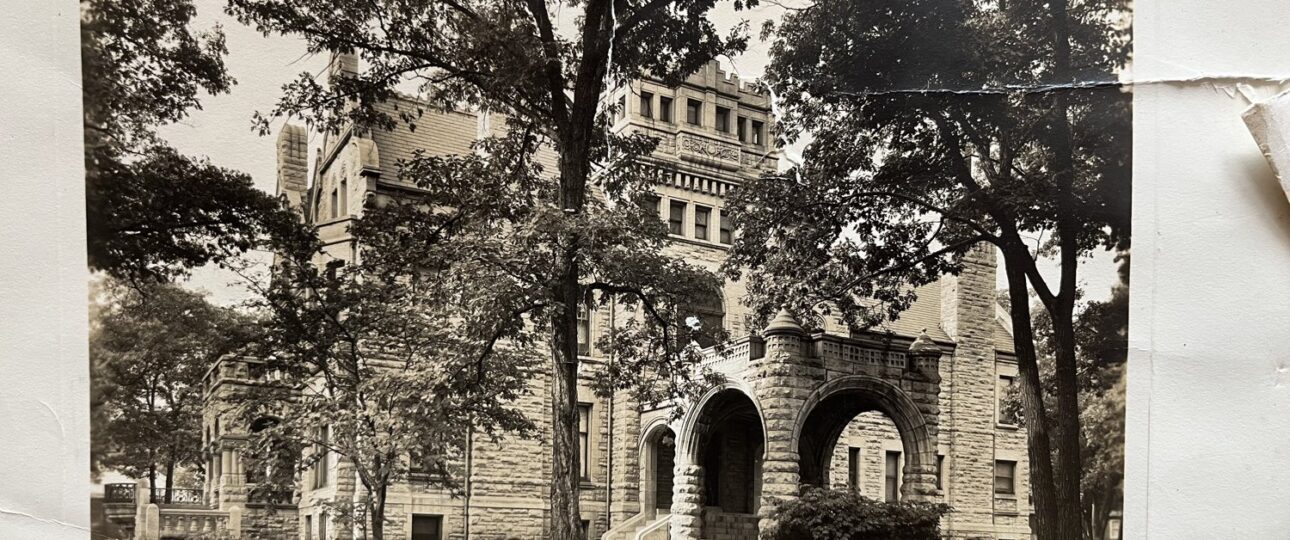
What Was Minneapolis Like in 1916, the Year the Pillsbury Mansion Was Finished?
In the closing weeks of 1916, workmen at 100 East 22nd Street fitted the last panels of centuries-old English oak into place, and the Charles S. Pillsbury Mansion was finished. But step out the front door of that brand-new Elizabethan manor and you entered a city at the absolute height of its powers. To understand why this house exists at all, you have to understand the Minneapolis of 1916 — a city that, for one remarkable year, out-milled the entire world.
The year the Mill City out-milled the world
1916 was the summit. That year, the mills crowded around St. Anthony Falls ground out 18.5 million barrels of flour — more than a fifth of the entire nation’s output, and more than any city on earth had ever produced, according to the Minnesota Historical Society. Three firms controlled some ninety percent of that thundering capacity: Washburn-Crosby, Northwestern Consolidated, and, of course, Pillsbury, whose six mills could turn out roughly 29,300 barrels a day. The mightiest of them, the Pillsbury A Mill, was the largest flour mill in the world.

There was a dark reason for the boom. Across the Atlantic, the First World War was grinding through its third year, and Europe was desperately hungry. American wheat and flour poured east to feed it — the peak of Minneapolis milling coincided almost exactly with the war. The United States itself would not enter the fighting until April 1917. In 1916, Minneapolis was still a neutral city growing rich on a world at war, and the fortune that built this mansion was, quite literally, milled from it.
A city moving at streetcar speed
The Minneapolis of 1916 moved on steel rails. The Twin City Rapid Transit Company ran one of the finest streetcar systems in America — by 1917 the Twin Cities were laced with nearly 450 miles of track — and its yellow cars rattled past the mansion’s front lawn on their way down the avenues. The city’s population, just over 300,000 at the 1910 census, was climbing fast toward the 380,000 it would reach by 1920. (The streetcars are gone, but the spirit survives: the Minneapolis Trolley Tours vintage trolley still departs from the Pillsbury Mansion today.)
And the neighborhood itself was in full flower. Directly across Washburn–Fair Oaks Park, the brand-new Minneapolis Institute of Art had opened its doors in January 1915. The park was ringed with the palaces of the city’s milling and banking dynasties — the doomed avenue of mansions we chronicled in The Last Mansion Standing. In 1916, every one of them still stood, their lamps lit, their carriage houses busy. No one imagined that within sixty years nearly all of them would be rubble — and that the newest house on the park would become the great survivor.
Meanwhile, on East 22nd Street
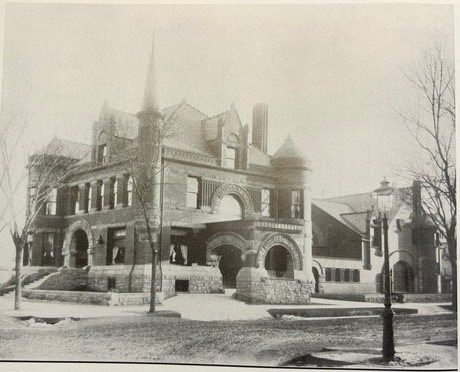
Into this roaring city, Charles S. Pillsbury set a house unlike anything the Midwest had seen. Behind its Tudor face stood a thoroughly modern steel skeleton — the same technology raising the era’s skyscrapers — and within it, genuine centuries-old English rooms: carved oak from Rotherwas Court, a fireplace that survived the Great Fire of London, ancient cathedral glass. It was 1916 Minneapolis in a single building — brand-new money, world-spanning ambition, and a hunger for history the young city didn’t yet have.
It wasn’t the only such statement in town. A few blocks northwest, near Loring Park, the lumber-fortune Carpenter family kept their own showpiece — today the 300 Clifton bed & breakfast, where you can still spend the night in Gilded Age Minneapolis. The city’s history, it turns out, is unusually good at surviving in comfort. For an overview of how the whole story began, Meet Minneapolis keeps a fine short history of the Mill City.
Walk into 1916
The flour dust has settled and the streetcars are museum pieces, but the mansion 1916 built still stands — oak, stone, glass, and all. Come see the year the Mill City ruled the world: book a tour of the Pillsbury Club, or climb aboard the Minneapolis Trolley right at our front door.