
Why Was Duveen Brothers Still Writing to the Pillsbury Next Door in 1947? A Carbon Copy From the Family Files
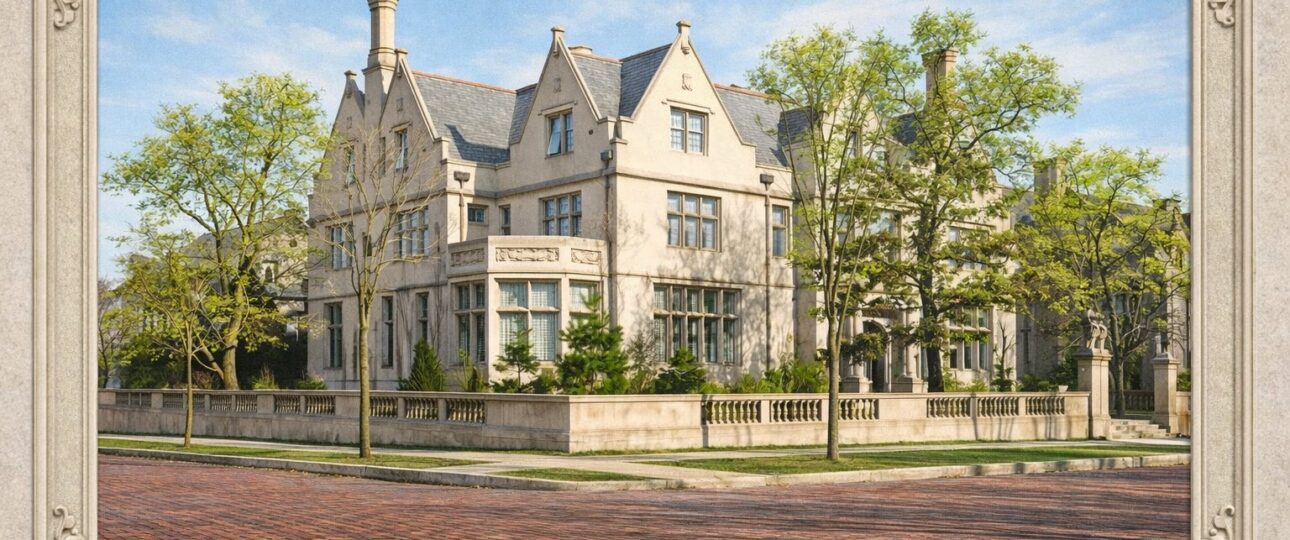
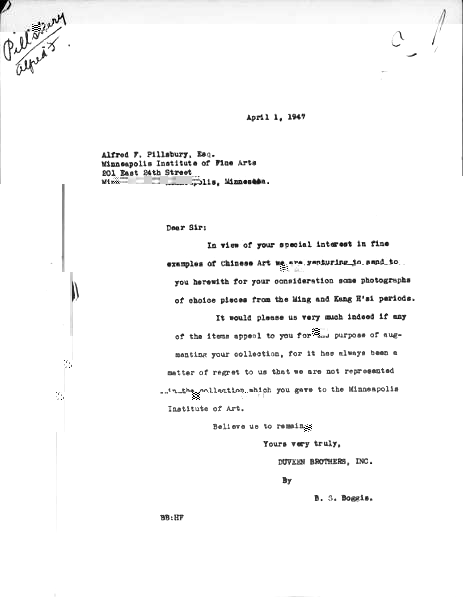
Among the family papers gathered for this house is a single typed sheet, dated April 1, 1947, on the letterhead of Duveen Brothers, Inc. of New York. It is not addressed to anyone who lived at 100 East 22nd Street. It is addressed to Alfred F. Pillsbury, Esq., care of the Minneapolis Institute of Fine Arts on East 24th Street — the cousin next door at 116, and the man whose Chinese jades and bronzes now fill galleries across the park. The letter is short, polite and a little wistful, and it tells a story the grand histories of the Duveen dynasty do not: eight years after Lord Duveen’s death, the most famous art dealers in the world were still writing to Minneapolis, and still hoping to get a single object past the front door of a Pillsbury.
What the letter says
The writer opens by acknowledging Alfred’s “special interest” in Chinese art and says the firm is enclosing photographs of choice pieces from the Ming and K’ang Hsi periods — that is, the Ming dynasty and the reign of the Qing emperor Kangxi — for his consideration. Then comes the line that gives the sheet its interest. The firm would be very pleased, it says, if any of the pieces appealed to him for the purpose of adding to his collection, because it had always been “a matter of regret to us” that Duveen Brothers was not represented in the collection Alfred had given to the Minneapolis Institute of Art. The letter is signed for the firm by B. S. Boggis, with a secretary’s initials beneath, and a hand at the top has pencilled “Pillsbury, Alfred F.” — the filing note of whoever kept the carbon.
Who was writing: a firm after its emperor
The name at the bottom is worth a pause. The Duveen Brothers business records — nearly four hundred linear feet of ledgers, cables and carbons now held by the Getty Research Institute — list Bertram Boggis among the firm’s inner circle, alongside Henry, Edward and Joseph Duveen, Edward Fowles and Armand Lowengard. By 1947 the emperor was gone. Joseph, Lord Duveen, who had sold Old Masters to Frick, Mellon and Kress, died in 1939; his nephew Lowengard and Fowles took the firm jointly, Lowengard died in 1943, and Fowles ran what was left until he sold it to Norton Simon in 1964. The Getty’s own account of those years is blunt: the Paris house was evacuated in the war, the London office closed soon after, and although notable clients came afterward, the business never recovered its old vigor. A letter offering photographs of Chinese porcelain to a Midwestern collector, and admitting the firm had never managed to place a piece with him, is exactly what a proud house in decline looks like on paper.
There is a family irony in the offer, too. Chinese porcelain was where the Duveens had begun — the first Joseph Joel Duveen and his brother Henry sold delftware and then Chinese porcelain from Hull in the firm’s earliest years, before it graduated to tapestries, furniture and finally the paintings that made it legendary. In 1947 the New York house was, in a sense, circling back to the shop it had started in.
Who was receiving: the other collector on East 22nd Street
Alfred F. Pillsbury and Charles Stinson Pillsbury were cousins, not brothers — each a son of one of the company’s co-founders, Alfred of Governor John S. Pillsbury and Charles of Charles A. — and they built their houses side by side on East 22nd Street. (The Minneapolis Institute of Art’s own page on the collection prints Alfred’s father as “John F.”; the governor was John Sargent Pillsbury.) While Charles filled 100 East 22nd with the oak and glass of old England, Alfred, as we have told before, looked east: archaic jade after the First World War, then Chinese and Persian pottery, tomb figurines, and at last the great ritual bronzes of the Shang and Zhou. He was not merely a donor to the museum across the park but one of its officers, which is why Duveen’s letter went to him at the Institute’s address rather than at home.
The letter’s phrase “the collection which you gave” is a useful date-stamp. By the spring of 1947 Alfred’s gifts to the museum were already substantial and public; the Institute published a summary of his donations the following year, 1948, which — according to Mia’s account — described the bronzes as the summit of Chinese art and his pursuit of them as the natural final step of his collecting life. His will completed the gift in 1950: 150 ancient Chinese bronzes and, in all, roughly a million dollars’ worth of Asian art, at the time the most valuable collection ever given to the museum. Whether any Ming or Kangxi piece from Duveen’s photographs ever joined it, the letter cannot say. What it records is the firm’s own admission that, as of April 1947, none had.
The Duveen who did get through the door — next door
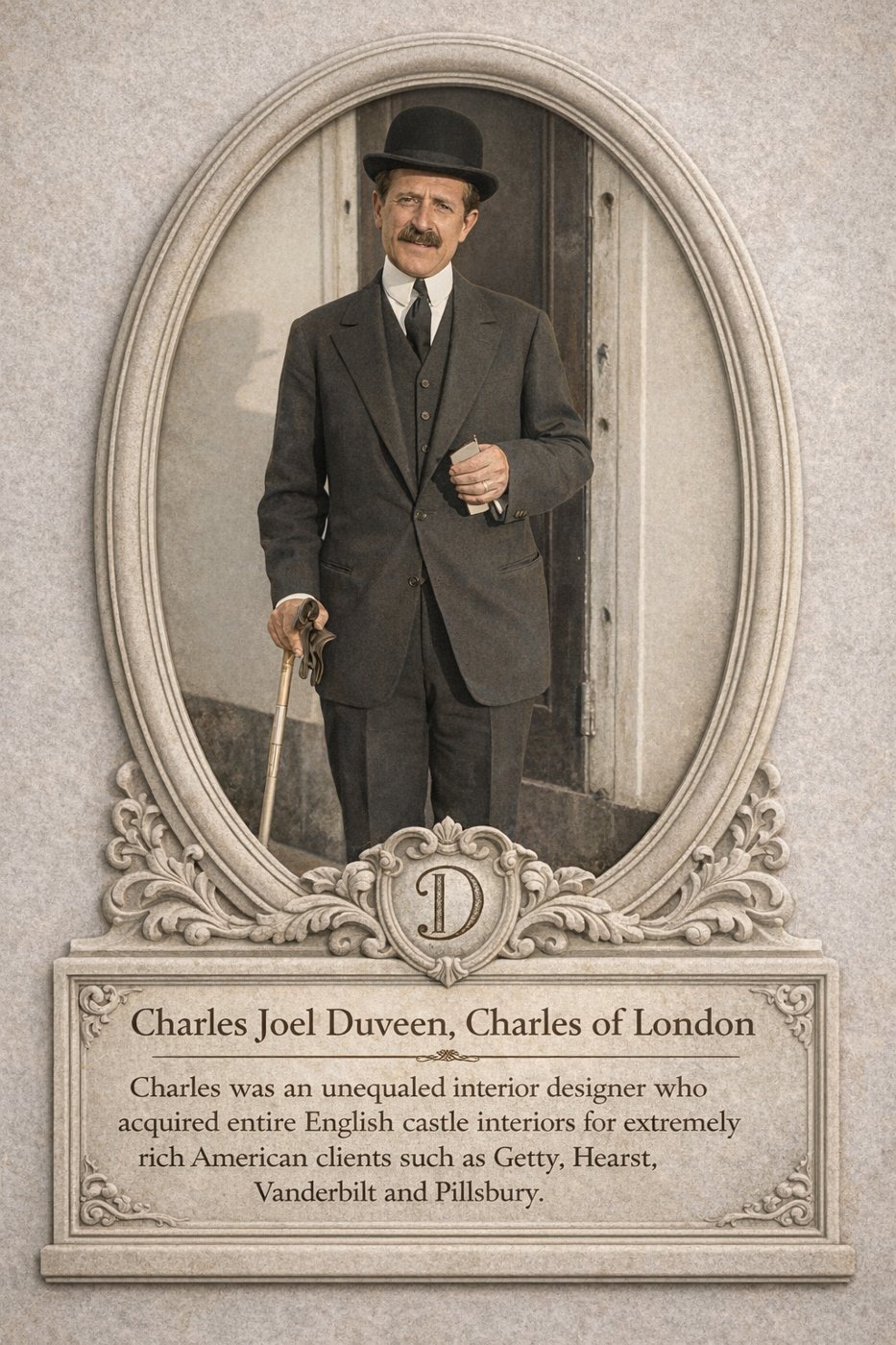
Here is the twist that makes the sheet feel at home in this house. The Duveen who succeeded on East 22nd Street was not the firm at all. It was the brother who walked out of it. Charles Joel Duveen left Duveen Brothers in 1908 to trade on his own as “Charles of London,” and it was Charles — not Lord Duveen, not Fowles, not Boggis — who sold Charles S. Pillsbury the Rotherwas oak, the plaster ceilings, the fireplaces and the ancient glass that make 100 East 22nd Street what it is. He closed his London branch in 1933, retired in failing health in 1938 and died in 1940, a year after his more famous brother. So by 1947 both Duveens who might have claimed a Pillsbury were dead, and the surviving firm was reduced to mailing photographs to the one Pillsbury whose museum collection held nothing of theirs. The company that “sold Europe to America” had, on this block, been beaten by its own black sheep — and then, in the Chinese galleries across the park, shut out altogether.
See both sides of the block
The oak Charles of London sold is still on the walls here, and you can stand in it: our guided mansion tours walk the Rotherwas rooms, the Tallow Chandlers chimneypiece and the glass, and our Splendors page tells each piece’s story. Then cross the park. Alfred’s bronzes are a short walk away at the Minneapolis Institute of Art, and the most beloved of them — the 3,200-year-old owl-shaped wine vessel known as the Pillsbury Owl, knocked from its plinth by a visitor in 2023 and painstakingly restored by a Japanese conservator — was scheduled to return to the galleries in April 2026. A dealer in New York once regretted never getting a piece into that collection. You can see, in an afternoon, exactly what he was up against. Plan your visit, and start on the side of the street where the Duveen who got in still hangs on the walls.