

Who Lectured on Babylonia Inside the Pillsbury Mansion in 1914?
On a Friday evening in the autumn of 1914, a professor from Yale stood up in a Minneapolis drawing room and talked to an invited audience about cuneiform tablets, ruined temples and the excavation of ancient Mesopotamia. The room was at 100 East Twenty-second Street. The house was the Charles S. Pillsbury Mansion.
We know because The Minneapolis Journal printed it the next morning, Saturday, October 3, 1914, on page eight, under the headline “Lecture at Pillsbury Home.”
What the notice actually says
It is a short item, and almost every line in it opens a door. One of a series of four lectures in the 1914–1915 season of the Minneapolis society of the Archaeological Institute of America, the paper reported, was given at the residence of Mr. and Mrs. Charles Pillsbury the previous night. Professor Albert T. Clay of Yale University discussed recent archaeological discoveries in Babylonia and Assyria.
Three more details follow, and each is worth pulling on.
- In the absence of Mrs. Pillsbury, Mrs. George H. Christian acted as hostess — a name from another of Minneapolis’ milling families.
- Two speakers were announced for the coming winter: Garrett Chatfield Pier of the Chicago society on the sculpture of China and Japan, and Professor John Garrett Winter of the University of Michigan on recent views of ancient Homeric sites.
- Dr. G. E. Vincent was elected president of the society, filling the place of the late John S. Bradstreet.
The man at the front of the room
Albert Tobias Clay (1866–1925) was not a local curiosity. He was the William M. Laffan Professor of Assyriology and Babylonian Literature at Yale and the founding curator of the Yale Babylonian Collection, funded by J. Pierpont Morgan in 1909. He published an Old Babylonian version of the Gilgamesh epic and a Hebrew deluge story in cuneiform. He would later help open the American research school in Baghdad.
That is who the Pillsburys had in their drawing room on a Friday night, in a city that was then barely sixty years old.
Why a private house?
Because that is how the Archaeological Institute of America worked, and largely still does. The AIA was founded in 1879 and chartered by Congress in 1906, and it operates through local societies — more than a hundred of them — that bring visiting scholars to their own cities. Before Minneapolis had the lecture halls it has now, a society meeting happened where somebody had a room big enough and was willing to open it.
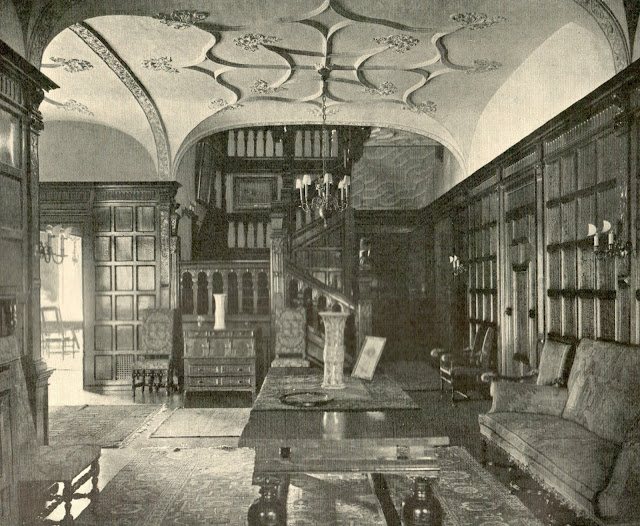
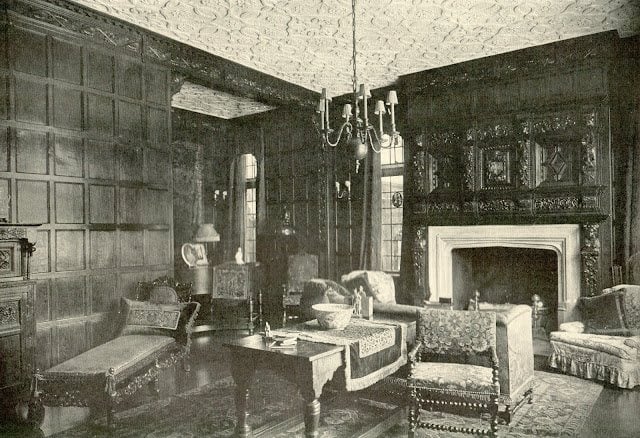
The Pillsbury house had rooms big enough. It was, from the beginning, a house built to receive people: a great hall, a drawing room, a dining room designed for entertaining, and centuries-old English interiors imported to make the point. If you have read about how the mansion was built or what was put inside it, this notice is the other half of the story — the part where the rooms get used.
A quiet date problem, left as we found it
Here is something we are not going to tidy up. Our own histories of this house describe construction running from 1912 into 1914 and the mansion being finished in 1916. This newspaper notice puts Mr. and Mrs. Charles Pillsbury receiving guests at 100 East Twenty-second Street in October 1914. The 1912 building permit, meanwhile, gives the address as 106 East Twenty-second.
We are recording the conflict rather than resolving it. Period sources disagree about this house more often than you would expect, and choosing a side quietly is how a wrong date becomes settled fact. If you know more, we would like to hear it.
The empty chair: John S. Bradstreet
The last line of the notice is the saddest and the most Minneapolis. Dr. Vincent — George Edgar Vincent, then president of the University of Minnesota — was elected to fill the place of the late John S. Bradstreet.
Bradstreet had died that August. He was the designer and importer who, more than anyone, taught wealthy Minneapolis what good taste looked like: the Minneapolis Craftshouse, the Japanese-influenced interiors, the eclectic “fellowship of good design.” He was also one of the small group who created the Minneapolis Society of Fine Arts in 1883 — the body that built the Minneapolis Institute of Art in 1915, and the same organisation that, half a century later, would help save four Minneapolis mansions from the wrecking ball.
So the 1914 archaeology season opened in this house with Bradstreet’s chair empty and a university president in it. The city’s cultural life was small enough that all of that fit into one paragraph of one newspaper.
What this tells us about the house
It is easy to read a Gilded Age mansion as a monument to money. Notices like this one complicate that. The house was a venue — for lecture societies, for war-relief work (we wrote about the amusement room in 1918), for the ordinary civic machinery of a city that was assembling its museums, its university and its societies more or less at once.
The oak in these rooms came from England by way of a dealer. The ideas came from Yale, Chicago and Ann Arbor. Both were imported, and both were meant to be shared.
Come stand in the room
The drawing room is still here, and so is the staircase. You can walk through both on a guided tour — see Experiences & Tours and Plan Your Visit, then book a reservation. More stories from the archive are in the History Journal.
Source: “Lecture at Pillsbury Home,” The Minneapolis Journal, Saturday, October 3, 1914, page 8. Further reading on the mansion’s National Register listing at the National Park Service and on Minneapolis’ milling era at the Mill City Museum.
Keep reading: Where Can You Shop for Minnesota-Made Gifts Inside a Historic Minneapolis Mansion?