
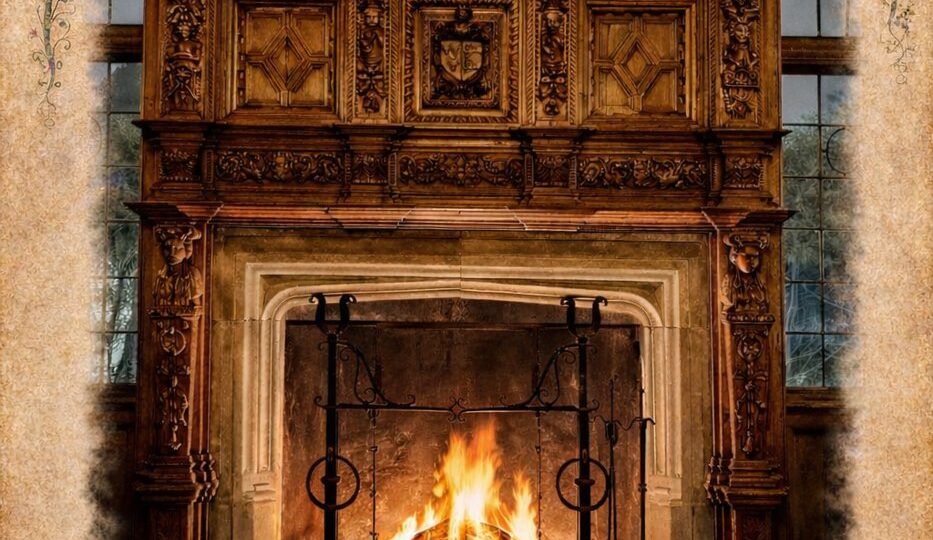
Whose Marriage Is Carved Into the Pillsbury Club’s Lounge Fireplace?
Step into the lounge of the Pillsbury Club and look up at the fireplace. Above the hearth, carved deep into English oak, two coats of arms lean together — a quiet announcement of a marriage made in Tudor England more than four centuries ago. It is one of the most personal objects in the whole mansion: not a king’s monument or a guild’s boast, but a wedding, frozen in wood, that somehow traveled from a manor on the Devon coast to a hill above downtown Minneapolis.
A marriage carved in oak
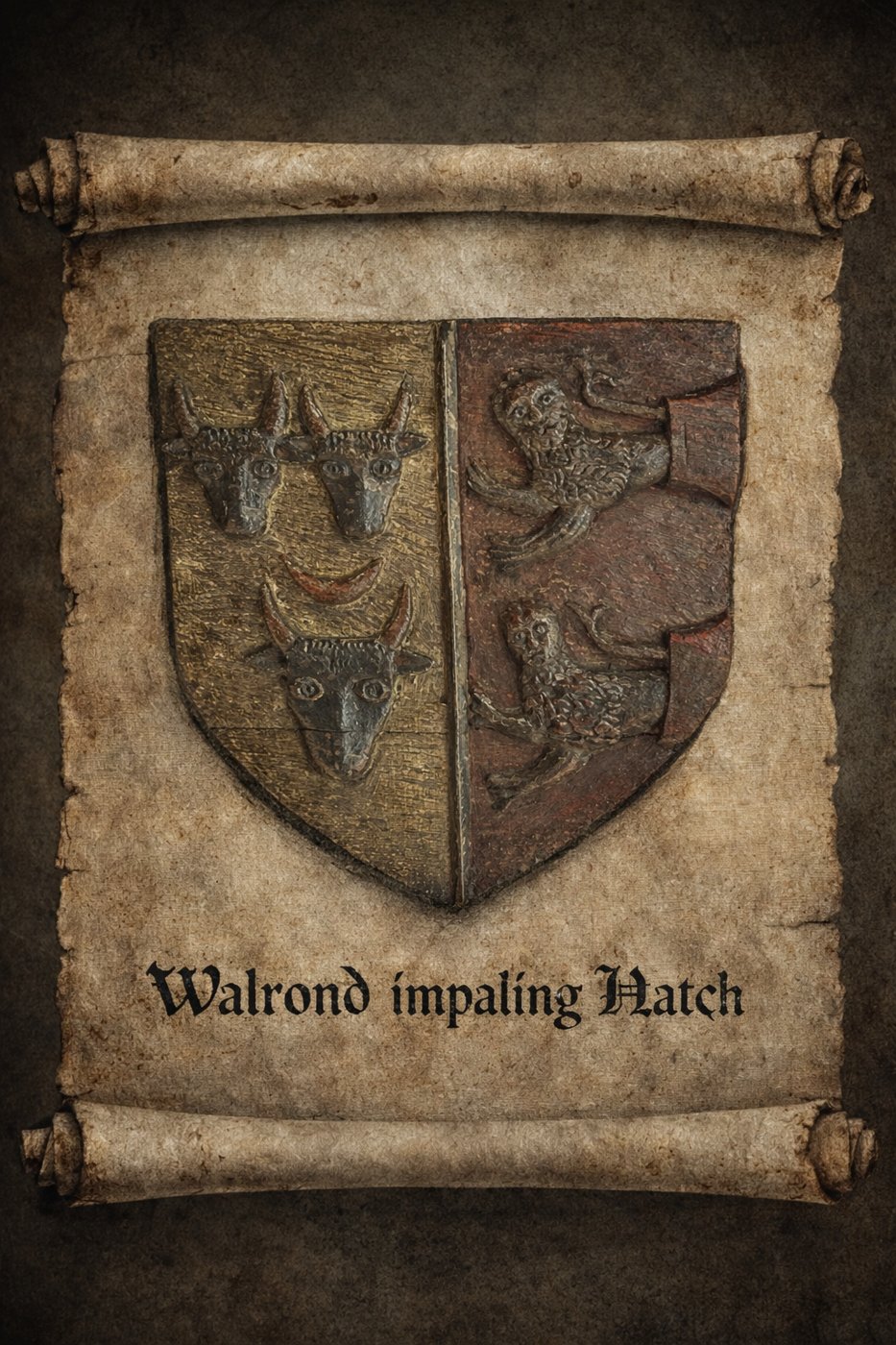
The overmantel is a marriage crest, and it follows a Tudor convention any guest of the period would have read at a glance. When two armigerous families were joined by marriage, their arms were placed side by side on a single shield — the husband’s to the left, the wife’s to the right — a practice heralds call impalement. Here, the charging bulls’ heads of the Walrond family share the shield with the lions of the Hatch family. Look closely and you’ll spot a small crescent tucked among the carving: in English heraldry, a crescent is the “difference” mark of a second son — the signature of a cadet branch of the family.
Bovey House: a Devon manor of secrets
The crest began life far from Minneapolis, at Bovey House near the fishing village of Beer on the East Devon coast. The manor is of medieval origin and is today a Grade II*-listed building; a lead rainwater head still fixed to its wall carries the date 1592, marking the great Elizabethan rebuild that gave the house its present face. By then it had already passed through extraordinary hands: after the dissolution of the monasteries stripped it from the See of Sherborne, Henry VIII folded it into the dowry of his sixth and final queen, Catherine Parr.
It is the kind of house that keeps secrets. Beneath it lies a well some 180 feet deep, its water once hauled up by a great timber tread-wheel that still survives. There is a priest’s hidey-hole and a network of secret escape passages, and the iron gates still wear the Walrond insignia on their pillars. The Walronds — the very family whose bulls’ heads crown our fireplace — were the manor’s long seat, buying it outright from Sir William Pole around 1670 after years of holding it as tenants.

The couple the crest remembers
The Pillsbury Club’s own history of the piece reads the overmantel as the marriage of John Walrond to Jane Hatch, two Devon families joined during that 1592 flourish — a union the couple wanted remembered in oak. Whatever exact names the centuries have blurred, the impulse behind the carving is unmistakable. In Elizabethan England a marriage crest was a billboard of lineage and alliance, carved to outlast everyone in the room. Four hundred years on, it has done exactly that.
The Devon gentry of this fireplace were also woven into the families who would help settle New England. The Poles of Devon — the same line as the Sir William Pole who later sold Bovey House to the Walronds — produced Elizabeth Pole, who sailed for Massachusetts in 1637 and founded the town of Taunton, becoming the first woman known to have founded a town in the Americas. The oak in our lounge belongs to that same restless, ambitious world — one where a Devon family’s fortunes might end up carved into a wall an ocean away.
How a Devon wedding reached Minneapolis
By the early 1900s, England’s old houses were being broken up, and a London dealer named Charles Duveen — better known as “Charles of London” — was buying their finest interiors and shipping them to America’s millionaires. Charles S. Pillsbury was among his clients, and the Duveen dealers sent the Walrond overmantel across the Atlantic to be set into the new Pillsbury mansion, completed in 1916. It has warmed the lounge ever since.
It is only one of seven imported English treasures gathered beneath this single Minneapolis roof — you can wander all of them in The Splendors — and it has a famous cousin just down the hall: the library’s stone chimneypiece that survived the Great Fire of London in 1666. Two fireplaces, two impossible journeys, one mansion.
Come stand beneath the crest
The best way to meet John and Jane is to stand under their marriage crest yourself. The Pillsbury Club is the home of the Minneapolis Trolley, and year-round tours of the mansion bring you face to face with the carved oak, the ancient stained glass, and the centuries-old fireplaces. Come see a four-hundred-year-old marriage that’s still going strong — book your tour and step into the story.
Keep reading: where did the mansion’s centuries-old stained glass come from?