
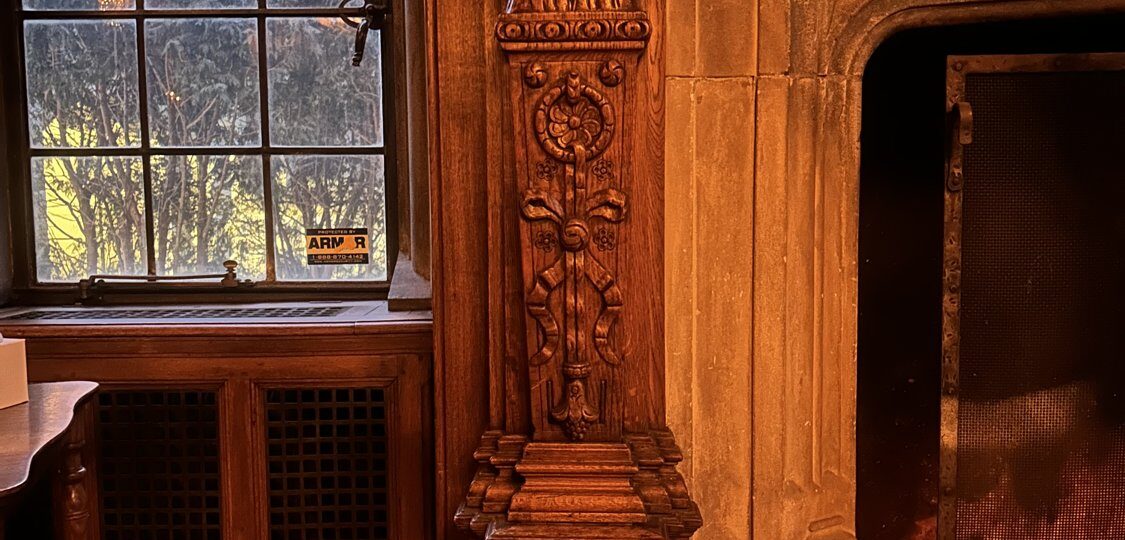
What Did the Pillsbury Mansion’s Library Look Like in 1914? A Newspaper’s “Book-Lover’s Nook” Column Walks Through It, Detail by Detail
Two weeks after a Minneapolis newspaper had called the Pillsbury Mansion’s pantry perfect, it came back for the library. On Sunday, January 11, 1914, page 55 of the Star Tribune ran its weekly “Making the Home Beautiful” feature under the heading “The Book-Lover’s Nook,” and after several paragraphs of general advice on cosy reading rooms — a well-upholstered divan, a library table with a reading lamp, a smoking set on a pedestal — the writer reached again for the best local example. “At the Charles Pillsbury residence on East Twenty-second street,” the column said, “a particularly attractive library of the smaller type has been arranged.”
What follows in the original clipping, which we keep in the Club’s archive, is the most detailed period description of the library we have — and it describes a room that is not quite the one you walk into today. That difference is the interesting part.
“English oak taken from old castles”
The column’s first observation is the one our Building the Mansion page already quotes: “The walls of the room are entirely of English oak taken from old castles.” The 1914 writer went further. The panels, it said, “are set together in squares and are waxed and polished,” and “in the walls are set-in bookcases in panel effect with striking carved borders. Two or three shelves are arranged in tiers in each wall opening.” That is a precise account of how a house full of imported antique panelling actually accommodated a working library: the bookcases were built into the old oak, not stood in front of it.
The furniture matched the walls. “The furniture is of English oak upholstered in wonderful antique tapestries imported from different European countries.” Then a paragraph of upholstery that reads like a dealer’s inventory: one great chair “covered with a plain deep rose velour, elaborated with pieces of Ecclesiastical embroidery done in the early days in European convents”; another “covered with a hand-made tapestry in harmonious shades”; still another “covered with a brocaded fabric in a deep rose.” Even the smoking stand was an antique — “a smoker of English oak … fitted with pieces of imported brass for the smoking set.”

Deep rose, orange shades, and the arms of Holland
Colour is the thing period photographs cannot give you, and the 1914 column is generous with it. The hangings were “of rich velour in a deep rose shade and trimmed with gold,” arranged “to draw back or forward on cords.” The floor was covered in Oriental rugs. The lighting fixtures were “imported antiques,” with shades that were “fan-shaped and … tinted in a light orange.” The room had French windows, and “antiques in colored glass decorate the window and door panel” — the earliest printed mention we have found of antique coloured glass in the library’s windows, where leaded glass still catches the light today.
So picture it in January 1914: dark waxed oak on every wall, rose velour at the windows, orange-tinted lamplight, and the winter sun coming through old coloured glass. It is a warmer, redder room than the one most visitors imagine when they hear “Elizabethan.”
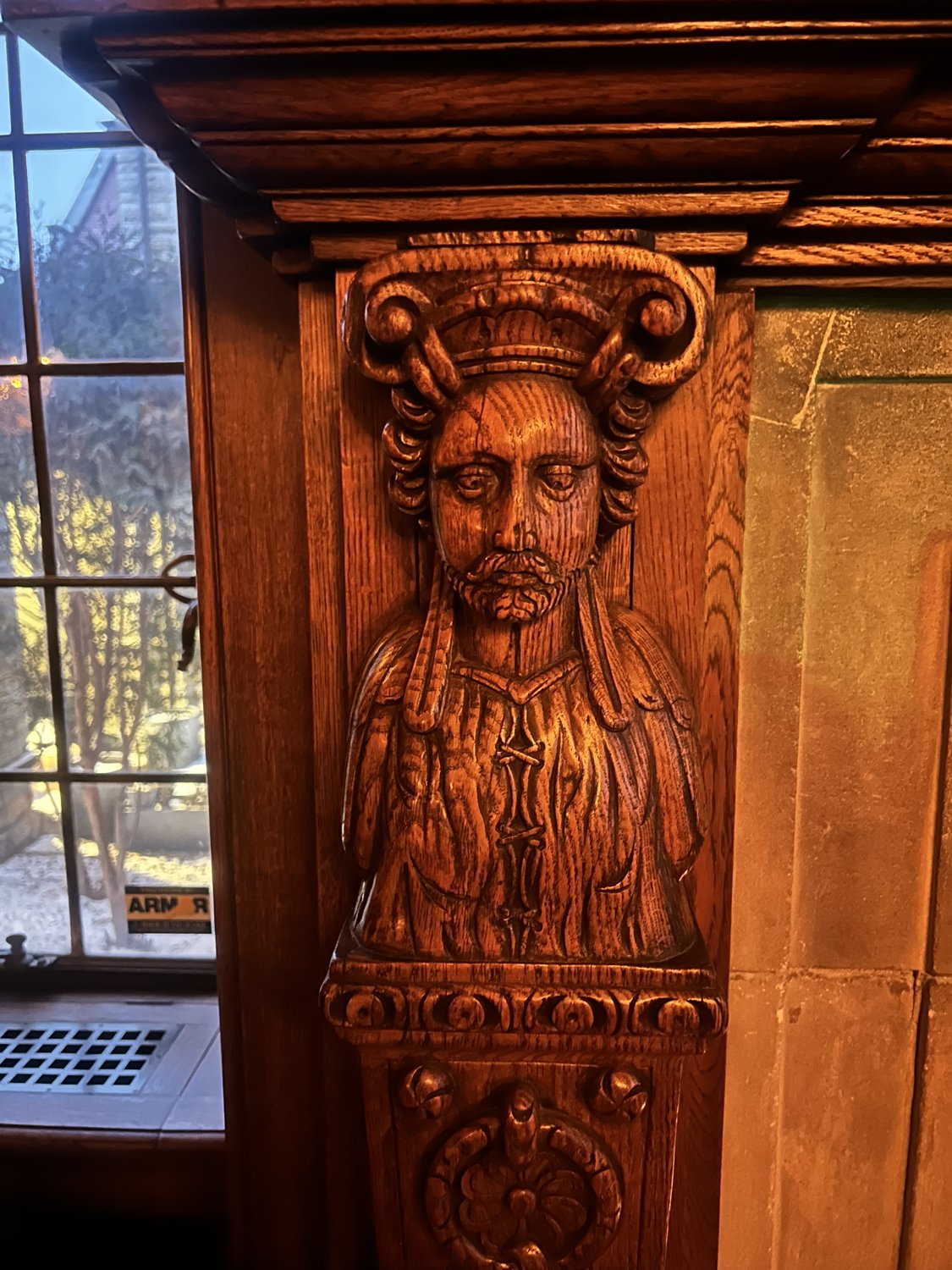
Then comes the sentence that stops you. “The most interesting part of the room is the fireplace, having an imported mantle of white plaster with the coat of arms of Holland done in blue and orange and having wonderful carved figures above. The piece is an antique of early date.”
A white plaster mantel — not the stone one
The library fireplace today is the one visitors come to see: the carved stone chimneypiece of the Tallow Chandlers’ guild, cut in London in 1476, a survivor of the Great Fire, with St. John the Baptist presiding above the hearth. It is described on our Splendors page, and the story of how it came to Minneapolis instead of to William Randolph Hearst is told in our post on Hearst’s $50,000 fireplace. Nothing about it is white plaster, and nothing about it is Dutch.
The 1914 column, then, was describing a different mantel in the library — a white plaster piece bearing the arms of Holland in blue and orange, with carved figures above it. We can offer two readings and we will leave the choice to you, because the record does not settle it. One: the plaster mantel was an interim installation, and the Tallow Chandlers’ stone chimneypiece, which our own pages place in the Hearst dispute of 1913, had simply not yet been set into the wall when the reporter visited. Two: “a library of the smaller type,” in the column’s own phrase, was not the great oak library at all but a second, smaller reading room somewhere in the house, and the Dutch mantel went wherever that room went. The original first-floor plan we read in an earlier post shows how many rooms were still being assigned their purposes in these years. Either way, somewhere in the mansion’s first winter there was a white-and-blue Dutch fireplace that no account we have found mentions again.
A note on the date
Our Building the Mansion page credits the “Book Lovers’ Nook” quotation to the Star Tribune of December 1914. The clipping in our archive carries the newspaper’s own header: Sunday, January 11, 1914, page 55. We are recording both here rather than quietly correcting one, because the page also carries a small line at the bottom — “Page Patented Mar. 1, 1913. No. 14” — which tells you the column was a syndicated feature that ran in a numbered series, and syndicated pages were sometimes reprinted. January 1914 is what the page says. It also fits the house’s timeline: the pantry column ran on December 28, 1913, the library column two Sundays later, and the family’s formal introduction to a national readership came with the Town & Country frontispiece two years after that.
Why a furnishing column matters
Newspaper society pages tell you who came to dinner. Furnishing columns tell you what the room felt like, and they were written for readers who would never be invited — which is why they explain everything. A century on, that makes “The Book-Lover’s Nook” one of the few sources that lets us stand in the library in its first winter and see the colours: castle oak, deep rose, gold trim, orange lamplight, blue-and-orange heraldry on white plaster. The house was assembled from pieces of old Europe by Charles of London and the Duveen brothers; the column is a rare glimpse of how those pieces were first arranged before a hundred years of owners rearranged them.
Come and stand in the library on a guided tour of the Pillsbury Mansion. Stand in front of the stone chimneypiece, look at the coloured glass in the leaded windows, and imagine the rose velour drawn back on its cords. Then decide for yourself where the Dutch fireplace went. Plan your visit, and read the rest of the History Journal for more of what the newspapers saw.
Keep reading: Why was Duveen Brothers still writing to the Pillsbury next door in 1947? A carbon copy from the family files.