
What Was the Pillsbury Mansion Worth in 1988? The Year Nobody Wanted a Minneapolis Mansion
One million, two hundred and fifty thousand dollars — and nobody was buying. On Sunday, March 20, 1988, the Star Tribune ran a Metro-section story by Mike Kaszuba under the headline “Stately pasts and uncertain futures,” and the Charles S. Pillsbury mansion was its opening example. “Selling the mansion where Charles Pillsbury slept — the one with William Randolph Hearst’s fireplace — is turning out to be harder than imagined.” The clipping, kept in the Club’s own files, is a snapshot of the lowest moment in this house’s fortunes, and it is worth reading closely, because almost every number in it tells you something about how Minneapolis felt about its mansions in the late 1980s.
The asking price, the tax bill, and the parking
$1.25 million, with an $18,500 tax bill attached
The paper’s summary of the problem was blunt: “As a place to live, the mansions are out of most everybody’s price range. The Charles Pillsbury mansion, with its annual $18,500 property tax bill, has a $1.25 million price tag. And the mansions aren’t well suited as a place to work because of limited parking.” Half a dozen of the city’s great houses were on the market at once, at asking prices from $345,000 to $1.25 million — ours was the top of that range — “and locations in less-than-fashionable neighborhoods,” in the paper’s phrase. Many had been sitting without buyers “since last summer.” Brian Coyle, the City Council member whose Sixth Ward held most of them, called the situation “a near crisis.”

Three mansions in a row, all for sale
The photograph across the top of the page was captioned “Three mansions in search of owners”: the Alfred Pillsbury mansion at 116 East 22nd Street, the Charles Pillsbury mansion at 100 East 22nd, and the Caroline Crosby mansion at 2105 First Avenue South. All three had housed the advertising agency Carmichael-Lynch, which had moved out the previous summer, and all three were for sale or lease. A Carmichael-Lynch official named Bob Rink, standing between two of the buildings for the reporter, gave the paper its best line: “That’s Alfred, and this is Charles.” Alfred’s house was priced at $675,000 and, the paper noted, had a wall in its library with a secret door leading to a room-sized vault. The Crosby house — 9,576 square feet — was $335,000. What the agency’s years here were actually like is told in What Happened When an Advertising Agency Moved Into the Pillsbury Mansion?
Why the office-in-a-mansion era ended
The Pillsbury house was not the only mansion whose corporate tenant had walked. The paper’s explanation was structural: mansions had become popular as offices in the 1970s, but by 1988 an office glut in the Twin Cities meant conventional space was cheap, and several firms had simply outgrown their mansions. The Franklin National Bank of Minneapolis, after 25 years in the Semple mansion at 100 West Franklin Avenue, had built a new building a quarter block away and moved in 1986; its president, Tom Palmer, said parking was the big problem, along with the frustration of drilling through three-foot-thick floors to run computer cables. “It’s hard to beat a building like that,” he said of a mansion with an upstairs ballroom — “(But) I think some of those companies that came into these buildings in that first wave, when this was trendy, they got tired of (the cost of) managing space like that.” A cosmetology school had left the Van Dusen mansion at 1900 LaSalle Avenue the previous May; it was still available at $750,000. A real estate agent, Charlene Roise, summed up the buyer she was looking for: “people who want a little more creativity. They’re not IBMs.”
The house on Clifton Avenue, and a note on which one
Two paragraphs in, the story turns to a second house that readers of this journal will recognise: “So is the job of trying to get $850,000 for the house built on Clifton Av. in Minneapolis for Elbert Carpenter, the lumberman who founded the Minneapolis Symphony Orchestra.” A caution is needed here. There are two Carpenter houses side by side on that bluff above Loring Park. The City of Minneapolis landmark record puts Elbert L. Carpenter’s house at 314 Clifton Avenue, a 1906 Georgian Revival by William Channing Whitney; the Eugene J. Carpenter house next door at 300 Clifton is the one that is now the 300 Clifton bed and breakfast and part of the Pillsbury Club Collection. The 1988 article names Elbert and gives no street number, so we cannot say from this clipping which of the two was on the market at $850,000 — only that a Carpenter house on Clifton Avenue was, and that it was not selling either. We leave the newspaper’s wording as it stands rather than guess.
A few blocks away, nobody would pay $345,000 for the William Murphy mansion on South 10th Street, built for the turn-of-the-century owner of the Minneapolis Tribune — “even throwing in the fact that actor Walter Pidgeon once rented a room in the building hasn’t helped.” Its owner, Jonathan Tomhave, joked: “I’m 41. The building is aging me. I’ll be 47 next year.”
St. Paul had Summit Avenue; Minneapolis had a problem
The story jumped to page 2B, where the reporter asked why St. Paul was having better luck. His answer: St. Paul had 69 houses of at least 4,000 square feet on Summit Avenue built before 1930, clustered together, some still owned by descendants of the families who built them; of St. Paul’s five national historic districts, three were residential, whereas of Minneapolis’s three districts, “none are in residential areas with large houses.” John Baule, then director of the Hennepin County Historical Society, put it plainly: “many of Minneapolis’ neighborhoods that were enclaves of substantial homes were never very deep. In St. Paul, with Summit Av. being what it is with the colleges, it tends to be a better anchor. During the time when nobody wanted a big house, they were able to better weather that.” The same page reported neighbourhood activists trying to save a late-19th-century Queen Anne house at 2013 Stevens Avenue South that Hennepin County wanted to buy and demolish for a parking lot. That is the 1988 backdrop against which our block survived at all — the earlier rescue is in Which Four Minneapolis Mansions Were Saved From the Wrecking Ball in 1969?
The Hearst fireplace, as the Star Tribune told it in 1988
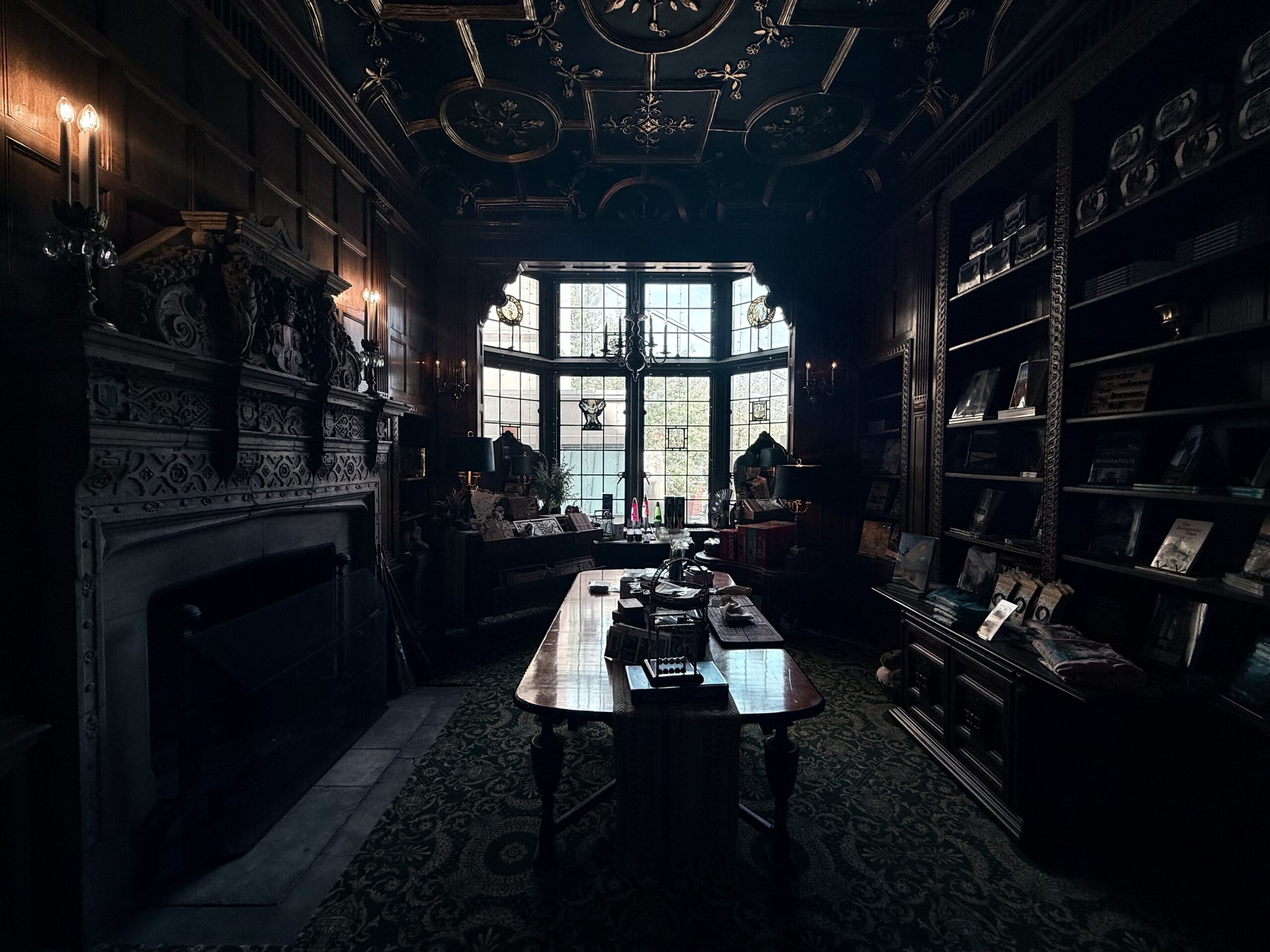
Because the reporter led with it, it is worth recording exactly how the fireplace legend was being told in 1988: “As one story goes, the library’s fireplace in the Charles Pillsbury house led to a falling out between Pillsbury and William Randolph Hearst, the newspaper tycoon. Hearst planned to put a stone fireplace in San Simeon, his famed castle in California, when Pillsbury saw it and had its designer build a copy. When the two fireplaces were inadvertently mixed up during shipping, Pillsbury refused to swap them.” Note the hedge — “as one story goes.” What the documents actually support, and how the versions differ, is examined in Did the Pillsbury Mansion Get William Randolph Hearst’s $50,000 Fireplace by Mistake?
A correction to our own record
An earlier post in this journal, on the years when a training center for the blind occupied the house, cited this same account of half a dozen mansions for sale between $345,000 and $1.25 million and dated it to 1993. The masthead on the clipping reads Sunday, March 20, 1988, pages 1B–2B. The 1988 date fits the rest of the article — Carmichael-Lynch had left “last summer,” and the bank’s move is dated 1986 — so 1988 is the date to rely on, and a note to that effect has been added to the earlier post. The house was, in other words, on the market and unwanted for longer than we had said. You can read the full scan of Minnesota’s newspapers of that era through the Minnesota Historical Society’s newspaper hub, and the mansion’s formal listing is on the National Register of Historic Places — see our post on what that listing did and did not protect.
See the $1.25 million house for yourself
The library with the disputed fireplace, the carved figures the 1988 photographer picked out, the three-foot floors the bank president complained about — all of it is still here, and the house that nobody wanted in 1988 is now the Pillsbury Club. Plan a visit, book one of the year-round guided mansion tours on Experiences & Tours, or read on through The Owners for the full chain of hands the house has passed through since the Pillsburys. For more from the archive, browse the History Journal.