
Why Does a Bundt Pan Company Own Minnesota’s Most Famous Grain Elevator? Peavey’s Folly and the Pillsbury Bake-Off
Drive through St. Louis Park, just west of Minneapolis, and you may notice a tall concrete cylinder painted with the name of a cookware company. It looks like an oversized advertisement. It is actually a National Historic Landmark — the world’s first known cylindrical concrete grain elevator, built in 1899 by a grain baron whose critics called it “Peavey’s Folly.” And the company whose logo it wears owes its most famous product to a cake that placed second at the Pillsbury Bake-Off. With National Bundt Day falling on November 15, here is the story of how wheat, fire, concrete and a fudge cake all tie back to the flour that built the Pillsbury Mansion.
Who was Frank Peavey, the “Elevator King”?
Frank Peavey (1850–1901) came west from Maine as a young man and became a grain merchant. His business sat in the middle of the flour economy: he bought wheat from farmers, stored it in elevators and delivered it to the flour mills. After basing himself in Minneapolis in 1881, he built a chain of elevators across Minnesota and Iowa and into the Dakotas, earning the nickname “Elevator King.” In other words, his trade was the other half of the business that made the Pillsbury name — the mills along St. Anthony Falls could grind only what the elevators could store and ship. (For the trading floor that set the price of all that wheat, see our story on the Minneapolis Grain Exchange.)
Why were wooden grain elevators so dangerous?
The elevators of the day were built of wood, packed with volatile grain dust and usually stood beside railroad tracks where locomotives threw sparks. Fires were common, and insurance rates climbed with every one. Minneapolis millers knew the danger of dust better than anyone: in 1878 a flour-dust explosion destroyed the Washburn A Mill and killed eighteen workers, a disaster now remembered inside its ruins at the Mill City Museum. Peavey was convinced a fireproof elevator could be built — and that reinforced concrete, a newer material popularized in the 1880s, was the answer.
How did “Peavey’s Folly” prove everyone wrong?
Peavey hired a local engineer and builder, Charles F. Haglin, and in the summer of 1899 they began an experimental round tower of concrete. Other engineers warned that it would burst when filled or crack when emptied. Haglin poured it in sections inside round forms braced with steel hoops, moving the forms upward as each ring hardened, until the cylinder stood 68 feet high, 20 feet across inside, with walls tapering from 12 inches thick at the base to 8 at the top. That fall it was filled with grain and left through the winter.
While it sat, Peavey sent Haglin to Europe — with Haglin’s young son and Peavey’s son-in-law, Frank Heffelfinger — to see what the Old World had built. From January to March 1900 they toured grain facilities from London and Hamburg to Budapest, Bucharest, Vienna and Paris. They found concrete storage, but nothing round; Haglin came home reporting that Europe was no further ahead than Minneapolis.
In the spring of 1900 came the moment of truth. A crowd gathered at a cautious distance, expecting a catastrophe. Haglin stood at the foot of the tower and pulled the lever himself. The grain poured out, the cylinder stood perfectly intact, and the crowd cheered. Haglin later raised it to 125 feet for more tests. The design spread across the Midwest, and the round concrete elevator became the shape of the prairie skyline. Peavey did not live to see it: he died of pneumonia on December 30, 1901.
How did a Pillsbury Bake-Off cake make the Bundt pan famous?
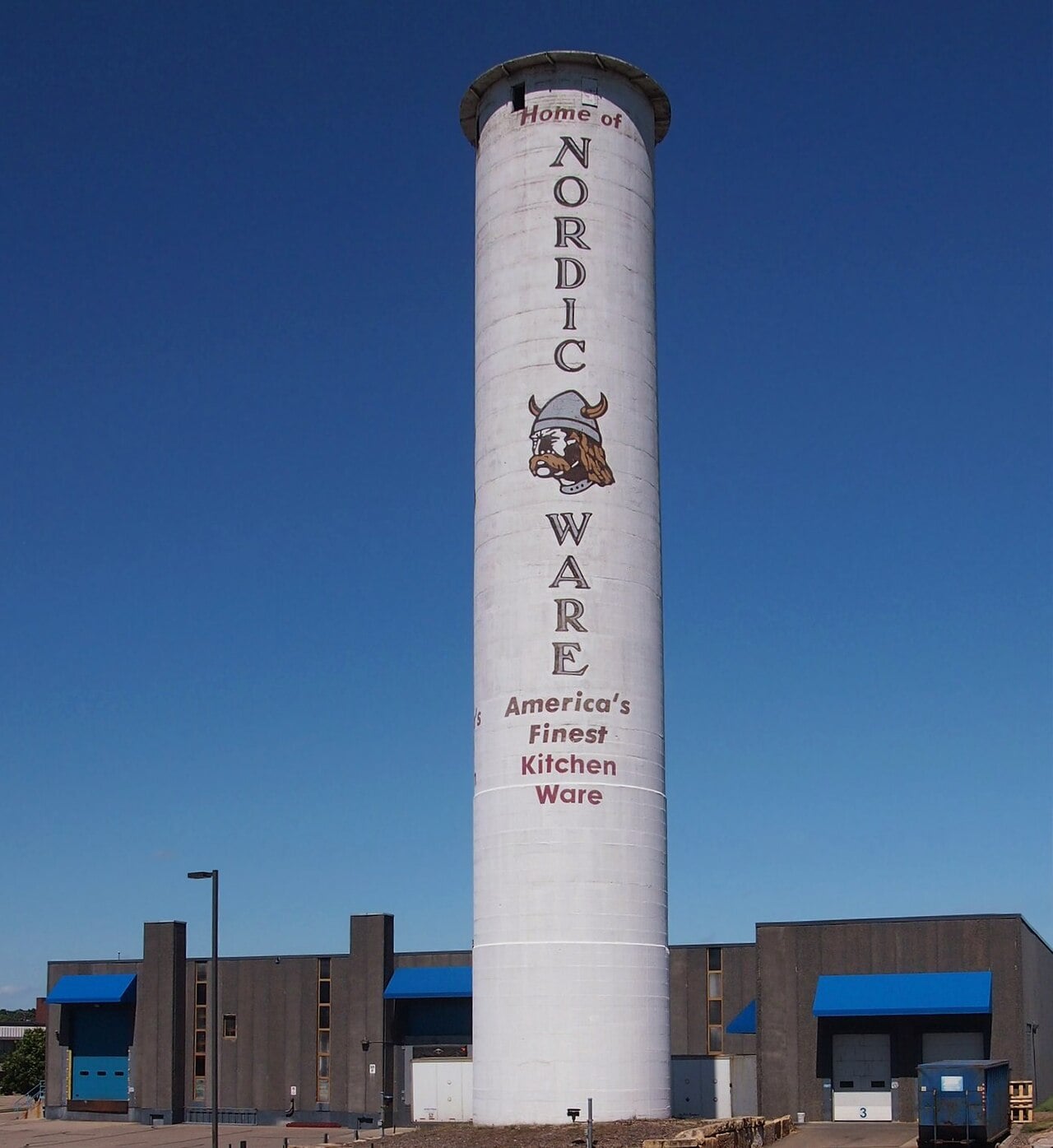
After its experiments, Peavey’s Folly never stored grain again. Industries came and went around it, and the land eventually passed to Nordic Ware, the St. Louis Park cookware company, which has maintained the elevator on its grounds since the late 1960s and painted it with its name. Nordic Ware’s signature product is the Bundt pan, a cast-aluminum take on a traditional fluted cake mold, first made in a small run in 1950. For years it sold so poorly that the company considered dropping it.
Then came 1966. A cake called the “Tunnel of Fudge,” baked by Ella Helfrich in a Bundt pan, took second place at the annual Pillsbury Bake-Off and won her $5,000. According to the history recounted on Wikipedia’s Bundt cake article, the publicity brought more than 200,000 requests to Pillsbury for Bundt pans, and the pan went on to become the best-selling cake pan in the country. In the 1970s Pillsbury licensed the Bundt name and sold Bundt cake mixes. The contest itself was the company’s own invention — we told that story in why Pillsbury created the Bake-Off.
Can you still see Peavey’s Folly?
Yes. The Peavey–Haglin Experimental Concrete Grain Elevator stands at 5005 County Road 25 in St. Louis Park, still wearing the Nordic Ware name. It was listed on the National Register of Historic Places in 1978, proclaimed a National Historic Landmark in 1981 and named a National Historic Civil Engineering Landmark in 1983. The St. Louis Park Historical Society tells its local story on its Peavey-Haglin elevator page. It is private company property, so admire it from the public way.
From the elevator to the mansion
Grain moved from farm to elevator to mill, and the profits of the mill built houses like the Charles S. Pillsbury Mansion on East 22nd Street. Read more about the business behind it on our Pillsbury Company page and about the family on the Pillsbury family page, or walk the flour district by way of the Stone Arch Bridge.
Better still, see the house the flour built in person. Book a guided tour of the Pillsbury Mansion, or plan your visit to the Club — and if anyone asks, a slice of Bundt cake counts as historical research.