
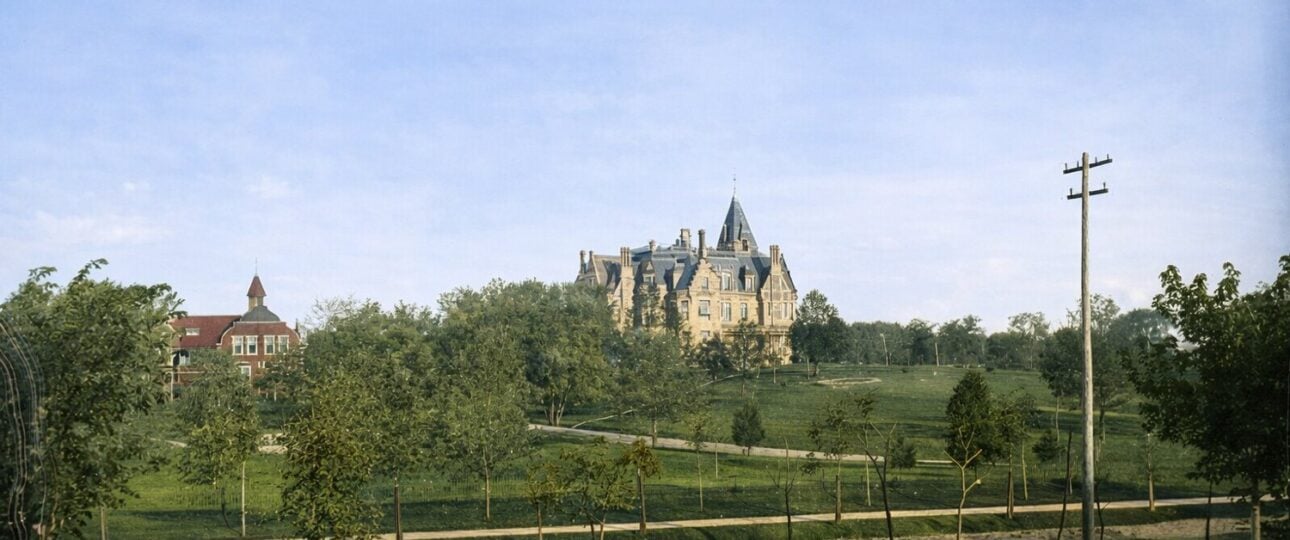
Why Is the Minneapolis Institute of Art Across the Street from the Pillsbury Mansion?
Step out the front door of the Charles S. Pillsbury Mansion at 100 East 22nd Street, cross the green of Washburn–Fair Oaks Park, and you find yourself at the foot of a gleaming neoclassical temple: the Minneapolis Institute of Art. Great art museums usually rise downtown, among banks and boulevards. So why does this one stand in a residential neighborhood, face to face with a 1916 English manor house? The answer involves a vanished estate called Villa Rosa, two remarkable letters, and a debt the mansion would one day owe the museum — its very survival.
Villa Rosa: the estate beneath the museum
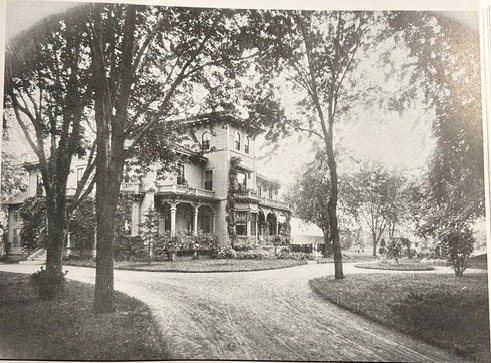
Long before the museum’s marble steps, this high ground belonged to Dorilus Morrison — lumberman, mill owner, and the first mayor of Minneapolis. Morrison chose the rise south of 24th Street for his home, a rambling estate he called Villa Rosa, set amid roughly ten acres of lawns and gardens at one of the highest points in the young city. He was among the neighborhood’s earliest empire-builders, settling here decades before the Pillsburys, Washburns, and Dunwoodys made these blocks an avenue of palaces.
Two letters that built a museum
On January 3, 1911, Dorilus’s son Clinton Morrison typed a three-page letter to the Minneapolis Society of Fine Arts, the art organization founded in 1883. A proper museum, he argued, must sit on clean, quiet, high ground — not downtown in the grit of traffic and industry. Then came the offer: if the Society could raise $500,000 for construction, he would give the city his family’s homestead, free and clear, as a memorial to his father.
The money came almost absurdly fast. Days before the fundraising dinner, milling magnate William Hood Dunwoody — whose own mansion stood nearby — sent a scrawled, handwritten note: “Put me down for $100,000.” At the dinner itself, donors pledged $335,500 in about ninety minutes. Villa Rosa came down, and on its lawns rose a Beaux-Arts landmark designed by McKim, Mead & White, the most celebrated architectural firm in America.
Opening day, 1915 — and a mansion rising across the park
When the Minneapolis Institute of Art opened in January 1915 with some 450 works on view, more than 12,000 people streamed through in a single day. And just across the park, the timing could hardly have been more poetic: the steel frame of Charles S. Pillsbury’s new home was already up, and within a year the family would move into a house filled with centuries-old English rooms — a private museum, in effect, facing the public one. Two monuments to the same conviction: that a young flour-milling city deserved old-world beauty.
The Pillsburys inside the museum
The family connection ran deeper than geography. Charles’s cousin Alfred F. Pillsbury lived next door to the museum’s patrons at 116 East 22nd Street and gave the Society of Fine Arts nearly forty years of service — trustee from 1911, treasurer, then president from 1935. At his death in 1950 he left the museum more than nine hundred objects, including one of the world’s great collections of Chinese jades and ritual bronzes — a bequest that still anchors the museum’s Asian galleries today.
The museum that saved the mansion
Then came the twist no one saw coming. By the late 1960s the neighborhood’s great houses were falling to the wrecking ball one after another. In 1969, an anonymous donor gave the Minneapolis Society of Fine Arts — the museum’s parent organization — the means to buy and protect four threatened mansions around Washburn–Fair Oaks Park, the Pillsbury Mansion the largest among them. In 1974 all four were listed together on the National Register of Historic Places, and in 1976 the Society passed them on to new stewards. The museum built on Villa Rosa’s lawn had, in the end, repaid the neighborhood: it saved the last of the palaces.

See both sides of the street
Few corners of America let you stand between a Beaux-Arts museum (per the Minnesota Historical Society, one of the finest in the state) and an authentic Elizabethan manor, each about a century old, each the other’s oldest neighbor. Spend a morning in the museum’s galleries, then cross the park for a tour of the Pillsbury Mansion’s storied rooms — or see the whole neighborhood the fun way aboard Minneapolis Trolley Tours. Making a weekend of it? The historic 300 Clifton mansion bed & breakfast is minutes away in Loring Park.
Keep reading: after your walk to Mia, see why every Minneapolis Trolley Tour departs from the Pillsbury Club — and how to turn it into a full evening.
Keep reading: Why Was the Pillsbury Mansion Built Like a Skyscraper? — the steel skeleton hiding beneath the mansion’s ancient English oak.