
Whose Coats of Arms Are Carved Into the Pillsbury Mansion?
Walk slowly through the Charles S. Pillsbury Mansion and you will start noticing shields. They are carved into oak overmantels, set into leaded glass, cut into stone above the front door. Coats of arms are everywhere in this house — and almost none of them belong to the Pillsburys.
That is the strange and rather wonderful thing about a Minneapolis house filled with imported English rooms. Every room brought its previous owners’ heraldry with it. Here is whose arms you are actually looking at.
Three chess rooks: the Bodenhams of Rotherwas
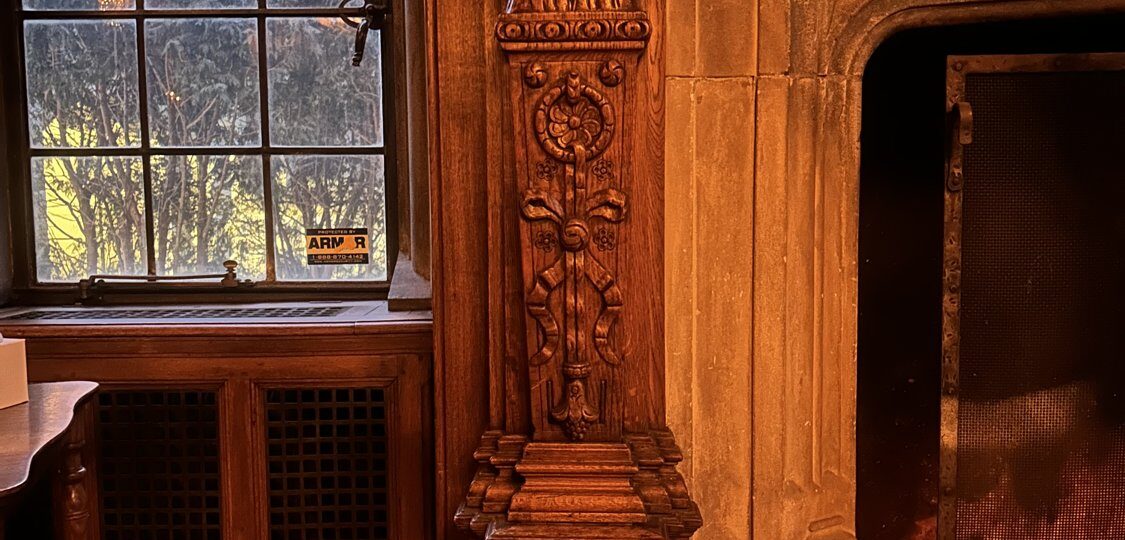
Start with the oak. The carved panelling and the staircase came from Rotherwas Court in Herefordshire, and hidden throughout the carving are three chess rooks — the Bodenham family’s punning heraldic signature, the kind of visual joke heralds call canting arms. Find the rooks and you have found the family.
The Bodenhams held the Rotherwas lands from before the Domesday Book of 1086 until 1912, when the estate was broken up and the dealer Charles Duveen carried its richest rooms across the Atlantic. We told their story in full in The Bodenhams of Rotherwas, and the rooms themselves are described on The Splendors.
A guild’s arms, granted in 1456
The stone chimneypiece in the library carries arms that are older than the room around it by centuries. They belong to the Worshipful Company of Tallow Chandlers, the London guild of candle-makers, and the mansion’s own account dates the grant to 1456 — under Henry VI, some twenty-eight years before the College of Arms was incorporated in 1484. The chimneypiece itself was carved in 1476 for the guild’s hall on Dowgate Hill.
Then comes the part that explains how it ever left London. The guild updated its arms in 1602, which made the older carved shield out of date — and an out-of-date shield is a sellable shield. The chimneypiece survived the Great Fire of London in 1666, warmed a guildhall in Chester for 250 years, and in 1913 was pursued by William Randolph Hearst for San Simeon. Pillsbury got it instead, and the legal tussle that followed did not move it.
The guild is still there, incidentally. The Worshipful Company of Tallow Chandlers still keeps its hall at 4 Dowgate Hill, still describes itself as one of the 113 Livery Companies of the City of London, dates the first written mention of its craft to 1376 and its full livery status to 1462. The arms on our library wall are their working identity, not a museum label. We wrote about the guild itself in Who were the Tallow Chandlers?
A marriage, impaled in oak: Walrond and Hatch, 1592
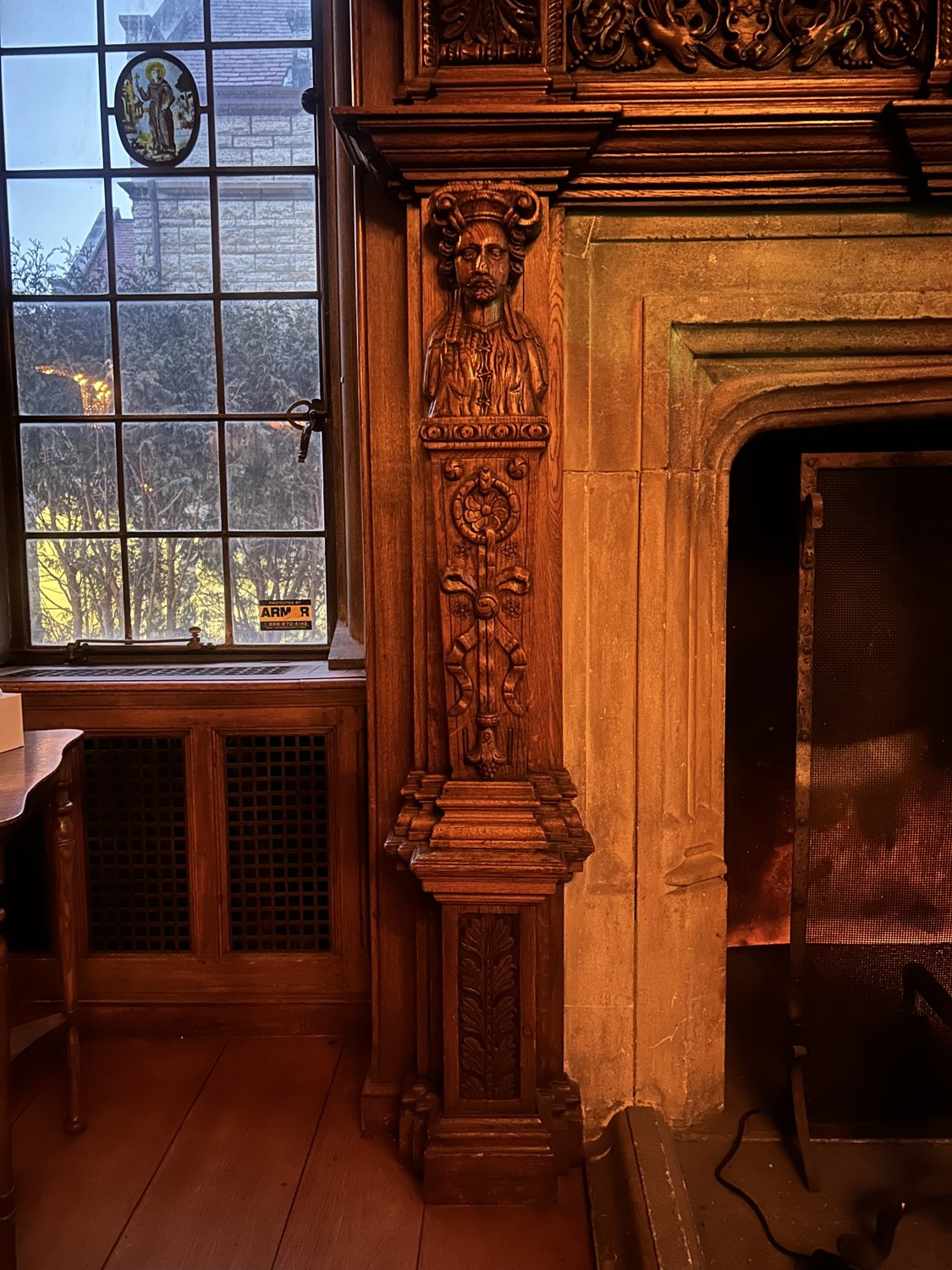
The lounge fireplace carries the most readable coat of arms in the building, because it is really two arms side by side. In 1592 John Walrond, a thirty-six-year-old Devon gentleman, married sixteen-year-old Jane Hatch, and commissioned a carved-oak fireplace for Bovey House at Beer to celebrate it. Heralds call the arrangement impaling: two shields joined down the middle for a marriage.
On the right are Jane’s family’s two lions. On the left are three charging bulls’ heads, the Walrond signature. And tucked among them is a small half-crescent moon — a cadency mark, the sign of a cadet branch descended from a second son. It is a piece of family bookkeeping carved into a fireplace, and it survived a marriage of thirty-one years, fourteen children, and an ocean crossing.
When the Walronds later tracked Duveen down hoping to buy their own crest back, he is said to have told them it was “a thousand miles west of New York.” In 1913 that was practically the moon.
A crest in the glass
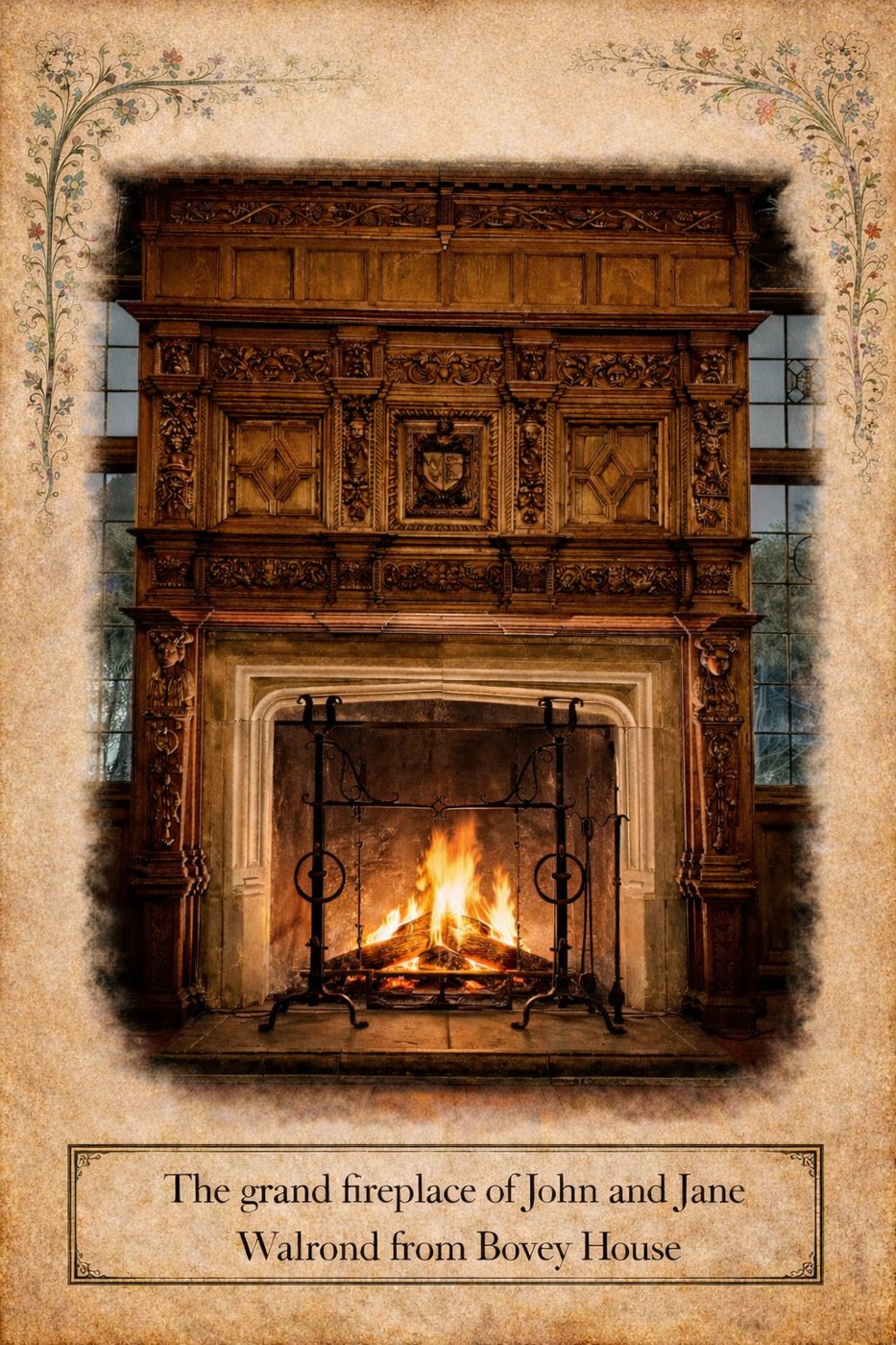
The centuries-old painted and stained glass in the first- and second-floor windows is mostly biblical scenes, but heraldic emblems run through it too. One crest belongs to Friedrich Magnus zu Salm (1606–1673), a general in the Dutch States Army — a soldier’s arms sitting quietly in a window in Minnesota, three and a half centuries after he carried them. The glass itself has its own long story, which we told in The Splendors.
And one coat of arms that is actually American
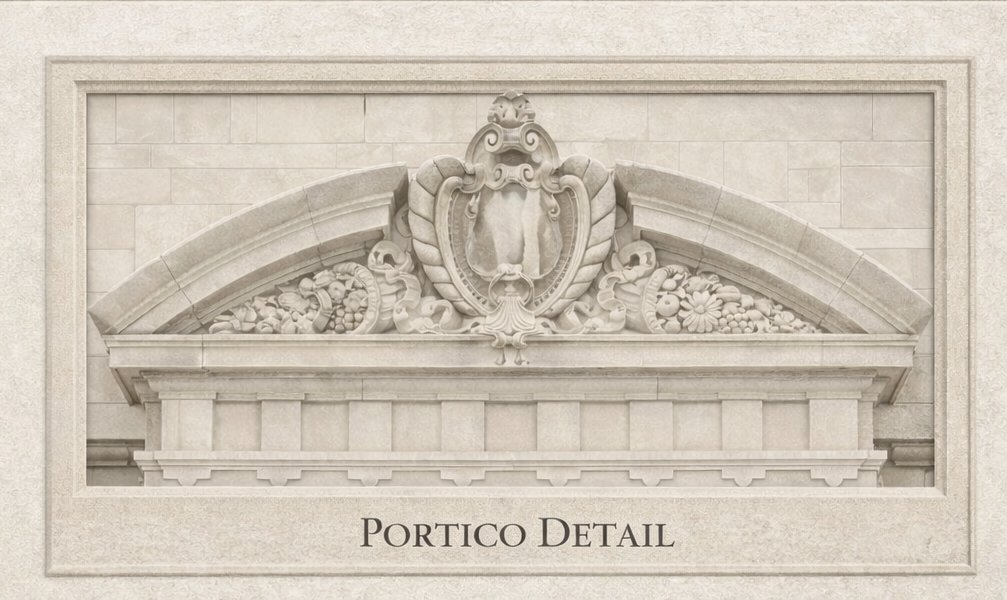
There is one shield in the house that did not sail here. Look up at the front entrance: the architect Edwin Hewitt, of Hewitt & Brown, put an armorial crest into his own stone composition above the door, along with carved parapet friezes running high above the street. The sculptor Charles S. Wells carved the portico, the friezes and the two Bedford-stone lions on the entry pillars — work the Star Tribune noted in September 1913, and which we covered in Who carved the stone lions?
It was a deliberate gesture. Hewitt was designing a Tudor-Gothic envelope to receive four centuries of English rooms, and he gave the outside of the house the same heraldic vocabulary as the inside. You can read more about how that envelope was built on Building the Mansion.
How to read a coat of arms when you are standing in front of one
You do not need to know blazon to enjoy this. Three things will get you most of the way. Look for puns — canting arms like the Bodenham rooks are commoner than you would think, because families liked a joke about their own name. Look for a vertical join — two designs sharing one shield almost always means a marriage. Look for something small and out of place — a crescent, a star, a little bird — because that is usually a cadency mark saying which son of which generation you are looking at.
Then remember that everything in this house was made for somebody else, somewhere else, and arrived here anyway. The mansion is on the National Register of Historic Places, and the newspapers that reported the rooms arriving in 1913 are readable today through the Minnesota Historical Society’s digital newspapers. The city those crates landed in is worth understanding too — the Mill City Museum tells the flour story that paid for all of it.
Come and find them
The rooks, the guild arms, the marriage crest and the shield above the door are all still where they were put. Guided mansion tours run year-round — you can see what is available on Experiences & Tours, and the practical details are on Plan Your Visit. Bring your reading glasses. The best of it is carved small.
Keep reading: Why Are Three Swedish Kings in the Windows of the Pillsbury Mansion?