
Why Are There No Saw Marks on the Pillsbury Mansion’s 400-Year-Old Oak?
Run your hand along the panelling in the great rooms of the Charles S. Pillsbury Mansion and you will notice something missing. There are no saw marks. Not faint ones, not sanded-out ones. There never were any.
That absence is the single most revealing thing about this woodwork, and it explains why a Minneapolis flour magnate went to the trouble of importing whole rooms from an English estate rather than commissioning new ones from a very good local shop.
Split, not sawn
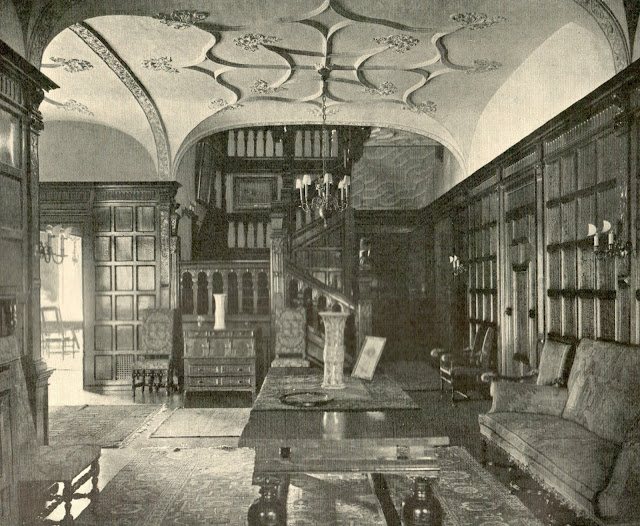
The oak in these rooms was cleaved — split along the grain with wedges, the way a shingle is split — and not cut with a blade. This was not a stylistic choice. In the age when the panelling was made, no machinery existed that could slice a board that large. A saw pit and two men could produce a plank; it could not produce these.
Riving oak means the wood decides where it separates. The split follows the natural fibre rather than crossing it, which is why riven panels stay flat for centuries while sawn boards of the same age cup and check. It also means every board is slightly different, because every tree is.
The “tiger’s eye”
Once the oak was split, the craftsmen hand-rubbed it smooth — and crucially, they rubbed perpendicular to the grain rather than along it. That cross-rubbing is what raises the luminous, shifting figure the old woodworkers called tiger’s eye: the surface appears to change depth as you move past it, catching light one moment and swallowing it the next.
Modern finishing does the opposite. Sand with the grain, seal, and the wood goes flat and even. Handsome, but inert. Stand in front of the panelling here at dusk and watch it move, and you will understand why Edwardian collectors paid what they paid.
Where it came from
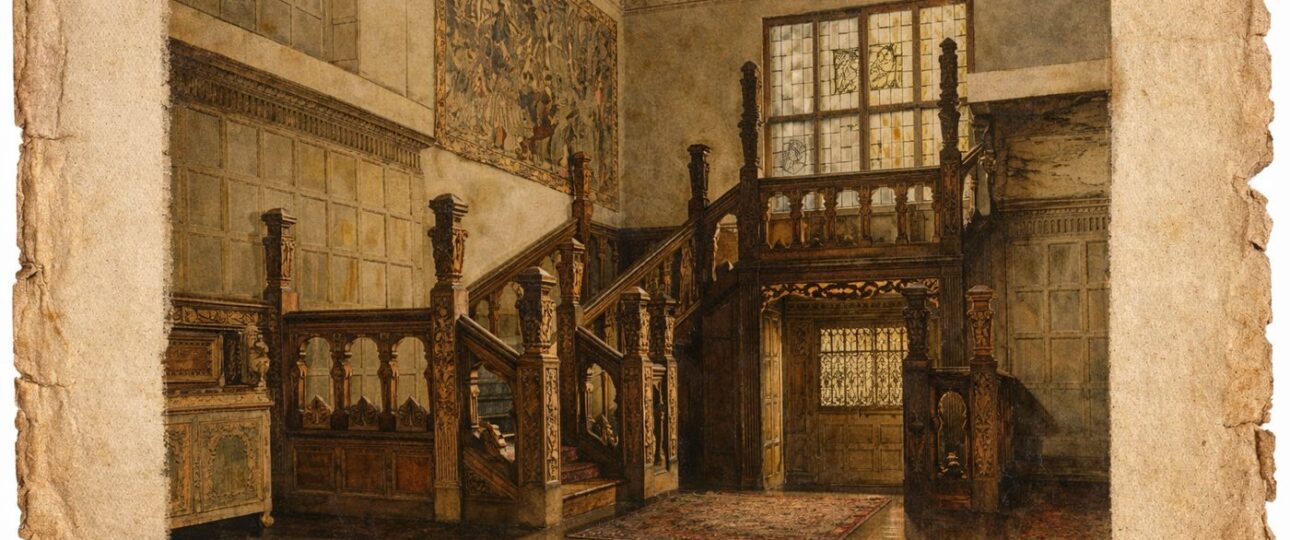
Most of this oak came out of Rotherwas Court in Herefordshire, held by the Bodenham family from before the Domesday survey of 1086 until 1912. When the estate was broken up, the dealer Charles Joel Duveen — “Charles of London” — stripped its richest rooms and shipped them to America, to the open dismay of the English press.
Look closely at the carving and you will find the family’s three chess rooks worked into it: a punning heraldic signature, hidden in plain sight for four hundred years and now doing the same thing in Minnesota.
Admitted to America as art
When the crates landed, U.S. Customs had to decide what they were looking at. Building material pays duty. Art does not. The oak was described as “not a piece of it less than 200 years of age” and classed as art — entering the country without a cent of import duty (Minneapolis Journal, August 1913). The Minnesota Historical Society’s digital newspaper collection is where those 1913 clippings live if you want to read the reporting yourself.
We have written elsewhere about the London syndicate years and about the steel frame that made rooms this big possible at all — modern bones under five-hundred-year-old skin.

The scars that travelled
One last detail, and it is our favourite. After a fire at Rotherwas, the Bodenhams abandoned the manor — and the newel posts of the staircase still carry the char. Duveen moved the carved hunting dogs from the upper landing down to the bottom posts when he rebuilt the stair here, and the scorch marks travelled with them. A fire in Herefordshire, still legible on a staircase in south Minneapolis.
Wood this old survives because of how it was made, and because people keep choosing to keep it. That is the whole argument of the preservation movement in one hallway — the case the National Trust for Historic Preservation and the National Register of Historic Places have been making for decades. The mansion joined the Register in 1974.
You can see all of it in person. Book a guided mansion tour and put your hand on the oak — you are permitted, and it is the only way to understand what riven wood actually feels like.
Keep reading: Can You Tour a Minneapolis Mansion at Christmas?
Keep reading: Which Pillsbury Daughters Survived the SS Mohawk Shipwreck of 1935?