
Why Did Governor John S. Pillsbury Pay for a $150,000 Hall of Science at the University of Minnesota?
Why Did Governor John S. Pillsbury Pay for a $150,000 Hall of Science at the University of Minnesota?
Cross the Mississippi to the University of Minnesota’s Minneapolis campus and you will find a building that carries the family name and looks like it was carved out of the earth. Pillsbury Hall, finished in 1889, is a Richardsonian Romanesque landmark paid for by Governor John S. Pillsbury, the uncle of flour miller Charles A. Pillsbury and the great-uncle of Charles S. Pillsbury, who built the mansion on East 22nd Street. It is a story about a gift made at a moment when the University itself was in danger.
Who was John S. Pillsbury at the University of Minnesota?
According to the College of Liberal Arts’ history of Pillsbury Hall, John S. Pillsbury was Minnesota’s governor from 1875 to 1881. His tie to the University began in 1863, when he became a regent, and lasted about fifty years. The University calls him the “Father of Our University.” As a businessman he became the institution’s financial guide, and at times he made personal loans so the University could acquire land.
The college’s account says his reorganization plan saved the University from a precarious financial situation that nearly caused its demise, and that friends estimated he devoted a quarter of his time to it. That is the man who stood up in front of the Legislature in 1889.
What did he promise the Legislature in 1889?
By 1889 the University was struggling to house a growing student body, and the state faced the prospect that land grants available under the Morrill Act for an agriculture and mechanic arts college might go elsewhere. Pillsbury’s answer, as the college recounts it, was an offer: he would erect and complete a hall of science at an expense of about $150,000 and give it to the state, if the state would keep those land grants intact and build one strong University. He wanted, in his own words, a “lasting monument” to the progress of the young state.
The hall of science was built and became Pillsbury Hall. The University stayed what he asked it to be: one undivided institution.
Who designed Pillsbury Hall?
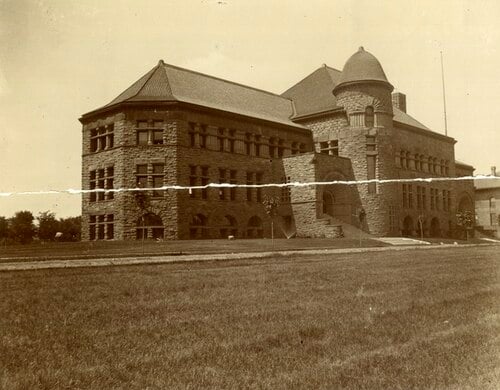
The architect was LeRoy S. Buffington, who worked in the Romanesque style of Henry Hobson Richardson. The college’s architecture and preservation page calls it his finest surviving work, and notes that Buffington also designed Eddy, Nicholson and Burton Halls on the campus. The same page says John S. Pillsbury also hired Buffington for the Pillsbury “A” Mill, the building we describe in our post on how big the A Mill was.
The page adds a wrinkle. Harvey Ellis, an associate in Buffington’s firm, is “believed” to have been the design architect for Pillsbury Hall, and many designs credited to Buffington may be Ellis’s work, because Ellis tended to remain anonymous. Ellis later became known for furniture designs produced by Gustav Stickley’s company. So when you look at the hall, you are looking at a Buffington building that may owe its look to Ellis; the sources do not settle it.
What does the building look like?
The walls are sandstone laid in a broken-range ashlar pattern. Each of the three stories has different windows: deep arches on the first level, then rectangular openings crossed by horizontal stone mullions above. A silo-like tower marks the interior stair, and the two matching entrances on Pillsbury Drive pair a shallow sweep of steps with a shadowy arch. We also touch on the hall in our guide to where else in Minneapolis you will find the Pillsbury name.
What has Pillsbury Hall been used for?
In the early days it housed animal biology, botany, geology, mineralogy and paleontology, with lecture rooms, laboratories and museum rooms. In the 1920s the entire basement served as the student health service, with room for 27 beds. Until 2017 it was home to the Department of Geology and Geophysics and the Limnological Research Center. The building reopened in fall 2021 as the home of the Department of English, its Creative Writing Program and the Liberal Arts Engagement Hub, so a hall built for rocks and specimens now holds writers.
For the family record, the Minnesota Legislative Reference Library’s member record for Charles A. Pillsbury lists John Sargent Pillsbury as his uncle, which is the relationship that ties this campus landmark to the mansion.
See the family’s other landmark for yourself
Pillsbury Hall belongs to the University, but the family’s grandest private house is the Charles S. Pillsbury Mansion at 100 East 22nd Street. You can read the full story on our history of the mansion page, then plan your visit to the Pillsbury Club or join a guided tour to see the carved English oak for yourself.
Keep reading: How does a BYOB holiday lights trolley work in Minneapolis?
Keep reading: What Is the History of the Tallow Chandlers’ Company? From Medieval London Candle-Makers to a Fireplace in Minneapolis